太阳系(综述)
贡献者: 待更新
本文根据 CC-BY-SA 协议转载翻译自维基百科相关文章。
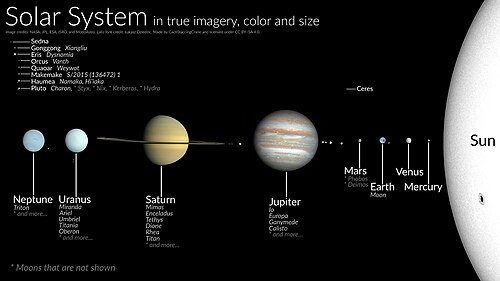
太阳系(The Solar System)由太阳及其所环绕的天体组成。该名称来源于 “Sōl”,即太阳的拉丁名称。大约在 46 亿年前,一个分子云中密度较高的区域发生坍缩,形成了太阳以及一个原行星盘(protoplanetary disc),环绕天体便由此汇聚而成。太阳核心内部的氢融合为氦,释放出能量,这些能量主要通过其外层光球(photosphere)向外辐射,从而在整个系统中形成一个由内而外逐渐降低的温度梯度。太阳系中超过 99.86% 的质量集中在太阳内部。
在绕太阳运行的天体中,质量最大的为八大行星。按与太阳距离递增的顺序,最靠近太阳的四颗类地行星(terrestrial planets)分别是—— 水星(Mercury)、金星(Venus)、地球(Earth)和火星(Mars)。它们构成了太阳系的内行星系统(inner Solar System)。其中,地球与火星是太阳系中仅有的两颗位于太阳宜居带(habitable zone)内的行星——在此范围内,行星表面可存在液态水。
在距离太阳约 5 个天文单位(AU)之外、越过 “霜线”(frost line)的位置,分布着四颗更为庞大的行星:两颗气态巨行星(gas giants)—— 木星(Jupiter)与土星(Saturn),以及两颗冰巨行星(ice giants)—— 天王星(Uranus)与 海王星(Neptune)。它们共同构成了太阳系的外行星系统(outer Solar System)。其中,木星与土星占据了太阳系除恒星外几乎 90% 的全部质量。
太阳系中还存在着数量庞大但质量较小的天体。天文学家普遍认为,太阳系至少拥有九颗矮行星(dwarf planets),分别是:谷神星(Ceres)、奥库斯(Orcus)、冥王星(Pluto)、哈梅亚(Haumea)、夸奥尔(Quaoar)、鸟神星(Makemake)、共工(Gonggong)、阋神星(Eris)与赛德娜(Sedna)。在这些天体中,有六颗行星、七颗矮行星及若干其他天体拥有自然卫星(natural satellites),即通常所称的 “月亮(moons)”。这些卫星的大小范围极广:从如地球之月那样接近矮行星尺度的巨型卫星,到仅有极小质量的 “月粒(moonlets)”。此外,太阳系中还存在大量小型天体(small Solar System bodies),包括小行星(asteroids)、彗星(comets)、半人马天体(centaurs)、流星体(meteoroids)以及星际尘埃云(interplanetary dust clouds)。其中一部分天体分布在小行星带(asteroid belt)(位于火星与木星轨道之间)以及柯伊伯带(Kuiper belt)(位于海王星轨道之外)。
在这些天体之间,存在着充满尘埃与粒子的行星际介质(interplanetary medium)。太阳不断释放的带电粒子形成太阳风(solar wind),它向外扩散,构成一个被称为日球层(heliosphere)的巨大空间。在距离太阳约 70–90 个天文单位(AU)处,太阳风受到星际介质(interstellar medium)的阻挡,形成边界——日球顶(heliopause)。这一区域标志着太阳系与星际空间的分界。更远处、约 2,000 个天文单位(AU)以外,是太阳系最外层的假想区域——奥尔特云(Oort cloud)。它被认为是长周期彗星(long-period comets)的来源,其范围可能延伸至太阳系的引力界限(Hill sphere)边缘,约 178,000–227,000 AU(2.81–3.59 光年),在此处太阳系的引力势与银河系的引力势达到平衡。目前,太阳系正穿越一个被称为本地星际云(Local Cloud)的星际介质区域。距离太阳系最近的恒星是比邻星(Proxima Centauri),距离约 269,000 AU(4.25 光年)。太阳系与比邻星都位于本地泡(Local Bubble)内,这是银河系中一个直径约 1,000 光年(ly)的相对稀薄的区域。
1. 定义
太阳系包括太阳以及所有受其引力约束并围绕其运行的天体。\(^\text{[15][16][17]}\)
国际天文学联合会(IAU)将太阳系描述为:由太阳引力所束缚的一切天体,包括太阳本身、八大行星,以及环绕太阳运行的其他天体。\(^\text{[11]}\) 美国国家航空航天局(NASA)则将太阳系定义为一个行星系统(planetary system),其中包括太阳及所有环绕它运行的天体。\(^\text{[12]}\)
当 “solar system” 一词不作为专有名词、且首字母不大写时,它可以指太阳系本身,也可泛指任何类似太阳系的行星系统。\(^\text{[15]}\)
2. 形成与演化
过去

太阳系形成于至少约 46.68 亿年前,源自一片巨大分子云中某个区域的引力坍缩。\(^\text{[b]}\) 这片最初的云可能横跨数光年,并极有可能同时孕育了多颗恒星。\(^\text{[19]}\) 如同其他分子云一样,它的主要成分是氢气,其次是氦气,并含有少量由前几代恒星通过核聚变产生的较重元素。\(^\text{[20]}\)
当原太阳星云 \(^\text{[20]}\) 开始坍缩时,角动量守恒使其旋转速度不断加快。中心区域由于聚集了大部分质量,变得比周围更炽热、更致密。\(^\text{[16]}\) 随着收缩的星云自转加速,它逐渐扁平化为一个直径约 200 天文单位(AU)的原行星盘 \(^\text{[19][21]}\),其中心形成了一个炽热而致密的原恒星。\(^\text{[22][23]}\) 行星由盘中的物质通过吸积(accretion)过程形成,\(^\text{[24]}\) 其中尘埃和气体相互引力吸引,逐渐聚合成更大的天体。在早期太阳系中,可能存在数百个原行星(protoplanets),但它们大多互相合并、被摧毁或被抛射出系统,最终仅留下行星、矮行星以及少量残余小天体。\(^\text{[25][26]}\)
在靠近太阳的内太阳系,即霜线(frost line)以内、甚至烟尘线(soot line)以内,\(^\text{[27]}\) 由于高温使除金属与硅酸盐外的物质难以以固体形式存在,因此这一带形成的行星主要由岩石构成,即:水星、金星、地球与火星。由于这些耐高温的物质仅占太阳星云极小的比例,类地行星因此无法增长得太大。\(^\text{[25]}\)
四颗巨行星——木星、土星、天王星与海王星——在霜线之外形成,该区域位于火星与木星轨道之间,温度足够低,使挥发性冰类化合物可以保持固态。这些冰的丰度远高于类地行星形成所用的金属与硅酸盐,这使得巨行星能长得足够大,从而捕获大量的氢与氦 —— 这两种元素是宇宙中最轻、最丰富的。\(^\text{[25]}\) 未能成为行星的残余碎片则聚集在小行星带、柯伊伯带与奥尔特云等区域。\(^\text{[25]}\)
约五千万年后,原恒星中心的氢气压与密度足够高,开始发生热核聚变反应。\(^\text{[28]}\) 随着核心中氦的积累,太阳逐渐变得更亮;\(^\text{[29]}\) 在主序星生命早期,其亮度仅为如今的约 70%。\(^\text{[30]}\) 温度、反应速率、压力与密度不断上升,直至达到静水平衡(hydrostatic equilibrium):即热压与引力达到平衡。此时,太阳成为一颗主序星。\(^\text{[31]}\) 太阳风从太阳表面喷射,形成了日球层(heliosphere),并将原行星盘中剩余的气体与尘埃吹散至星际空间。\(^\text{[29]}\)
在原行星盘消散后,尼斯模型(Nice model)提出:气体巨行星与微行星之间的引力相互作用导致行星迁移至不同轨道。这引发了整个系统的动力学不稳定,使微行星被散射,最终将气体巨行星带入如今的位置。在这一时期,大调车假说(Grand Tack Hypothesis)认为:木星的一次最终向内迁移扰乱了小行星带的大部分物质,从而引发了晚期重轰炸(Late Heavy Bombardment)。\(^\text{[32][33]}\)
现在与未来
太阳系目前处于一个相对稳定、缓慢演化的状态,所有天体都沿着受引力束缚的轨道绕太阳运行。\(^\text{[34]}\) 尽管太阳系在数十亿年来一直较为稳定,但从技术角度上看,它是一个混沌系统,未来可能受到扰动。在未来数十亿年内,存在极小概率会有其他恒星穿越太阳系。这可能导致系统的轻微失稳,在数百万年后造成行星被逐出、相互碰撞或坠入太阳,但最有可能的结果仍是:太阳系将大体保持如今的样貌。\(^\text{[35]}\)
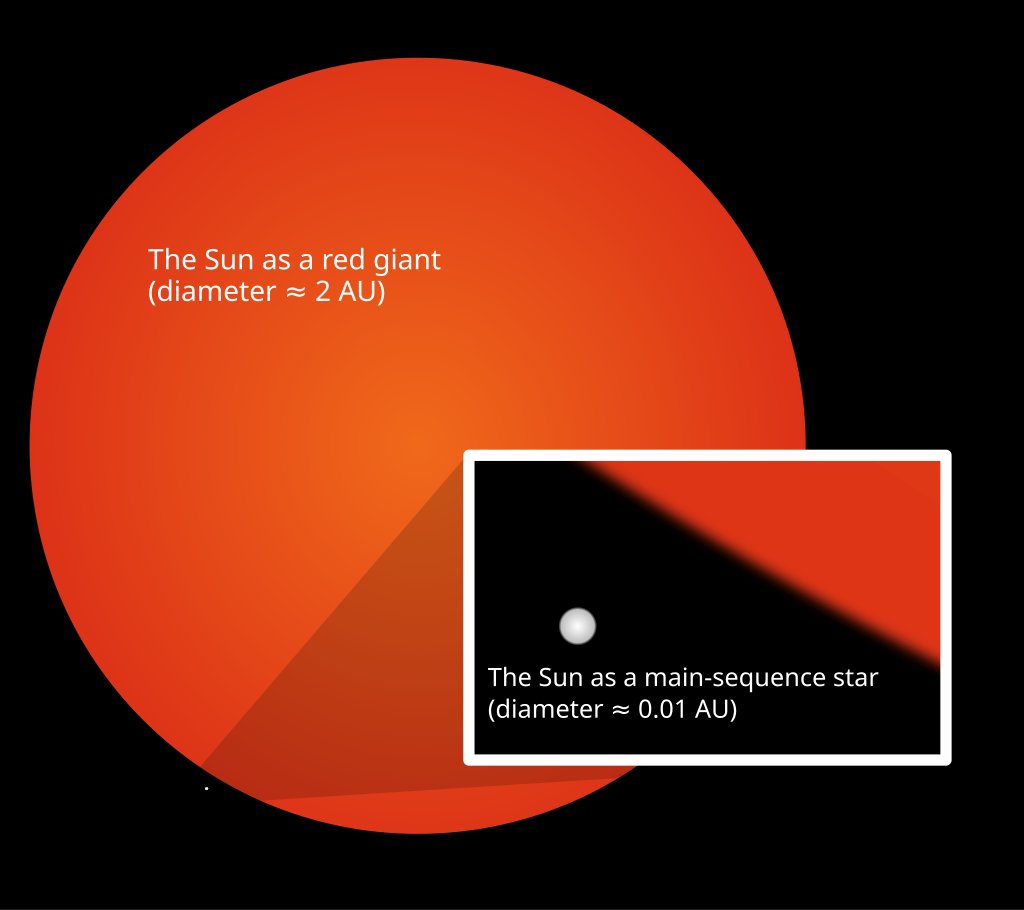
太阳的主序阶段(main-sequence phase)——从开始到结束——将持续约 100 亿年,而此后所有阶段(从主序末期到白矮星前的各阶段)加起来的寿命仅约 20 亿年。\(^\text{[36]}\) 太阳系将在此期间大体保持如今的状态,直到太阳核心中的氢完全转化为氦为止—— 这将发生在大约 50 亿年后。届时,太阳的主序生命将走到尽头。
那时,太阳的核心将因引力进一步收缩,氢聚变将仅在包围惰性氦核的壳层(shell)中进行,其总能量输出将超过当前水平。太阳的外层将剧烈膨胀,直径将达到目前的约 260 倍,并演化为一颗红巨星(Red Giant)。由于表面积大幅增加,其表面温度将下降,在最冷时约为 2,600 K(4,220 °F),远低于主序阶段的温度。\(^\text{[36]}\)
膨胀后的太阳预计将汽化水星与金星,并使地球与火星变得不可居住(甚至可能完全摧毁地球)。\(^\text{[37][38]}\) 最终,太阳核心温度将升高到足以点燃氦聚变反应;太阳将在核心燃烧氦,但这一阶段仅持续其氢燃烧阶段的极小一部分时间。由于太阳的质量不足以启动更重元素的聚变,核心中的核反应将逐渐衰竭并停止。太阳的外层将在这一过程中被抛射到太空中,留下一个致密的白矮星(White Dwarf)—— 其质量约为太阳原始质量的一半,但体积仅有地球大小。\(^\text{[36]}\) 被抛射的外层气体可能形成一个行星状星云(Planetary Nebula),将太阳形成时的部分物质—— 此时已被碳等重元素所 “富集”—— 重新送回星际介质(Interstellar Medium)。\(^\text{[39][40]}\)
3. 一般特征
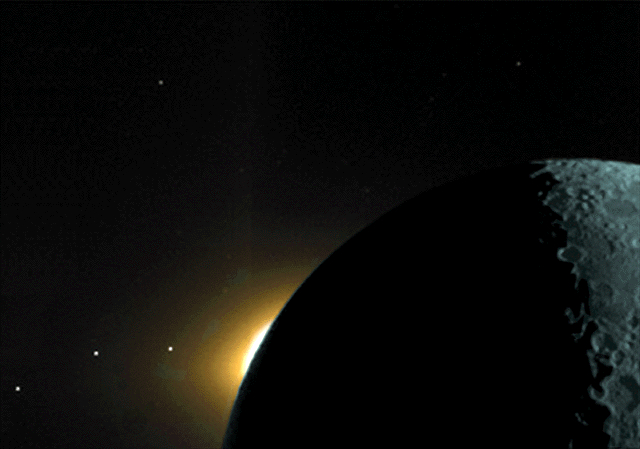
天文学家有时会将太阳系的结构划分为若干独立的区域。内太阳系(Inner Solar System)包括水星、金星、地球、火星以及位于小行星带中的天体;外太阳系(Outer Solar System)包括木星、土星、天王星、海王星以及位于柯伊伯带中的天体。\(^\text{[41]}\) 自从发现柯伊伯带以来,太阳系的最外层部分被视为一个独立的区域,由位于海王星之外的天体组成。\(^\text{[42]}\)
组成
太阳系的主要成分是太阳,一颗 G 型主序星(G-type main-sequence star),其质量占整个系统已知总质量的 99.86%,在引力上完全主导着整个系统。\(^\text{[43]}\) 围绕太阳运行的四个最大天体——四大行星——占据剩余质量的 99%,其中仅木星和土星就合计超过 90%。太阳系的其他所有天体(包括四颗类地行星、矮行星、卫星、小行星与彗星等)总共的质量还不到太阳系总质量的 0.002%。\(^\text{[h]}\)
太阳的成分大约由 98%的氢与氦组成,\(^\text{[47]}\) 木星与土星的成分也大体相同。\(^\text{[48][49]}\) 太阳系中存在一个由早期太阳的热量与光压形成的成分梯度:距离太阳较近、受热与光压影响更强的天体,主要由熔点较高的元素构成;而距离太阳较远的天体,则主要由熔点较低的物质组成。\(^\text{[50]}\) 在太阳系中,那条易挥发物质能够凝聚的界限称为霜线(frost line),其位置大约在距离太阳约地球距离的五倍处。\(^\text{[5]}\)
轨道
行星与其他围绕太阳运行的大型天体的轨道大多位于太阳系的不变平面(invariable plane)附近,地球的轨道(称为黄道面,ecliptic)也接近这一平面;其中木星的轨道与该平面的夹角最小,仅为 0.3219°。\(^\text{[51]}\) 而较小的冰质天体(例如彗星)则常以更大的倾角绕此平面运行。\(^\text{[52][53]}\) 太阳系中的大多数行星都拥有自己的 “次级系统”,即被称为卫星(moons)的天然卫星所环绕。所有最大型的天然卫星都呈同步自转(synchronous rotation),始终以一面对着其母行星。四大行星(木星、土星、天王星、海王星)皆拥有行星环(planetary rings)—— 由无数微小颗粒组成的薄环盘,这些颗粒共同绕行行星。\(^\text{[54]}\)
由于太阳系形成的原因,行星与绝大多数其他天体的公转方向与太阳自转方向一致,即从地球北极上方观察为逆时针方向(counter-clockwise)。\(^\text{[55]}\) 不过也有例外,例如哈雷彗星(Halley’s Comet)。\(^\text{[56]}\) 多数较大的卫星以顺行方向(prograde direction)绕行行星,即与母行星的自转方向一致;而海王星的卫星海卫一(Triton)是已知最大的一颗逆行(retrograde)运行的卫星。\(^\text{[57]}\) 大多数大型天体的自转方向相对于其公转方向也是顺行的,但金星(Venus)的自转方向为逆行。\(^\text{[58]}\)
在良好的近似下,开普勒行星运动定律(Kepler’s laws of planetary motion)可以描述天体绕太阳的轨道运动。\(^\text{[59]: 433–437}\) 这些定律指出:每个天体沿着一个椭圆轨道运行,而太阳位于该椭圆的一个焦点上,这导致天体在公转过程中与太阳的距离不断变化。天体距太阳最近的位置称为近日点(perihelion),最远的位置称为远日点(aphelion)。\(^\text{[60]: 9–6 }\) 除水星外,行星的轨道几乎为圆形,而许多彗星、小行星和柯伊伯带天体则具有高度椭圆的轨道。开普勒定律只考虑太阳对轨道天体的引力作用,未考虑天体之间的相互引力。在人类的时间尺度上,这些扰动可通过数值模型加以修正,\(^\text{[60]: 9–6}\) 但在数十亿年的时间尺度上,整个行星系统可能会发生混沌变化。\(^\text{[61]}\)
太阳系的角动量(angular momentum)衡量了系统内所有运动成分的总轨道与自转动量。\(^\text{[62]}\) 虽然太阳的质量占据绝对主导,但其仅贡献了大约 2% 的角动量。\(^\text{[63][64]}\) 行星——主要是木星——由于其质量、轨道与距离太阳的组合,占据了系统绝大部分的角动量,而彗星可能也提供了显著的次要贡献。\(^\text{[63]}\)
距离与尺度
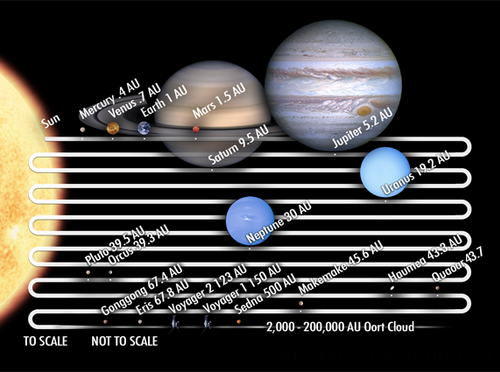
太阳的半径为 0.0047 AU(70 万千米;40 万英里)。\(^\text{[65]}\) 因此,太阳的体积仅占一个半径等于地球轨道半径的球体体积的 0.00001%(即 1/10^7),而地球的体积大约仅为太阳的百万分之一(10^{-6})。最大行星木星距离太阳 5.2 AU,半径为 71,000 千米(0.00047 AU;44,000 英里);最远的行星海王星则距离太阳 30 AU。\(^\text{[49][66]}\)
除少数例外外,行星或行星带距离太阳越远,其轨道间距也越大。例如:金星比水星远约 0.33 AU;而土星比木星远 4.3 AU;海王星则比天王星远 10.5 AU。天文学家曾尝试寻找这些轨道间距的规律,如提丢斯–波得定律(Titius–Bode law)\(^\text{[67]}\) 以及开普勒(Johannes Kepler)基于柏拉图立体(Platonic solids)的模型 \(^\text{[68]}\),但随着新的天体被发现,这些假说已被证伪。\(^\text{[69]}\)
太阳系比例模型(Solar System Scale Models)一些太阳系模型尝试以人类直观方式表现其中的相对尺度。有的模型较小(甚至可为机械式,称为行星仪 orrery),也有的规模宏大,跨越整个城市或地区。\(^\text{[70]}\) 目前已知最大的比例模型是瑞典的 “瑞典太阳系模型(Sweden Solar System)”,它以斯德哥尔摩的阿维奇竞技场(Avicii Arena)—— 一座直径 110 米(361 英尺)的穹顶建筑——代表太阳。按照比例:木星是一颗直径 7.5 米(25 英尺)的球体,位于斯德哥尔摩阿兰达机场(40 千米 / 25 英里 之外);而最远的天体 —— 赛德娜(Sedna)—— 则是一颗直径仅 10 厘米(4 英寸)的球体,位于吕勒奥(Luleå),距 “太阳” 912 千米(567 英里)。\(^\text{[71][72]}\) 在这一比例下,最近恒星比邻星(Proxima Centauri)的距离大约是地月距离的八倍。
若将太阳至海王星的距离缩放为 100 米(330 英尺),则太阳的直径约为 3 厘米(1.2 英寸)—— 约为高尔夫球直径的三分之二;四大行星的直径均不超过 3 毫米(0.12 英寸);而地球及其他类地行星的直径在该比例下将小于跳蚤(约 0.3 毫米 / 0.012 英寸)。\(^\text{[73]}\)

宜居性
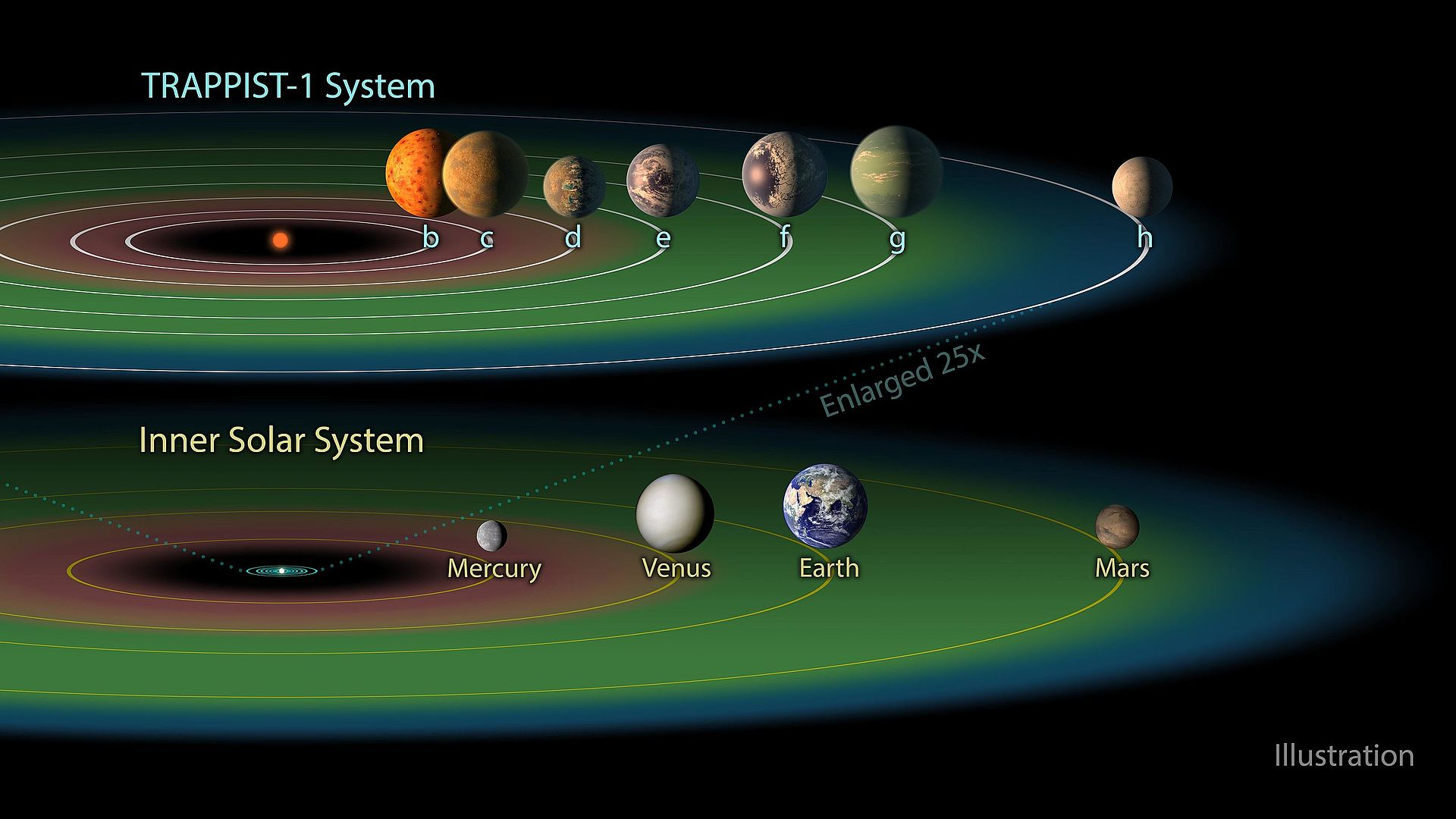

太阳系的宜居带(habitability zone)通常被认为位于内太阳系靠近地球的区域,在那里由于太阳辐射的作用,大气层中的液态水可以稳定存在。\(^\text{[74]}\)
除了太阳能外,太阳系中能够支持生命存在的主要特征是日球层(heliosphere)以及各行星自身的磁场(对于那些拥有磁场的行星而言)。这些磁场在一定程度上屏蔽了来自星际空间的高能粒子——宇宙射线。星际介质中宇宙射线的密度以及太阳磁场的强度会在极长的时间尺度上变化,因此太阳系中宇宙射线的渗透水平也随之变化,但其变化幅度目前仍未知。\(^\text{[75]}\)
太阳系中的宜居性不仅仅取决于表面条件或太阳辐射环境,因为在若干太阳系天体中可能存在的地下海洋中也可能具备生命存在的潜力,\(^\text{[76]}\) 甚至在某些行星(尤其是金星)的云层中,也可能存在可居住层。\(^\text{[77]}\)
与太阳系外行星系统的比较
对开普勒(Kepler)望远镜观测数据的分析表明,银河系中被观测到的行星系统大致可分为三类:“相似型(similar)” 系统——行星大小相近、间距相似且轨道高度圆形;“有序型(ordered)” 系统——行星的质量随着与恒星距离的增加而增大;“混合型(mixed)” 系统——行星质量分布无明显规律。太阳系属于 “有序型” 系统,占已观测系统的约 37%。然而,“相似型” 系统为多数,占 59%,而 “混合型” 系统仅占 4%。\(^\text{[78]}\)
与许多太阳系外行星系统相比,太阳系的一个显著特征是 —— 缺乏位于水星轨道以内的行星。\(^\text{[79][80]}\) 太阳系中也没有 “超级地球”(质量为地球的 1 至 10 倍的行星),\(^\text{[79]}\) 尽管假设中的 “第九行星”(Planet Nine)若存在,可能是一颗位于太阳系边缘的超级地球。\(^\text{[81]}\)
另一个不寻常之处在于太阳系仅包含较小的类地行星和巨大的气体行星,而在其他行星系统中,中等大小的行星更为常见——包括岩质型与气态型——因此在地球与海王星(半径约为地球的 3.8 倍)之间的 “尺寸空档” 在太阳系中非常明显。由于许多超级地球的轨道都比水星更靠近其母星,有一种假说认为所有行星系统最初都有许多靠近恒星的行星,而随后它们通过一系列碰撞事件合并成更少但更大的行星。然而在太阳系中,这些碰撞反而导致行星的破坏与被抛出系统。\(^\text{[79][82]}\)
太阳系行星的轨道几乎为圆形。与许多其他系统相比,它们的轨道偏心率要小得多。\(^\text{[79]}\) 尽管有尝试将这种现象部分归因于径向速度法的观测偏差,以及长期多行星相互作用的动力学效应,但其确切原因仍未确定。\(^\text{[79][83]}\)
太阳
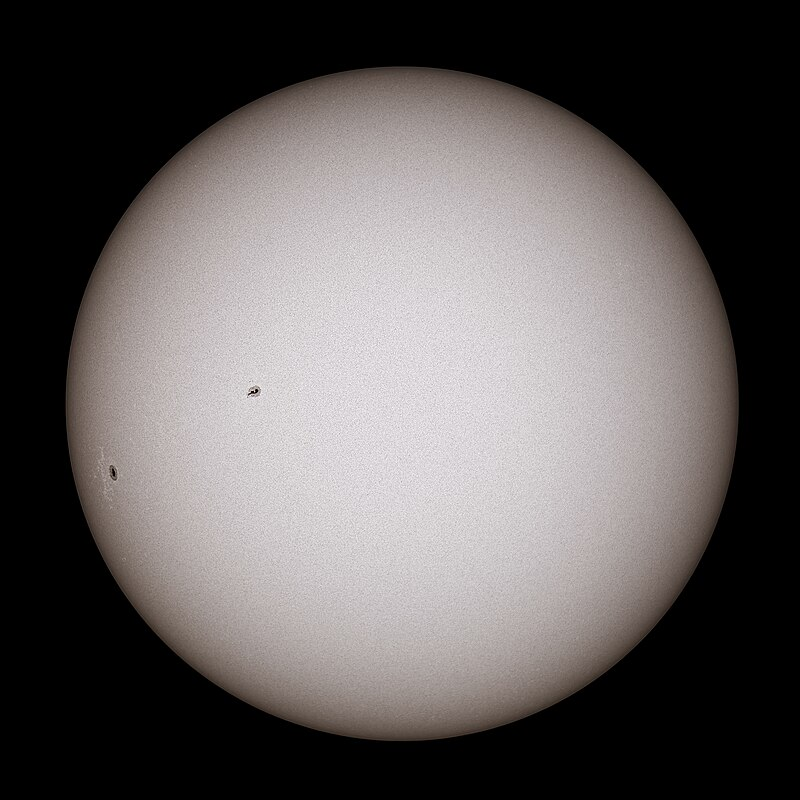
太阳(The Sun)是太阳系的中心恒星,也是其最为巨大的组成部分。它拥有巨大的质量(约为地球质量的 332,900 倍),\(^\text{[84]}\) 占太阳系总质量的 99.86%,\(^\text{[85]}\) 这一庞大的引力使其核心达到足以维持氢聚变为氦的高温高压。\(^\text{[86]}\) 这一聚变过程释放出极其巨大的能量,主要以电磁辐射的形式向外辐射,其辐射峰值位于可见光波段。\(^\text{[87][88]}\)
由于太阳在核心中进行氢聚变,因此它是一颗主序星。更具体地说,它属于 G2 型主序星(G2V star),其中类型编号指其有效温度。主序星温度越高,其光度越强,但寿命越短。太阳的温度介于最热恒星与最冷恒星之间。比太阳更明亮、更炽热的恒星相对罕见;而显著更暗、更冷的恒星——即所谓的红矮星——约占银河系中所有核聚变恒星的 75%。\(^\text{[89]}\)
太阳属于第一族恒星(Population I star),形成于银河系的旋臂中。与银河系核球与晕中的老年第二族恒星相比,它含有更多比氢与氦更重的元素(在天文学中称为 “金属”)。\(^\text{[90]}\) 这些较重元素是在更早一代恒星的核心与爆炸中形成的,因此宇宙必须先经历第一代恒星的死亡,才能被这些重元素所富集。最古老的恒星几乎不含金属,而后期形成的恒星则金属丰度更高。人们认为这种较高的金属丰度对太阳形成行星系统至关重要,因为行星正是由这些 “金属” 物质的吸积所形成的。\(^\text{[91]}\)
由太阳磁层主导的空间区域称为日球层(heliosphere),它覆盖了太阳系的大部分区域。除了光之外,太阳还不断释放带电粒子流(等离子体),称为太阳风(solar wind)。太阳风以每小时 90 万公里(56 万英里)至 288 万公里(179 万英里)的速度向外扩散,\(^\text{[92]}\) 充满了太阳系天体之间的真空空间,形成了一种稀薄、含尘的介质,称为行星际介质(interplanetary medium),其范围至少延伸至 100 天文单位。\(^\text{[93]}\)
太阳表面的活动,如太阳耀斑(solar flares)与日冕物质抛射(coronal mass ejections, CME),会扰动整个日球层,产生 空间天气(space weather)并引发 地磁风暴(geomagnetic storms)。\(^\text{[94]}\) 日冕物质抛射及类似事件会将磁场与大量物质从太阳表面喷射出来。这些磁场与物质与地球磁场相互作用,将带电粒子引导至地球高层大气,其相互作用形成极光(aurora),可在地磁极附近观测到。\(^\text{[95]}\) 日球层中最大的稳定结构是 日球电流片(heliospheric current sheet),它是由太阳自转磁场作用于行星际介质形成的螺旋形结构。\(^\text{[96][97]}\)
4. 内太阳系
内太阳系是指包含类地行星与小行星的区域。\(^\text{[98]}\) 该区域内的天体主要由硅酸盐和金属组成,\(^\text{[99]}\) 并且它们距离太阳相对较近;整个区域的半径小于木星与土星轨道之间的距离。此区域位于冰霜线(frost line)之内,该冰霜线距离太阳略小于 5 个天文单位(AU)。\(^\text{[52]}\)
类地行星
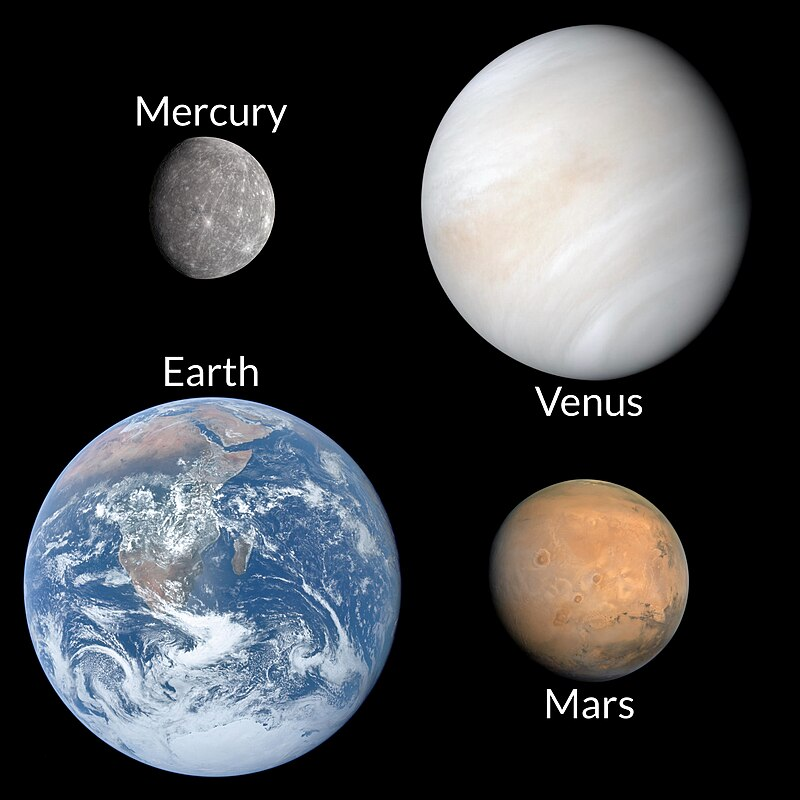
四颗类地行星(或称内行星)具有致密的岩质组成,卫星稀少或完全没有,也不存在行星环系统。它们主要由耐高温的矿物(如硅酸盐)组成,这些矿物形成了行星的地壳与地幔;而其核心则主要由铁与镍等金属构成。四颗行星中的三颗——金星、地球和火星——拥有足够厚的气体包层,能够形成天气系统;所有类地行星都具有陨石坑和构造地貌,如裂谷与火山。\(^\text{[100]}\)
- 水星(距离太阳 0.31–0.59 AU)\(^\text{[D 6]}\) 是太阳系中最小的行星。其表面呈灰色,拥有由逆冲断层形成的广阔断崖(rupes)系统,以及由撞击事件残迹形成的明亮射纹系统。\(^\text{[101]}\) 表面温度变化剧烈——赤道区域夜间温度可达 −170 °C(−270 °F),而白天则高达 420 °C(790 °F)。在过去,水星曾有火山活动,形成了类似月球的光滑玄武质平原。\(^\text{[102]}\) 水星可能拥有硅酸盐地壳与巨大的铁核。\(^\text{[103][104]}\) 它的大气极其稀薄,仅由太阳风粒子与喷射出的原子组成。\(^\text{[105]}\) 水星没有天然卫星。\(^\text{[106]}\)
- 金星(距离太阳 0.72–0.73 AU)\(^\text{[D 6]}\) 拥有高度反射的白色大气,主要由二氧化碳组成。其表面气压约为地球海平面气压的 90 倍。\(^\text{[107]}\) 金星表面温度超过 400 °C(752 °F),主要原因是其大气中温室气体含量极高。\(^\text{[108]}\) 该行星缺乏可抵御太阳风剥蚀的磁场,这表明其大气可能由火山活动持续补充。\(^\text{[109]}\) 其表面显示出广泛的火山活动证据,属于 “停滞盖板构造”(stagnant-lid tectonics)。\(^\text{[110]}\) 金星没有天然卫星。\(^\text{[106]}\)
- 地球(距离太阳 0.98–1.02 AU)[D 6]是宇宙中目前已知唯一存在生命与地表液态水的天体。\(^\text{[111]}\) 地球大气中含有 78% 的氮气与 21% 的氧气,这正是生命活动的结果。\(^\text{[112][113]}\) 地球拥有复杂的气候与天气系统,不同气候带之间差异显著。\(^\text{[114]}\) 地表主要由绿色植被、荒漠与白色冰盖组成。\(^\text{[115][116][117]}\) 地球的板块构造塑造了大陆形态。\(^\text{[102]}\) 其行星磁层(magnetosphere)能屏蔽辐射,减少大气流失,从而维持生命宜居性。\(^\text{[118]}\)
- 月球是地球唯一的天然卫星。\(^\text{[119]}\) 其直径约为地球的四分之一。\(^\text{[120]}\) 表面覆盖着极细的风化层(regolith),并布满撞击坑。\(^\text{[121][122]}\) 月球上的大暗斑——“月海”(maria)——由古代火山活动形成。\(^\text{[123]}\) 其大气极其稀薄,仅为部分真空,粒子密度低于每立方厘米 10^7。\(^\text{[124]}\)
- 火星(距离太阳 1.38–1.67 AU)[D 6]其半径约为地球的一半。\(^\text{[125]}\) 由于火星土壤中的氧化铁,其表面呈红色。\(^\text{[126]}\) 极地地区覆盖着由水和二氧化碳组成的白色冰盖。\(^\text{[127]}\) 火星大气主要由二氧化碳组成,表面气压仅为地球的 0.6%,但仍足以产生一些天气现象。\(^\text{[128]}\) 火星年为 687 个地球日,其表面温度变化剧烈,范围从 −78.5 °C(−109.3 °F)至 5.7 °C(42.3 °F)。表面布满火山与裂谷,并富含多种矿物。\(^\text{[129][130]}\) 火星内部结构高度分化,并在约 40 亿年前失去了磁层。\(^\text{[131][132]}\) 火星拥有两颗微小卫星:\(^\text{[133]}\)
- 火卫一(Phobos)是火星的内卫星。其形状不规则,平均半径为 11 km(7 mi)。表面反射率极低,布满撞击坑。\(^\text{[D 7][134]}\) 其中最大的撞击坑为 Stickney,半径约 4.5 km(2.8 mi)。\(^\text{[135]}\)
- 火卫二(Deimos)是火星的外卫星。与火卫一相似,形状不规则,平均半径 6 km(4 mi),表面反光度同样极低。[D 8][D 9]然而,火卫二的表面比火卫一更为光滑,因为风化层部分覆盖了撞击坑。\(^\text{[136]}\)
小行星

除最大的小行星谷神星(Ceres)外,其他小行星均被归类为 “太阳系小天体”(small Solar System bodies)。它们主要由碳质物质、耐高温的岩石与金属矿物组成,部分含有冰。\(^\text{[137][138]}\) 其尺寸范围从数米至数百公里不等。许多小行星依据其轨道特征被划分为不同的小行星族群(groups)与家族(families)。部分小行星拥有绕其运行的天然卫星,即所谓 “次级小行星”——绕更大行星体运行的小行星。\(^\text{[139]}\)
- 穿越水星轨道的小行星(Mercury-crossing asteroids)指近日点轨道位于水星轨道以内的小行星。截至目前已知至少有 362 颗,它们包括太阳系中距离太阳最近的天体。\(^\text{[140]}\) 目前尚未发现任何位于水星轨道与太阳之间的 “火神星族”(vulcanoids)。\(^\text{[141][142]}\) 截至 2024 年,仅发现一颗完全在金星轨道以内运行的小行星——594913ꞌAylóꞌchaxnim。\(^\text{[143]}\)
- 穿越金星轨道的小行星(Venus-crossing asteroids)指轨道与金星轨道相交的小行星。截至 2015 年,共记录 2,809 颗。\(^\text{[144]}\)
- 近地小行星(Near-Earth asteroids)其轨道相对接近地球轨道。\(^\text{[145]}\) 部分被列为潜在危险天体(potentially hazardous objects),因为它们未来有可能与地球发生碰撞。\(^\text{[146][147]}\) 截至 2024 年,已知的近地小行星数量超过 37,000 颗。\(^\text{[148]}\) 一些绕太阳运行的流星体(meteoroids)在撞击地球前足够大,能够被直接观测与追踪。如今普遍认为,过去的撞击事件在塑造地球的地质与生物演化历史中起到了重要作用。\(^\text{[149]}\)
- 穿越火星轨道的小行星(Mars-crossing asteroids)指近日点大于 1.3 AU、轨道穿越火星轨道的小行星。\(^\text{[150]}\) 截至 2024 年,美国 NASA 已确认 26,182 颗火星交叉小行星。\(^\text{[144]}\)
小行星带
小行星带位于距离太阳约 2.3 至 3.3 个天文单位(AU)的环状区域,其位置介于火星与木星轨道之间。一般认为,它由太阳系形成时期未能聚合成行星的残余物质组成,这种失败主要是由于木星强大的引力扰动所致。\(^\text{[151]}\) 小行星带中含有数以万计、甚至可能数百万计直径超过一公里的天体。\(^\text{[152]}\) 尽管数量庞大,但其总体质量不太可能超过地球质量的千分之一。\(^\text{[46]}\) 小行星带的物质分布极为稀疏,探测器在穿越该区域时通常不会遭遇任何碰撞或损伤。\(^\text{[153]}\)
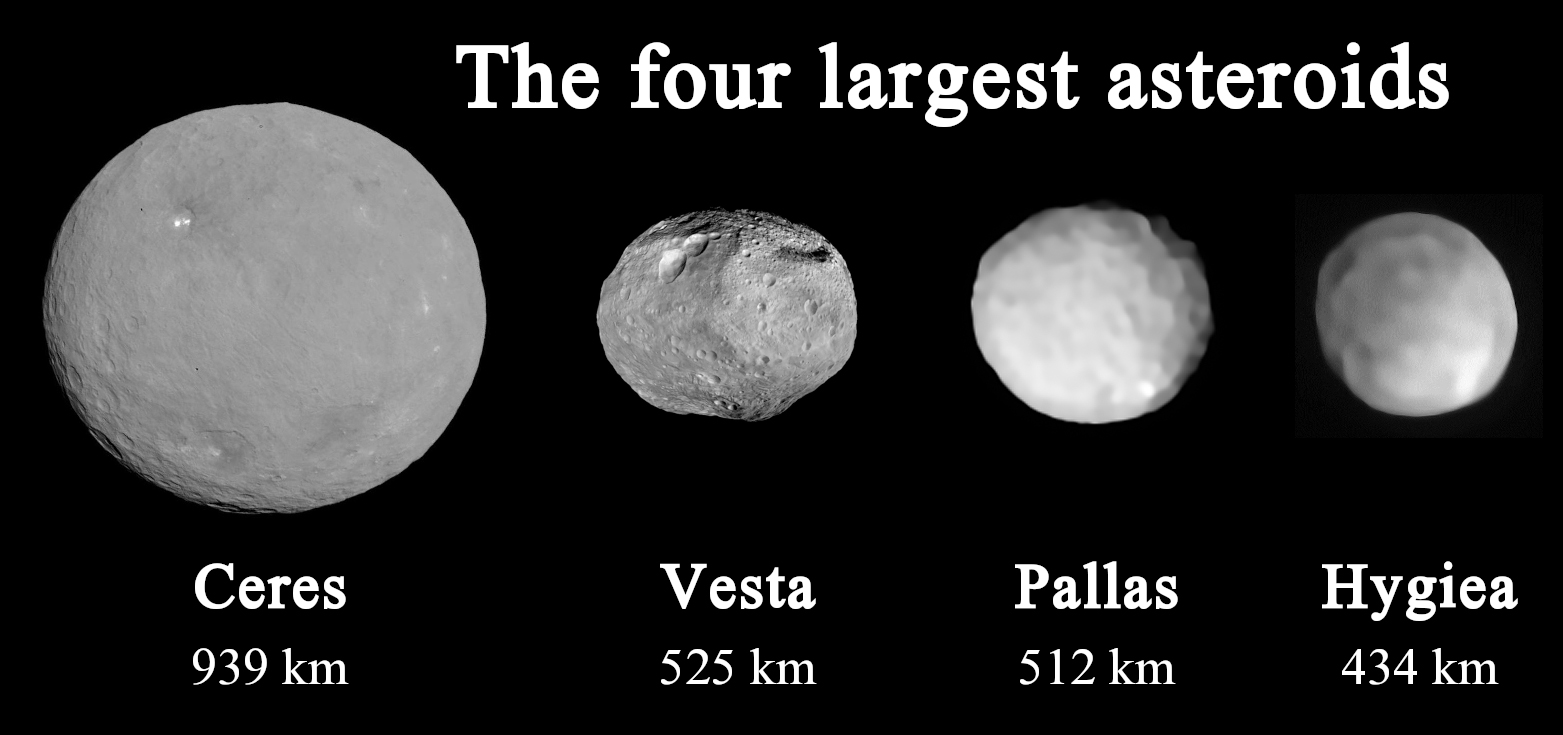
以下是小行星带中三大天体的简介。它们都被认为是相对完整的原行星(protoplanets),即行星在完全形成前的早期阶段(参见 特殊小行星列表):\(^\text{[154][155][156]}\)
- 谷神星(Ceres,2.55–2.98 AU)谷神星是小行星带中唯一的矮行星。\(^\text{[157]}\) 它是该区域中最大的天体,直径约为 940 公里(580 英里)。\(^\text{[158]}\) 其表面由碳质物质、冻结水与含水矿物的混合物组成。\(^\text{[159][160]}\) 表面存在过去低温火山活动(cryovolcanism)的迹象,这类活动会喷发出水等挥发性物质,在表面形成亮斑区域。\(^\text{[161]}\) 谷神星拥有极其稀薄的水汽大气层,但实际上几乎与真空无异。\(^\text{[162]}\)
- 灶神星(Vesta,2.13–3.41 AU)灶神星是小行星带中第二大天体。\(^\text{[163]}\) 其碎片仍以 “灶神星族”(Vesta family)的形式存在,\(^\text{[164]}\) 并且在地球上发现了大量来源于它的 HED 陨石。\(^\text{[165]}\) 灶神星表面以玄武质与变质物质为主,其密度高于谷神星。\(^\text{[166]}\) 表面具有两个巨大的撞击坑:Rheasilvia 与 Veneneia。\(^\text{[167]}\)
- 智神星(Pallas,2.15–2.57 AU)智神星是小行星带中第三大天体。\(^\text{[163]}\) 它拥有自己的 “智神星族”。\(^\text{[164]}\) 由于尚未有航天器造访智神星,人们对其了解有限,\(^\text{[168]}\) 但推测其表面主要由硅酸盐物质构成。\(^\text{[169]}\)
希尔达族小行星(Hilda asteroids)这类小行星与木星呈 3:2 共振关系,即它们每绕太阳三周,木星绕行两周。\(^\text{[170]}\) 它们分布在木星轨道与主小行星带之间的三个互相关联的聚集区中。
特洛伊小行星(Trojans)这类天体位于其他行星的引力稳定拉格朗日点处:\(L_4\) 点位于行星轨道前方 60°,\(L_5\) 点位于其轨道后方 60°。\(^\text{[171]}\) 除水星外,所有行星都已知至少拥有一个特洛伊小行星。\(^\text{[172][173][174]}\) 木星的特洛伊小行星数量大约与整个小行星带相当。\(^\text{[175]}\) 在木星之后,海王星拥有第二多的特洛伊天体,目前确认的数量为 28 个。\(^\text{[176]}\)
5. 外行星
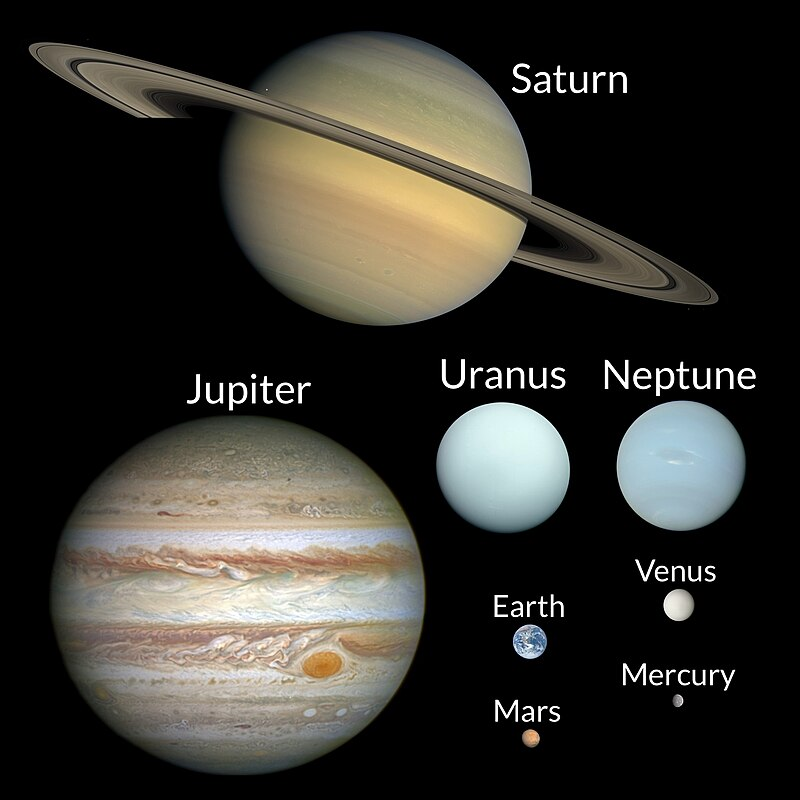
四颗外行星,又称巨行星(giant planets)或类木行星(Jovian planets),共同构成了围绕太阳运行天体质量的 99%。\(^\text{[h]}\) 所有四颗巨行星都有多颗卫星与行星环系统,但从地球上肉眼仅能轻易观测到土星的环。\(^\text{[100]}\) 木星与土星主要由熔点极低的气体(如氢、氦与氖)组成,\(^\text{[177]}\) 因此被称为气体巨行星(gas giants)。\(^\text{[178]}\) 天王星与海王星则为冰巨行星(ice giants),\(^\text{[179]}\) 即在天文学意义上主要由 “冰” 组成 —— 包括熔点在数百开尔文以内的化合物(如水、甲烷、氨、硫化氢与二氧化碳)。\(^\text{[177][180]}\) 冰质物质也是巨行星卫星与海王星轨道以外小天体的主要成分。\(^\text{[180][181]}\)
- 木星(Jupiter, 4.95–5.46 AU)\(^\text{[D 6]}\) 木星是太阳系中体积最大、质量最高的行星。其表面可见橙褐与白色云带,按照大气环流原理高速运动,并伴有如 “大红斑(Great Red Spot)” 及白色 “卵形风暴” 等巨大气旋。木星的磁层极为强大,足以偏转电离辐射并在两极产生极光。\(^\text{[182]}\) 截至 2025 年,木星已确认有 97 颗卫星,大致可分为三类:
- 阿玛尔忒亚群(Amalthea group):包含 Metis、Adrastea、Amalthea 与 Thebe,它们的轨道显著近于木星,且其物质构成了木星微弱的行星环。\(^\text{[183][184]}\)
- 伽利略卫星(Galilean moons):包含 Ganymede(盖尼米得)、Callisto(卡利斯托)、Io(木卫一)与 Europa(欧罗巴),它们是木星最大、最具行星特征的卫星。\(^\text{[185]}\)
- 不规则卫星(Irregular satellites):体积较小,轨道更远且偏心率更高。\(^\text{[186]}\)
- 土星(Saturn, 9.08–10.12 AU)\(^\text{[D 6]}\) 土星最显著的特征是其围绕赤道的壮丽环系统,由冰与岩石微粒组成。与木星类似,它主要由氢与氦构成。\(^\text{[187]}\) 土星南北两极存在巨大的六边形风暴,其直径超过地球。土星的磁层能产生微弱极光。截至 2025 年,土星已确认有 274 颗卫星,主要分为:
- 环内小卫星与牧羊卫星(Ring moonlets & shepherds):它们分布在环内或其附近。小卫星仅能部分清理轨道尘埃,\(^\text{[188]}\) 而牧羊卫星能完全清空轨道物质,形成可见间隙。\(^\text{[189]}\)
- 内层大卫星:包括 Mimas、Enceladus、Tethys 与 Dione。它们位于 E 环内,由水冰为主组成,内部结构已分化。\(^\text{[190]}\)
- 特洛伊卫星(Trojan moons):Calypso 与 Telesto(Tethys 的特洛伊卫星),Helene 与 Polydeuces(Dione 的特洛伊卫星),这些小卫星与各自母卫星共享轨道。\(^\text{[191][192]}\)
- 外层大卫星:Rhea、Titan、Hyperion 与 Iapetus。\(^\text{[190]}\) 其中 土卫六 Titan 是太阳系中唯一拥有浓厚大气层的卫星。\(^\text{[193]}\)
- 不规则卫星:轨道更远、形状不规则,其中最大者为 Phoebe。\(^\text{[194]}\)
- 天王星(Uranus, 18.3–20.1 AU)\(^\text{[D 6]}\) 天王星独特地 “横躺” 在轨道上,其自转轴倾角超过 90°。这导致它经历极端的季节变化,两极交替指向与背离太阳。\(^\text{[195]}\) 天王星外层呈黯淡的青绿色,但其内部气候仍存诸多谜团,如极低的内部热量与不规则的云层活动。 截至 2025 年,天王星已确认 28 颗卫星,可分为三类:
- 内卫星:位于环系统内部,\(^\text{[196]}\) 它们之间的距离极近,轨道呈混沌状态。\(^\text{[197]}\)
- 大卫星:Titania、Oberon、Umbriel、Ariel 与 Miranda。\(^\text{[198]}\) 大多数由近乎等量的岩石与冰组成,唯独 Miranda 主要由冰构成。\(^\text{[199]}\)
- 不规则卫星:轨道更远且离心率更大。\(^\text{[200]}\)
- 海王星(Neptune, 29.9–30.5 AU)\(^\text{[D 6]}\) 海王星是目前已知距离太阳最远的行星。其外层大气呈暗青色,偶尔出现表面暗斑风暴。如同天王星,其大气现象仍未完全解释,包括异常高温的热层及磁层倾角高达 47°。截至 2025 年,海王星已确认 16 颗卫星,主要分为:
- 规则卫星(Regular satellites):轨道近圆形,接近赤道面。\(^\text{[194]}\)
- 不规则卫星(Irregular satellites):轨道不规则。其一 —— 海卫一 Triton,是海王星最大卫星。它地质活动活跃,存在喷发氮气的间歇泉,并拥有稀薄的氮云大气层。\(^\text{[201][193]}\)
半人马小行星
半人马类天体是冰质的、类彗星的小天体,其轨道半长轴大于木星而小于海王星(约 5.5~30 个天文单位之间)。它们是曾经属于柯伊伯带(Kuiper Belt)或散射盘(Scattered Disc Objects, SDO)的天体,后被外行星的引力扰动而迁入更靠近太阳的区域,预计最终会演化为彗星或被逐出太阳系。\(^\text{[45]}\) 大多数半人马类天体呈不活跃的类小行星状态,但部分天体会表现出彗星活动。例如首个被发现的半人马天体 —— 2060 Chiron(凯龙星),因在接近太阳时会形成彗发(coma),而被归类为彗星(95P)。\(^\text{[202]}\) 已知最大的半人马天体是 10199 Chariklo(查里克洛),直径约为 250 千米(160 英里),它是少数被发现拥有环系统的小行星之一。\(^\text{[203][204]}\)
6. 海王星外区域
在海王星轨道之外,是所谓的 “海王星外区域”,其中包括环状的柯伊伯带(Kuiper Belt)—— 冥王星(Pluto)及其他多颗矮行星的所在地,以及与其重叠、相对于太阳系平面略倾斜并向更远处延伸的散射盘(Scattered Disc)。这一整片区域仍然几乎未被充分探测。它似乎主要由成千上万颗小型天体组成,其中最大者的直径仅为地球的五分之一,质量远小于月球。这些天体主要由岩石与冰构成。该区域有时被称为 “太阳系的第三层区域(the third zone of the Solar System)”,环绕并延伸于内、外太阳系之外。\(^\text{[205]}\)
柯伊伯带
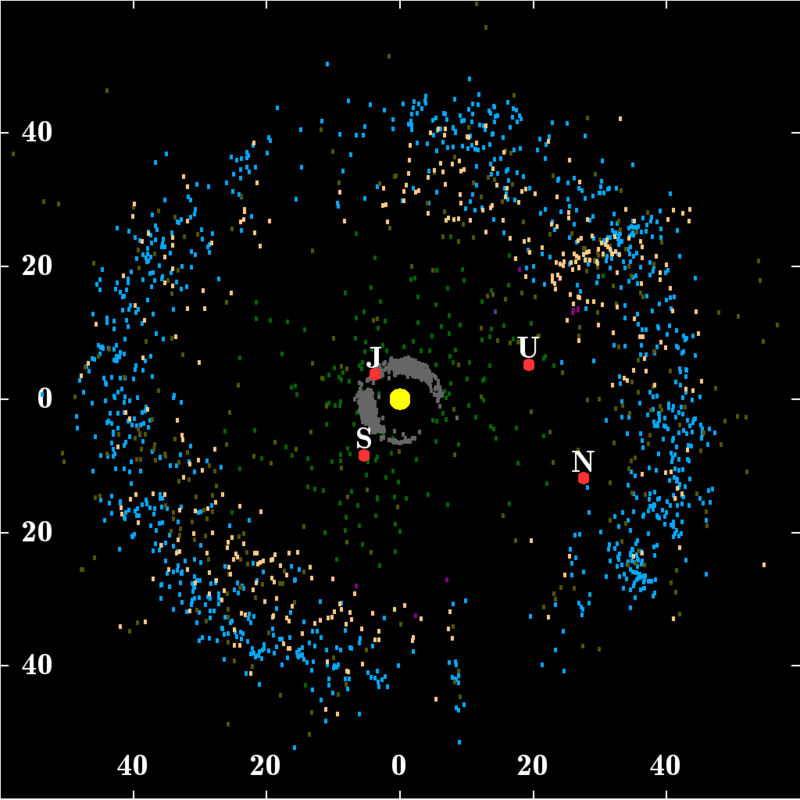
柯伊伯带(Kuiper belt)是一条巨大的碎片环,类似于小行星带,但主要由冰质天体组成。\(^\text{[206]}\) 它分布在距离太阳约 30 至 50 天文单位(AU)之间。该区域主要由小型太阳系天体构成,尽管其中最大的一些天体可能已经足够大,可以被归类为矮行星。\(^\text{[207]}\) 估计柯伊伯带中直径超过 50 公里(30 英里)的天体数量超过十万个,但其总质量被认为仅为地球质量的十分之一,甚至百分之一。\(^\text{[45]}\) 许多柯伊伯带天体拥有卫星,\(^\text{[208]}\) 且大多数轨道相对于黄道平面有较大倾角(约 10°)。\(^\text{[209]}\)
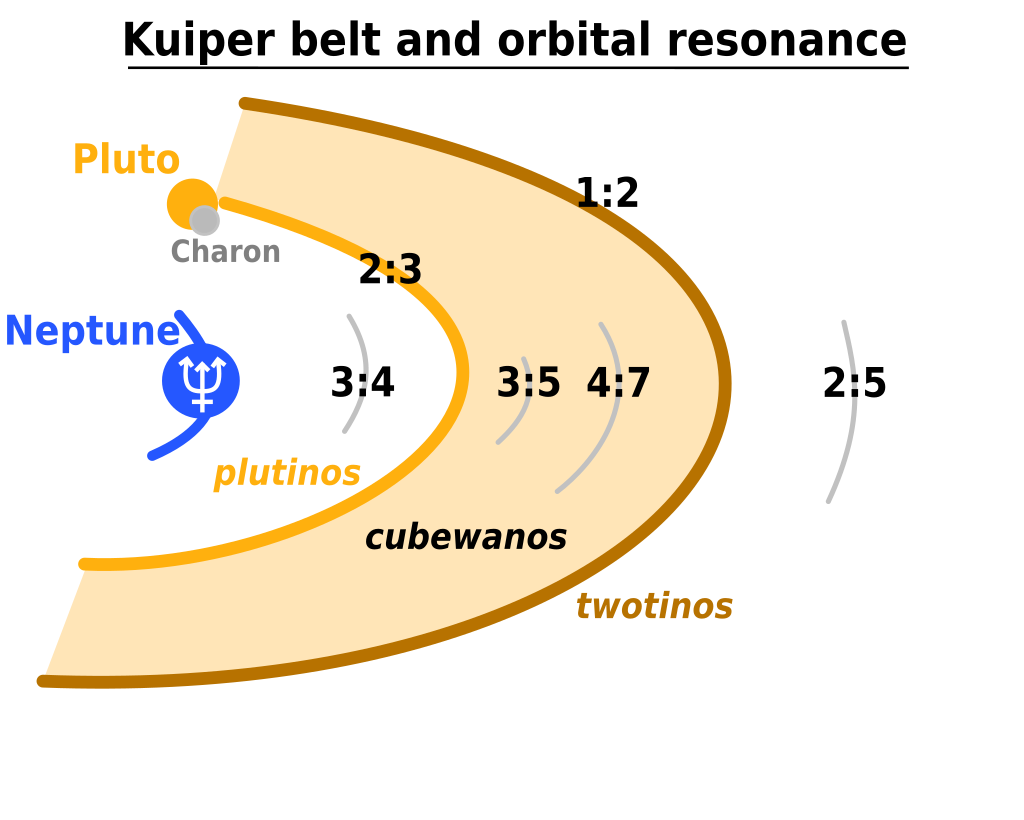
柯伊伯带可大致分为 “经典带”(classical belt)与 “共振区”(resonant trans-Neptunian objects)。\(^\text{[206]}\) 后者的轨道周期与海王星呈简单整数比,例如绕太阳运行两圈时海王星运行三圈,或一圈对应两圈。经典带由与海王星无共振的天体组成,范围大致从 39.4 AU 延伸至 47.7 AU。\(^\text{[210]}\) 经典柯伊伯带的成员有时被称为 “cubewanos”,名称来源于首个被发现的同类天体——1992 QB₁(现名 Albion),这些天体依然保持着接近原始的低偏心率轨道。\(^\text{[211]}\)
目前天文学界普遍认为,柯伊伯带中至少有五个天体是矮行星。\(^\text{[207][212]}\) 同时,还有更多矮行星候选体正在等待观测确认。\(^\text{[213]}\)
- 冥王星(Pluto,29.7–49.3 AU)是柯伊伯带中已知最大的天体。其轨道偏心率较高,并相对于黄道面倾斜 17°。冥王星与海王星存在 2:3 的轨道共振关系,即冥王星绕太阳两圈时,海王星完成三圈。与冥王星轨道共振的柯伊伯带天体被称为 “冥族天体”(plutinos)。\(^\text{[214]}\) 冥王星拥有五颗卫星:卡戎(Charon)、冥卫一 Styx、冥卫二 Nix、冥卫三 Kerberos、冥卫四 Hydra。\(^\text{[215]}\) 其中卡戎是最大的一颗,有时被认为与冥王星构成 “矮行星双星系统”,因为两者的质心位于两体之外(即它们似乎彼此 “互相绕转”)。
- 奥库斯(Orcus,30.3–48.1 AU)与冥王星一样处于与海王星的 2:3 共振轨道,是继冥王星之后该共振族中最大的成员。\(^\text{[216]}\) 其轨道偏心率与倾角与冥王星相似,但近日点与冥王星相差约 120°。因此,当冥王星位于近日点(最近在 1989 年)时,奥库斯位于远日点(最近在 2019 年),反之亦然。\(^\text{[217]}\) 基于这种轨道 “相反” 关系,它被称为 “反冥王星”(anti-Pluto)。\(^\text{[218][219]}\) 奥库斯拥有一颗已知卫星——Vanth。\(^\text{[220]}\)
- 哈梅亚(Haumea,34.6–51.6 AU)于 2005 年发现,\(^\text{[221]}\) 目前处于与海王星 7:12 的暂时性轨道共振。[216]哈梅亚拥有一个环系统、两颗卫星(Hiʻiaka 与 Namaka),并且自转速度极快(约 3.9 小时一转),导致其形状被拉伸成椭球体。它属于一类具有相似轨道的碰撞族成员,说明数十亿年前,一次巨大的撞击从哈梅亚上剥离出大量碎片进入太空。\(^\text{[222]}\)
- 鸟神星(Makemake,38.1–52.8 AU)虽小于冥王星,但却是 “经典柯伊伯带” 中已知最大的天体(即与海王星无共振关系的柯伊伯带天体)。鸟神星是柯伊伯带中仅次于冥王星的最亮天体,2005 年发现,2009 年正式命名。\(^\text{[223]}\) 其轨道倾角达 29°,远高于冥王星。\(^\text{[224]}\) 鸟神星拥有一颗已知卫星:S/2015 (136472) 1。\(^\text{[225]}\)
- 夸欧尔(Quaoar,41.9–45.5 AU)是 “经典柯伊伯带” 中第二大已知天体,仅次于鸟神星。与鸟神星和哈梅亚相比,夸欧尔的轨道偏心率与倾角都要小得多。\(^\text{[216]}\) 它拥有一个环系统和一颗已知卫星——Weywot。\(^\text{[226]}\)
散射盘
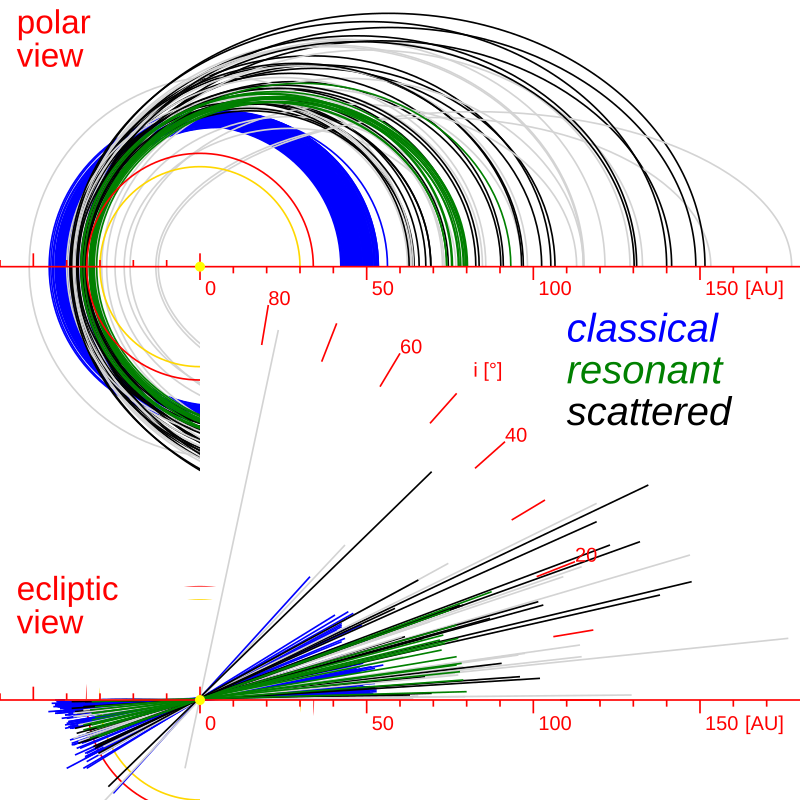
散射盘(Scattered disc)与柯伊伯带部分重叠,但向外延伸至约 500 天文单位(AU),被认为是短周期彗星的主要来源。散射盘天体被认为是在海王星早期向外迁移的过程中,受到其引力扰动而被抛入不规则轨道的。\(^\text{[227]}\) 大多数散射盘天体的近日点位于柯伊伯带范围内,但远日点却远超柯伊伯带(有些距离太阳超过 150 AU)。这些天体的轨道相对于黄道面的倾角可高达 46.8°。\(^\text{[227]}\) 一些天文学家认为散射盘仅是柯伊伯带的一个延伸区域,并将散射盘天体称为 “散射柯伊伯带天体”(scattered Kuiper belt objects)。\(^\text{[228]}\) 另一些学者则将半人马型天体(Centaurs)归为 “向内散射的柯伊伯带天体”,与散射盘中的 “向外散射天体” 对应。\(^\text{[229]}\)
目前,天文学界普遍认为散射盘中至少有两颗天体是矮行星:
- 厄里斯(Eris,38.3–97.5 AU)是目前已知最大的散射盘天体,也是质量最大的矮行星。厄里斯的发现引发了关于 “行星定义” 的争论,因为它的质量比冥王星大约高出 25%,\(^\text{[230]}\) 而直径几乎相当。它拥有一颗已知卫星 —— 纷争女神(Dysnomia)。与冥王星类似,厄里斯的轨道偏心率很高,近日点为 38.2 AU(与冥王星相当),远日点为 97.6 AU,且其轨道相对于黄道面倾斜 44°。\(^\text{[231]}\)
- 龚龚(Gonggong,33.8–101.2 AU)是另一颗矮行星,其轨道与厄里斯相似,但与海王星存在 3:10 的轨道共振关系。\(^\text{[D 10]}\) 它拥有一颗已知卫星 —— 相柳。\(^\text{[232]}\)
极端跨海王星天体
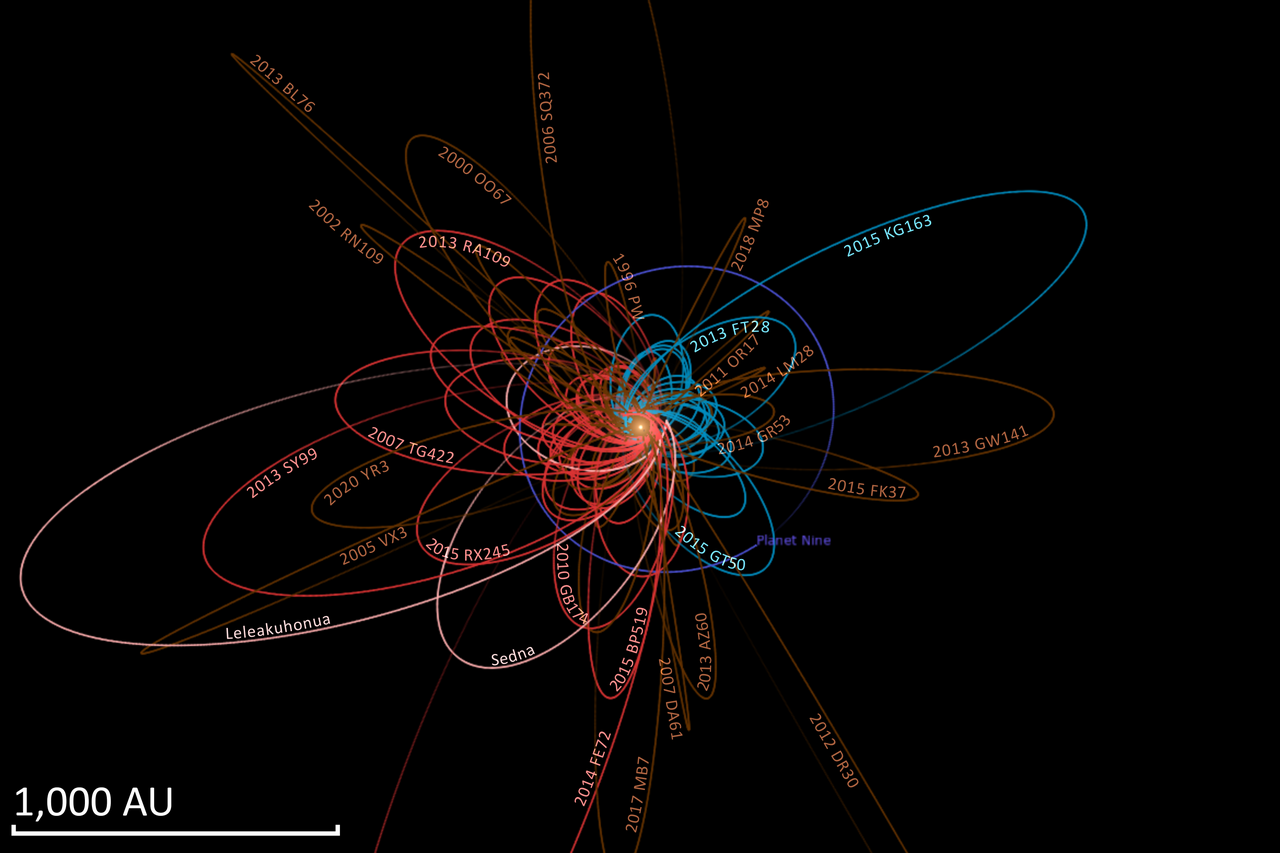
太阳系中有一些天体的轨道极为遥远, 因此它们受到已知巨行星(如木星、土星、天王星、海王星)引力影响的程度远小于其他小行星族群。这些天体被称为极端跨海王星天体(Extreme Trans-Neptunian Objects,简称 ETNOs)。\(^\text{[233]}\) 一般而言,ETNOs 的轨道半长轴至少在 150–250 天文单位(AU)之间。\(^\text{[233][234]}\) 例如,541132 Leleākūhonua 绕太阳一周需约 32,000 年, 其距离太阳的范围在 65–2000 AU 之间。\(^\text{[D 11]}\)
天文学家将这一族群分为三类:散射型 ETNOs(Scattered ETNOs)其近日点约在 38–45 AU,轨道偏心率极高(>0.85)。与普通散射盘天体类似,它们很可能是早期被海王星引力散射形成的,并且仍然会与巨行星发生引力相互作用。分离型 ETNOs(Detached ETNOs)其近日点大约在 40–45 AU 到 50–60 AU 之间,受海王星影响较小,但仍处于相对接近的范围内。赛德娜族或内奥尔特云天体(Sednoids / Inner Oort Cloud Objects)其近日点超过 50–60 AU,距离海王星太远,几乎不再受其引力影响。\(^\text{[233]}\)
目前,只有一颗极端跨海王星天体被确认为矮行星:
- 赛德娜(Sedna,76.2–937 AU)是首个被发现的极端跨海王星天体。它是一颗体积较大、呈红色的天体,绕太阳公转一周约需 11,400 年。其发现者迈克·布朗(Mike Brown,2003 年)认为,赛德娜不可能属于散射盘或柯伊伯带,因为其近日点距离过远,不可能受到海王星迁移的影响。\(^\text{[235]}\)“赛德娜族”(Sednoids)这一名称正是以它命名的。\(^\text{[233]}\)
在部分 ETNO 的轨道中,天文学家发现其近日点分布存在统计聚集现象:它们最接近太阳的点集中在同一空间区域,且这些天体的轨道倾角也非常相似。\(^\text{[236][237][238]}\) 部分天文学家推测,这可能是海王星外一颗大型行星的引力所致 —— 这一假设天体被称为第九行星(Planet Nine)。\(^\text{[239]}\) 但也有研究者认为,这种轨道聚集可能仅仅是观测偏差或随机巧合所致。\(^\text{[240]}\)
奥尔特云
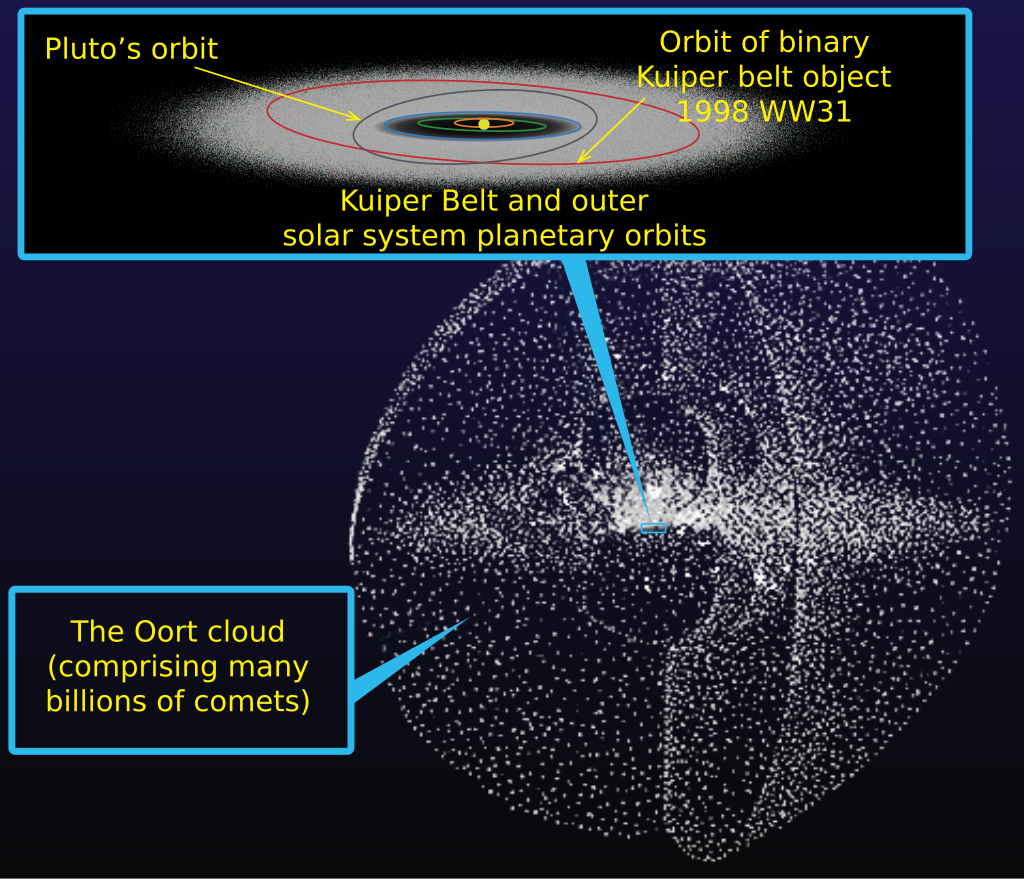
奥尔特云(Oort Cloud)是一种假设存在的球形壳层结构,可能包含多达一万亿个冰质天体。它被认为是所有长周期彗星的来源。\(^\text{[241][242]}\) 这些天体最初由太阳系内部形成,后来因与外行星的引力相互作用而被抛射到遥远的轨道上。奥尔特云中的天体运动极其缓慢,但会受到一些偶发事件的扰动,例如:与其他天体的碰撞;掠过恒星的引力效应;以及来自银河系的潮汐力(即所谓的 “星系潮”)。\(^\text{[241][242]}\) 由于其距离极为遥远、光度极低,以目前的观测技术尚无法直接探测到奥尔特云。\(^\text{[243]}\)
根据理论模型,奥尔特云可能从距离太阳约 2,000 AU 延伸至 200,000 AU。而较低的估计则认为其外缘不会超过 50,000 AU。\(^\text{[244]}\) 其主要质量集中在 3,000 至 100,000 AU 之间的区域。\(^\text{[245]}\) 已知最远的天体(如西彗星(Comet West))其远日点大约位于 70,000 AU 处。\(^\text{[246]}\)
7. 引力不稳定族群
流星体、流星与尘埃
直径小于一米的固体天体通常被称为流星体(meteoroids),更小的(粒状)则称为微流星体(micrometeoroids),但两者的确切划分标准多年来一直存在争议。\(^\text{[247]}\) 截至 2017 年,国际天文学联合会(IAU)规定:直径约在 30 微米至 1 米 之间的固体天体统一称为流星体(meteoroids),并弃用了 “微流星体” 这一分类;而更小的颗粒则被简单称为尘埃粒子(dust particles)。\(^\text{[248]}\)
部分流星体来源于彗星或小行星的解体,另有少数来自行星表面撞击所产生的喷射碎片。大多数流星体由硅酸盐及重金属(如镍、铁)组成。\(^\text{[249]}\) 当彗星经过太阳系时,其物质因蒸发或破碎形成一条由流星体构成的轨迹。当这些流星体进入行星大气层时,与空气摩擦发光,产生天空中明亮的划线现象,即流星(meteor)。如果一群流星体以平行轨迹同时进入大气层,它们在天空中看似从某一点 “辐射” 出来,这种现象称为流星雨(meteor shower)。\(^\text{[250]}\)
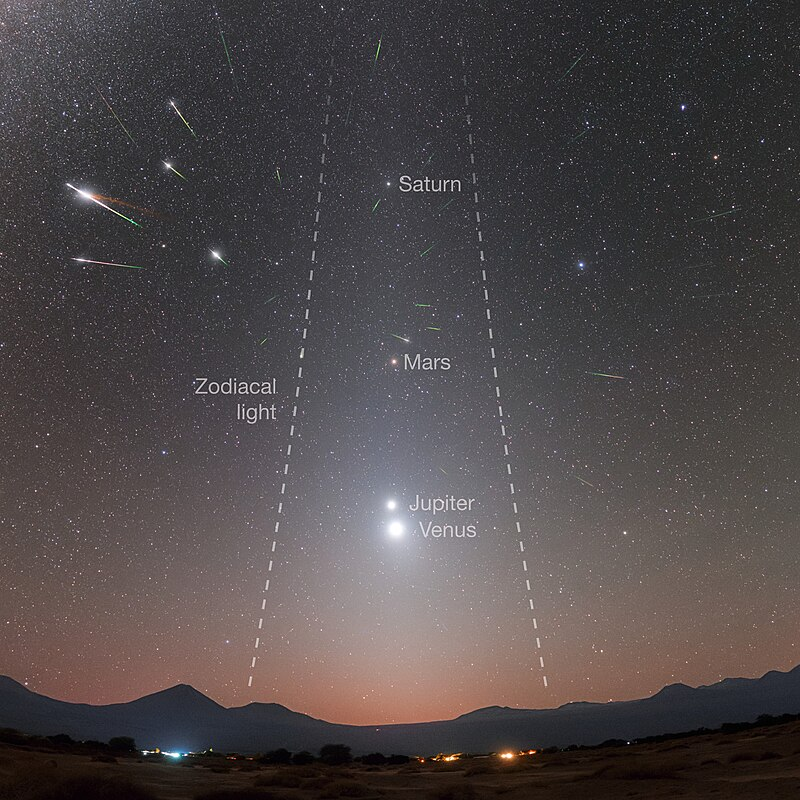
太阳系内区存在黄道尘埃云(zodiacal dust cloud),在无光污染的暗夜中可见为黄道光(zodiacal light)。该尘埃云可能由小行星带中因行星引力扰动引发的碰撞形成,也有研究提出其部分物质可能源自火星。\(^\text{[251]}\) 太阳系外区也存在宇宙尘埃云(cosmic dust cloud),范围约在 10 AU 至 40 AU 之间,被认为主要由柯伊伯带天体间的碰撞所产生。\(^\text{[252][253]}\)
彗星

彗星(Comets)是太阳系中的小型天体,通常直径只有数公里,主要由挥发性冰质物质组成。它们的轨道具有极高的离心率:近日点一般位于类地行星轨道内,而远日点则常远远超出冥王星轨道。当彗星进入内太阳系时,靠近太阳的高温使其冰质表面升华并电离,从而形成彗发(coma)—— 一条由气体与尘埃组成的长尾,常可肉眼观测到。\(^\text{[254]}\)
短周期彗星(short-period comets)的轨道周期小于两百年;长周期彗星(long-period comets)的轨道周期则可长达数千年。天文学家普遍认为:短周期彗星起源于柯伊伯带(Kuiper belt),而像海尔–波普彗星(Hale–Bopp)这样的长周期彗星,起源于奥尔特云(Oort cloud)。许多彗星群(如克罗伊茨掠日群彗星,Kreutz sungrazers)被认为源自同一母体的分裂。\(^\text{[255]}\) 部分具有双曲线轨道(hyperbolic orbits)的彗星可能起源于太阳系之外,但由于轨道测定困难,其确切来源尚不确定。\(^\text{[256]}\) 那些因长期受太阳加热、其内部挥发物几乎被完全驱逐的古老彗星,通常被归类为小行星(asteroids)。\(^\text{[257]}\)
8. 边界区域与不确定性

太阳系的外层区域仍有大量未知。距离太阳 100 个天文单位(AU)以外的空间几乎尚未被探索,因此对该区域的研究极为困难。人类目前对这一区域的认识,主要依赖于那些轨道被扰动、偶然靠近太阳的天体所提供的推测。即便如此,探测这些天体往往也只能在它们变得足够明亮、被观测为彗星时才有可能实现。\(^\text{[258]}\) 可以确定的是,太阳系外层仍存在大量尚未被发现的天体。\(^\text{[259]}\)
据估计,太阳的引力势能范围在约 两光年(125,000 AU)内仍主导着周围恒星的引力影响。太阳的希尔球(Hill sphere)—— 即太阳的引力势与银河系的引力势相等的边界 —— 被认为正好包围着奥尔特云(Oort cloud)其范围可能延伸至距离太阳约 230,000 AU 之远。\(^\text{[8][27][260]}\)
日球层(heliosphere)与希尔球的边界,代表了太阳系与银河系环境之间的交界处。在那里,太阳的引力势、星际介质(interstellar medium)与银河系整体引力势达到平衡。
日球层的边缘

太阳的恒星风气泡——称为日球层(heliosphere)—— 是一个由太阳主导的空间区域,其边界位于终止激波(termination shock)处。根据太阳相对于局部静止标准(local standard of rest)的特有运动,这一边界在朝向星际介质的上风方向约距太阳 80–100 AU,而在下风方向约为 200 AU。\(^\text{[261]}\) 在此处,太阳风(solar wind)与星际介质(interstellar medium)发生碰撞,其速度显著降低、密度增加并变得更加湍流,从而形成一个巨大的椭圆形结构 —— 称为日球层顶(heliosheath)。\(^\text{[261]}\)
理论上,日球层顶的外形与行为极类似于彗星的尾部:在上风侧进一步延伸约 40 AU,而在下风侧则可拖曳至数千个天文单位之远。\(^\text{[263][264]}\) 来自 “卡西尼号(Cassini)” 与 “星际边界探测器(Interstellar Boundary Explorer)” 的观测证据表明,日球层受到星际磁场(interstellar magnetic field)的约束作用,被压缩成一个泡状结构(bubble shape),\(^\text{[265][266]}\) 但其实际形状仍未确定。\(^\text{[267]}\)
日球层外缘的形态可能受到星际介质交互作用的流体动力学效应以及太阳南半球主导的磁场分布的共同影响。例如,它呈现出 “钝形”,其中北半球的延伸范围比南半球多约 9 AU。\(^\text{[261]}\) 日球层顶(heliopause)被视为星际介质的起点。\(^\text{[93]}\) 在约 230 AU 处之外,存在所谓的弓形激波(bow shock):这是太阳在穿越银河系时所留下的等离子体尾迹(plasma wake)。\(^\text{[268]}\) 位于日球层之外的大型天体依然受太阳引力束缚,但星际介质中的物质流动会使微小尺度天体的分布逐渐均匀化。\(^\text{[93]}\)
9. 天体邻域
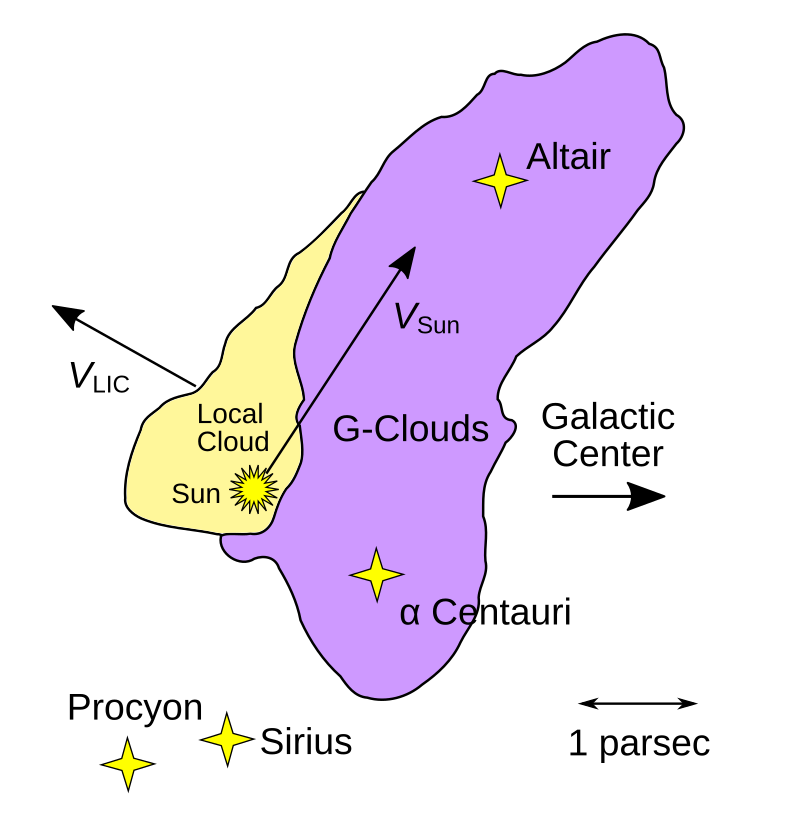
在距离太阳 10 光年范围内,恒星相对稀少;其中最近的是半人马座 α(三合星系统,Alpha Centauri),距离约 4.4 光年,可能位于 “局部泡”(Local Bubble)的 G 云(G-Cloud)内。\(^\text{[270]}\) 半人马座 α A 与 α B 是一对类似太阳的紧密双星,而距离太阳最近的恒星 —— 红矮星比邻星(Proxima Centauri)—— 则以约 0.2 光年的距离环绕它们运行。2016 年,天文学家发现一颗潜在可居住的系外行星环绕比邻星运行,被命名为比邻星 b(Proxima Centauri b),这是目前距离太阳最近的已确认系外行星。\(^\text{[271]}\)
太阳系被局部星际云(Local Interstellar Cloud)包围,但尚不清楚它是嵌入于该星际云之中,还是仅位于其边缘之外。\(^\text{[272]}\) 在距离太阳 300 光年范围内,存在多个星际云——统称为局部泡(Local Bubble)。\(^\text{[272]}\) 这一结构呈 “沙漏形空腔” 或 “超泡”,在星际介质中横跨约 300 光年。其内部充满高温等离子体,表明该结构可能由多次近期超新星爆发所形成。\(^\text{[273]}\)
与邻近的更大尺度结构相比,局部泡只是一个较小的超泡。在它的邻域中存在更广阔的结构:Radcliffe 波(Radcliffe Wave)与分裂线性结构(Split Linear Structure,原 Gould 带),二者的长度都达到数千光年。\(^\text{[274]}\) 这些结构共同属于猎户臂(Orion Arm)的一部分,该旋臂中包含了肉眼可见的银河系大部分恒星。\(^\text{[275]}\)
恒星通常在星团(star clusters)中形成,之后再逐渐解体为共动星群(co-moving associations)。其中一个肉眼可见的显著星群是大熊座移动星群(Ursa Major moving group),距离约 80 光年,位于局部泡内部。最近的星团是金牛座毕宿星团(Hyades),位于局部泡的边缘。距离最近的恒星形成区包括:南冕座分子云(Corona Australis Molecular Cloud)、蛇夫座ρ云复合体(Rho Ophiuchi cloud complex)以及金牛座分子云(Taurus molecular cloud);其中金牛座分子云位于局部泡之外,是 Radcliffe 波的一部分。\(^\text{[276]}\)
恒星近掠事件(stellar flybys)——即恒星经过距离太阳 0.8 光年以内 —— 大约每 10 万年 发生一次。最近一次测得的事件是朔尔茨星(Scholz’s Star),约在 7 万年前曾接近至 5 万 AU,很可能穿过了奥尔特云(Oort cloud)的外层。\(^\text{[277]}\) 每 10 亿年约有 1%的概率会有恒星掠过太阳 100 AU 范围内,这种事件可能扰乱整个太阳系的轨道结构。\(^\text{[278]}\)
10. 银河系位置
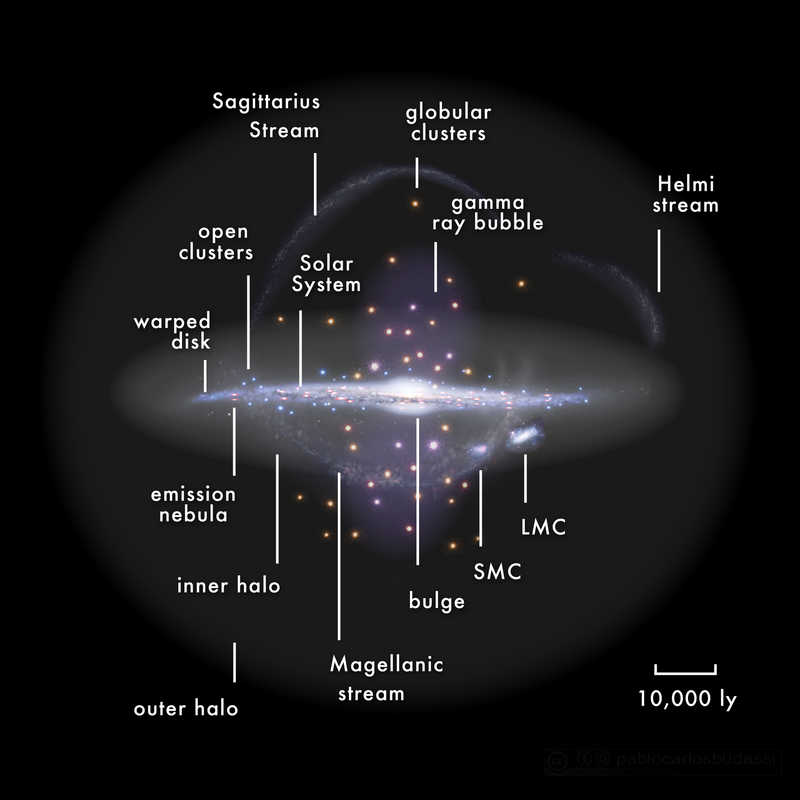
太阳系位于银河系(Milky Way)之中。银河系是一种棒旋星系(barred spiral galaxy),直径约 10 万光年,包含超过 1000 亿颗恒星。\(^\text{[279]}\) 太阳系所在的区域属于银河系外侧的一个旋臂,称为猎户–天鹅臂(Orion–Cygnus Arm)或本地支臂(Local Spur)。\(^\text{[280][281]}\) 太阳属于薄盘恒星族(thin disk population)的一员,这类恒星绕银河盘面近距离运行。\(^\text{[282]}\)
太阳绕银河系中心运行的速度约为 220 km/s,完成一周约需 2.4 亿年。\(^\text{[279]}\) 这一周期被称为太阳系的银河年(galactic year)。\(^\text{[283]}\) 太阳在星际空间中的运行方向称为太阳顶点(solar apex),其位置位于武仙座(Hercules)方向,大致朝向目前明亮恒星织女星(Vega)所在的位置。\(^\text{[284]}\) 黄道面与银河盘面之间的夹角约为 60°。\(^\text{[c]}\)
太阳以近圆形轨道绕银河中心(Galactic Center)运行,该中心处为人马座 A(Sagittarius A\) 超大质量黑洞所在。太阳与银河中心的距离约为 26,660 光年,\(^\text{[286]}\) 其公转速度与银河旋臂的旋转速度大致相同。\(^\text{[287]}\) 如果太阳的轨道更靠近银河中心,附近恒星的引力扰动可能会扰乱奥尔特云(Oort Cloud)中的天体,从而使大量彗星被送入内太阳系,造成与地球的撞击,对生命带来潜在的灾难性影响。此外,银河中心的强烈辐射也可能干扰复杂生命的演化。\(^\text{[287]}\)
太阳系在银河系中的位置对地球生命的演化历史具有重要影响。银河旋臂中存在更高密度的超新星(supernovae)、引力不稳定区(gravitational instabilities)与高能辐射环境,这些因素都可能扰乱太阳系的稳定性。然而,由于地球位于本地支臂(Local Spur),而非频繁穿越旋臂的区域,这为地球生命的长期演化提供了相对稳定的条件。\(^\text{[287]}\) 不过,根据颇具争议的湿婆假说(Shiva hypothesis),太阳系相对于银河系其他部分位置的周期性变化可能解释地球上出现的周期性生物大灭绝事件。\(^\text{[288][289]}\)
11. 发现与探索
人类对太阳系的认识在几个世纪中逐步积累与扩展。直到中世纪晚期至文艺复兴时期,从欧洲到印度的天文学家普遍认为 —— 地球静止于宇宙的中心,\(^\text{[290]}\) 并且与那些在天空中运动的神圣或以太天体本质上截然不同。尽管希腊哲学家萨摩斯的阿里斯塔克斯(Aristarchus of Samos)曾提出过关于太阳中心说(heliocentric)宇宙的推测,但尼古拉·哥白尼(Nicolaus Copernicus)是已知第一个建立可数学预测的日心体系模型的人。\(^\text{[291][292]}\)
日心说(Heliocentrism)并未立即战胜地心说(geocentrism),但哥白尼的工作得到了几位学者的支持,其中最著名的是约翰内斯·开普勒(Johannes Kepler)。开普勒在哥白尼模型的基础上进行了改进 —— 他允许行星轨道为椭圆形轨道,并结合了第谷·布拉赫(Tycho Brahe)的精确观测数据,编制了著名的《鲁道夫星表(Rudolphine Tables)》,这使得对当时已知行星位置的计算达到了前所未有的精确度。皮埃尔·伽森狄(Pierre Gassendi)于 1631 年利用该星表预测了水星凌日(transit of Mercury),杰里迈亚·霍罗克斯(Jeremiah Horrocks)则在 1639 年成功预测了金星凌日(transit of Venus)。这些成果为日心说与开普勒的椭圆轨道理论提供了强有力的验证。\(^\text{[293][294]}\)
在 17 世纪,伽利略·伽利莱(Galileo Galilei)率先将望远镜引入天文学观测;他与西蒙·马里乌斯(Simon Marius)分别独立发现,木星(Jupiter)拥有四颗绕行的卫星。\(^\text{[295]}\) 克里斯蒂安·惠更斯(Christiaan Huygens)在此基础上发现了土星最大卫星——泰坦(Titan),并揭示了土星环的形状。\(^\text{[293]}\)1677 年,爱德蒙·哈雷(Edmond Halley)观测到水星凌日现象,由此意识到:过观测行星的太阳视差(solar parallax)—— 理想情况下为金星凌日—— 可以使用三角测量法精确地确定地球、金星与太阳之间的距离。\(^\text{[297]}\) 他的朋友艾萨克·牛顿(Isaac Newton)在 1687 年出版的巨著《自然哲学的数学原理(Principia Mathematica)》中,证明了天体并非与地球上的物体本质不同:相同的运动定律与引力法则同样适用于地球与天空中的天体。\(^\text{[59]: 142 }\)

“太阳系(Solar System)” 这一术语最早于 1704 年进入英语语言体系,当时约翰·洛克(John Locke)用它来指代太阳、行星与彗星。\(^\text{[298]}\)1705 年,爱德蒙·哈雷(Edmond Halley)意识到多次观测到的某颗彗星其实是同一个天体,它以 75–76 年为周期规律性地回归。这是第一个证明除行星外,亦有天体周期性环绕太阳运行的证据,\(^\text{[299]}\) 尽管早在公元 1 世纪,塞内卡(Seneca)就曾在理论上推测过类似的观点。\(^\text{[300]}\)1769 年对金星凌日(transit of Venus)的精确观测,使天文学家得以计算出平均地日距离(Earth–Sun distance)为 93,726,900 英里(150,838,800 公里),仅比现代测定值高出 0.8%。\(^\text{[301]}\)
天王星(Uranus)自 1690 年起偶有被观测到,甚至可能早于古代,但直到 1783 年才被确认为位于土星轨道之外的行星。\(^\text{[302]}\)1838 年,弗里德里希·贝塞尔(Friedrich Bessel)成功测量了恒星视差(stellar parallax)—— 即由于地球绕太阳公转而导致的恒星位置的视在偏移,这为日心说提供了第一个直接且实验证据。\(^\text{[303]}\) 几年后的 1846 年,海王星(Neptune)被确认为行星,其发现得益于它对天王星轨道的微弱但可测的引力扰动。\(^\text{[304]}\) 而对水星轨道异常(Mercury’s orbital anomaly)的观测曾促使天文学家假设存在比水星更靠内的行星——火神星(Vulcan),但这一假说最终在阿尔伯特·爱因斯坦(Albert Einstein)于 1915 年提出的广义相对论(general relativity)中被否定。\(^\text{[305]}\)
在 20 世纪,人类开始了太阳系的太空探索(space exploration)。自 20 世纪 60 年代起,人类便将望远镜送入太空轨道。\(^\text{[306]}\) 到 1989 年,八大行星均已被探测器访问过。\(^\text{[307]}\) 探测器曾从彗星 \(^\text{[308]}\) 与小行星 \(^\text{[309]}\) 采集样本返回地球,亦曾穿越太阳日冕(corona)\(^\text{[310]}\),并访问过两颗矮行星:冥王星(Pluto)与谷神星(Ceres)。\(^\text{[311][312]}\) 为节省燃料,一些任务利用引力助推(gravity assist)机动,例如旅行者一号与二号(Voyager 1 & 2)在飞掠外行星时获得加速,\(^\text{[313]}\) 而帕克太阳探测器(Parker Solar Probe)则在飞越金星后减速,进入更靠近太阳的轨道。\(^\text{[314]}\)
人类在 20 世纪 60–70 年代通过阿波罗计划(Apollo program)成功登月,\(^\text{[315]}\) 并计划在 2020 年代通过阿耳忒弥斯计划(Artemis program)重返月球。\(^\text{[316]}\)20 至 21 世纪的发现推动了 “行星” 定义的重新修订(2006 年),导致冥王星被降级为矮行星(dwarf planet),\(^\text{[317]}\) 并激发了人类对海王星外天体(trans-Neptunian objects)的更深研究兴趣。\(^\text{[318]}\)

12. 参见
- 行星际航行(Interplanetary spaceflight)—— 载人或无人进行的恒星或行星间旅行
- 太阳系内受引力整形的天体列表(List of gravitationally rounded objects of the Solar System)
- 太阳系极值列表(List of Solar System extremes)
- 按大小排列的太阳系天体列表(List of Solar System objects by size)—— 太阳系中最大的天体
- 太阳系地质特征列表(Lists of geological features of the Solar System)—— 小行星、卫星及除地球以外行星的地质特征目录
- 太阳系纲要(Outline of the Solar System)—— 太阳系的总体概览与主题导引
- 行星助记语(Planetary mnemonic)—— 用于记忆太阳系行星顺序的短语
- 虚构作品中的太阳系(Solar System in fiction)—— 文学、影视及艺术作品中的太阳系描绘
13. 注释
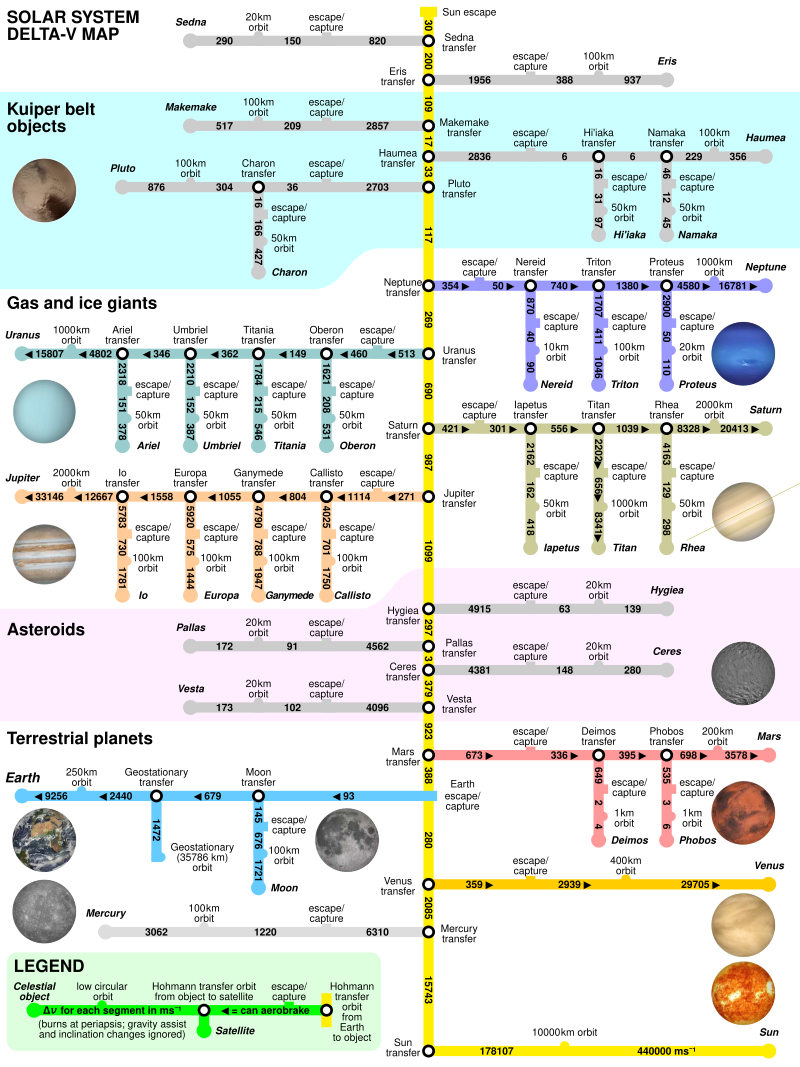
a.小行星带、柯伊伯带与散射盘未被绘入图中,因为其中的单个小行星体积太小,无法在图示上体现。
b.日期依据目前在陨石中发现的最古老包裹体(CAIs),年代为 45.682 ± 0.0002 亿年上限 +0.2 Ma,下限 −0.4 Ma),被认为是原始星云塌缩后形成首批固态物质的时间。\(^\text{[18]}\)
c.若 $\psi$ 表示黄道北极与银河北极之间的夹角,则有:
\[
\cos \psi = \cos\left(\beta_g\right) \cos\left(\beta_e\right) \cos\left(\alpha_g - \alpha_e\right) + \sin\left(\beta_g\right) \sin\left(\beta_e\right) ~
\]
其中:\(\beta_g = 27^{\circ}07'42.01'', \quad \alpha_g = 12^{\mathrm{h}}51^{\mathrm{m}}26.282^{\mathrm{s}}\) 分别为银河北极的赤纬与赤经,[285]而:\(\beta_e = 66^{\circ}33'38.6'', \quad \alpha_e = 18^{\mathrm{h}}00^{\mathrm{m}}00^{\mathrm{s}}\) 为黄道北极的赤纬与赤经(均为 J2000 历元)。计算结果为:\(\psi = 60.19^{\circ}\)
d.“Solar System” 的大小写并不统一。 国际天文学联合会(IAU)作为命名权威机构,规定所有单独天体名称首字母应大写,但在其官方《命名指南》(2021 年 7 月 25 日存档)中同时出现 “Solar System” 与 “solar system” 两种形式。在日常用法中,如《牛津英语词典》(Oxford English Dictionary)与《韦氏大学词典》第十一版(Merriam-Webster’s 11th Collegiate Dictionary,2008 年 1 月 27 日存档)均采用小写形式 “solar system”。
e.天文单位(Astronomical Unit, AU)是用于表示太阳系尺度的自定义距离单位:
$1\,\mathrm{AU} = 150,000,000\,\mathrm{km} = 93,000,000\,\mathrm{mi}$
该数值等于假设地球绕太阳为完美圆轨道时的平均地日距离。\(^\text{[13]}\)
f.截至 2024 年,国际天文学联合会小行星中心(IAU MPC)尚未正式将奥库斯(Orcus)、夸奥尔(Quaoar)、共工(Gonggong)与 赛德娜(Sedna)列入 “矮行星” 名单。
g.关于太阳系天体的更多分类,参见《小行星群体列表(List of minor-planet groups)》与 《彗星 § 分类(Comet § Classification)》。
h.太阳系除去太阳、木星与土星后的质量可通过将主要天体的已测质量相加,并估算各区质量得出:奥尔特云约 3 个地球质量(Earth masses),\(^\text{[44]}\) 柯伊伯带约 0.1 个地球质量,\(^\text{[45]}\) 小行星带约 0.0005 个地球质量,\(^\text{[46]}\) 总和(取上限)约 37 个地球质量,占太阳系绕太阳公转物质量的 约 8.1%。若再减去天王星与海王星合计约 31 个地球质量,剩余物质量约为 6 个地球质量,占总公转质量的 约 1.3%。
14. 参考文献
数据来源
- Lurie, John C.; Henry, Todd J.; Jao, Wei-Chun; 等(2014)。〈太阳系邻域 XXXIV:使用天体测量法搜寻环绕附近 M 型矮星的行星〉,《天文学杂志》(The Astronomical Journal),第 148 卷第 5 期:91。arXiv:1407.4820。Bibcode:2014AJ....148...91L。doi:10.1088/0004-6256/148/5/91。ISSN 0004-6256。S2CID 118492541。
- 《最近的一百个恒星系统》(The One Hundred Nearest Star Systems)。astro.gsu.edu。佐治亚州立大学 “邻近恒星研究联盟”(Research Consortium On Nearby Stars)。2007 年 9 月 7 日。原始档案存于 2007 年 11 月 12 日。检索于 2014 年 12 月 2 日。
- 《太阳系天体》(Solar System Objects)。美国国家航空航天局(NASA)喷气推进实验室太阳系动力学(JPL Solar System Dynamics)。原始档案存于 2021 年 7 月 7 日。检索于 2023 年 8 月 14 日。
- 《最新发布数据》(Latest Published Data)。国际天文学联合会小行星中心(The International Astronomical Union Minor Planet Center)。原始档案存于 2019 年 3 月 5 日。检索于 2024 年 5 月 27 日。
- Yeomans, Donald K.〈HORIZONS 网页界面:海王星质心(主要天体编号=8)〉。jpl.nasa.gov。NASA 喷气推进实验室在线星历系统(JPL Horizons On-Line Ephemeris System)。原始档案存于 2021 年 9 月 7 日。检索于 2014 年 7 月 18 日。——选择 “星历类型:轨道要素(Ephemeris Type: Orbital Elements)”,“时间范围:2000-01-01 12:00 至 2000-01-02”。(目标天体:海王星质心(Neptune Barycenter);中心:太阳系质心(Solar System Barycenter (@0))。)
- Williams, David(2021 年 12 月 27 日)。〈行星资料表——公制版〉(Planetary Fact Sheet – Metric*)。戈达德太空飞行中心(*Goddard Space Flight Center)。原始档案存于 2011 年 8 月 18 日。检索于 2022 年 12 月 11 日。
- 《行星卫星物理参数》(Planetary Satellite Physical Parameters)。喷气推进实验室太阳系动力学部(JPL, Solar System Dynamics)。2006 年 7 月 13 日。原始档案存于 2013 年 11 月 1 日。检索于 2008 年 1 月 29 日。
- 《HORIZONS 网页界面》(HORIZONS Web-Interface)。NASA。2013 年 9 月 21 日。原始档案存于 2007 年 3 月 28 日。检索于 2013 年 12 月 4 日。
- 《行星卫星物理参数》(Planetary Satellite Physical Parameters)。喷气推进实验室(JPL,太阳系动力学部)。2006 年 7 月 13 日。原始档案存于 2013 年 11 月 1 日。检索于 2008 年 1 月 29 日。
- 《JPL 小天体数据库浏览器:225088 Gonggong (2007 OR10)》(最后观测日期 2015 年 9 月 20 日)。喷气推进实验室。2017 年 4 月 10 日。原始档案存于 2020 年 6 月 10 日。检索于 2020 年 2 月 20 日。
- 《JPL 小天体数据库浏览器:(2015 TG387)》(最后观测日期 2018 年 10 月 17 日)。喷气推进实验室。原始档案存于 2020 年 4 月 14 日。检索于 2018 年 12 月 13 日。
其他来源
- 《我们的本地银河邻域》(Our Local Galactic Neighborhood)。interstellar.jpl.nasa.gov。NASA 星际探测器计划(Interstellar Probe Project)。2000 年。原始档案存于 2013 年 11 月 21 日。检索于 2012 年 8 月 8 日。
- Hurt, R.(2017 年 11 月 8 日)。〈银河系〉(The Milky Way Galaxy)。science.nasa.gov。检索于 2024 年 4 月 19 日。
- Chiang, E. I.; Jordan, A. B.; Millis, R. L.; 等(2003)。〈柯伊伯带中的共振占据情况:5:2 与特洛伊型共振的实例研究〉(Resonance Occupation in the Kuiper Belt: Case Examples of the 5:2 and Trojan Resonances)。《天文学杂志》(The Astronomical Journal),第 126 卷第 1 期:430–443。arXiv:astro-ph/0301458。Bibcode:2003AJ....126..430C。doi:10.1086/375207。S2CID 54079935。
- de la Fuente Marcos, C.; de la Fuente Marcos, R.(2024 年 1 月)。〈超越外缘,进入未知:柯伊伯悬崖之外的结构〉(Past the outer rim, into the unknown: structures beyond the Kuiper Cliff)。《皇家天文学会月刊·通讯》(Monthly Notices of the Royal Astronomical Society Letters),第 527 卷第 1 期(发表于 2023 年 9 月 20 日):L110–L114。arXiv:2309.03885。Bibcode:2024MNRAS.527L.110D。doi:10.1093/mnrasl/slad132。原始档案存于 2023 年 10 月 28 日。检索于 2023 年 9 月 28 日。
- Mumma, M. J.; Disanti, M. A.; Dello Russo, N.; 等(2003)。〈彗星中母体挥发物的红外遥测观测:早期太阳系的窗口〉(Remote infrared observations of parent volatiles in comets: A window on the early solar system)。《空间研究进展》(Advances in Space Research),第 31 卷第 12 期:2563–2575。Bibcode:2003AdSpR..31.2563M。CiteSeerX 10.1.1.575.5091。doi:10.1016/S0273-1177(03)00578-7。
- Greicius, Tony(2015 年 5 月 5 日)。〈NASA 航天器踏上历史性的星际之旅〉(NASA Spacecraft Embarks on Historic Journey Into Interstellar Space)。nasa.gov。原始档案存于 2020 年 6 月 11 日。检索于 2024 年 4 月 19 日。
- Souami, D.; Cresson, J.; Biernacki, C.; Pierret, F.(2020 年 8 月 21 日)。〈引力势影响球的局部与整体性质〉(On the local and global properties of gravitational spheres of influence)。《皇家天文学会月刊》(Monthly Notices of the Royal Astronomical Society),第 496 卷第 4 期:4287–4297。arXiv:2005.13059。doi:10.1093/mnras/staa1520。
- Chebotarev, G. A.(1963 年 1 月 1 日)。〈主要行星、月球与太阳的引力势影响球〉(Gravitational Spheres of the Major Planets, Moon and Sun)。《天文学杂志》(Astronomicheskii Zhurnal),第 40 卷:812。Bibcode:1964SvA.....7..618C。ISSN 0004-6299。原始档案存于 2024 年 5 月 7 日。检索于 2024 年 5 月 6 日。
- Francis, Charles; Anderson, Erik(2014 年 6 月)。〈银河中心距离的两种估算〉(Two estimates of the distance to the Galactic Centre)。《皇家天文学会月刊》(Monthly Notices of the Royal Astronomical Society),第 441 卷第 2 期:1105–1114。arXiv:1309.2629。Bibcode:2014MNRAS.441.1105F。doi:10.1093/mnras/stu631。S2CID 119235554。
- 《太阳:事实》(Sun: Facts)。science.nasa.gov。2017 年 11 月 14 日。原始档案存于 2024 年 4 月 19 日。检索于 2024 年 4 月 19 日。
- 《国际天文学联合会天文教育办公室》(IAU Office of Astronomy for Education)。astro4edu.org。国际天文学联合会教育办公室。原始档案存于 2023 年 12 月 11 日。检索于 2023 年 12 月 11 日。
- 《太阳系:事实》(Solar System: Facts)。NASA Science。2017 年 11 月 13 日。检索于 2025 年 7 月 10 日。
- Standish, E. M.(2005 年 4 月)。〈天文单位的新定义〉(The Astronomical Unit now)。《国际天文学联合会会议录》(Proceedings of the International Astronomical Union),2004 年(IAUC196):163–179。Bibcode:2005tvnv.conf..163S。doi:10.1017/S1743921305001365。S2CID 55944238。
- Obidowski, Justine C.; Webb, Jeremy J.; Zwart, Simon Portegies; Cai, Maxwell X.(2025)。〈恒星团中奥尔特云的形成与演化〉(Oort Cloud Formation and Evolution in Star Clusters)。《天体物理学杂志》(The Astrophysical Journal),第 987 卷第 1 期:29。arXiv:2505.17246。Bibcode:2025ApJ...987...29O。doi:10.3847/1538-4357/add92c。
- 《太阳系定义》(Definition of SOLAR SYSTEM)。梅里亚姆–韦伯斯特词典(Merriam-Webster)。2024 年 8 月 5 日。检索于 2025 年 7 月 10 日。
- Boulter, Michael(2025 年 7 月 7 日)。〈“SOLAR SYSTEM” 的定义与含义〉(SOLAR SYSTEM Definition und Bedeutung)。《柯林斯英语词典》(Collins English Dictionary,德文版)。检索于 2025 年 7 月 10 日。
- 《我们的太阳系特征——英国中学物理学生指南》(Features of our Solar System guide for KS3 physics students)。BBC Bitesize。2022 年 6 月 6 日。检索于 2025 年 7 月 10 日。
- Bouvier, A.; Wadhwa, M.(2010)。〈由陨石包裹体最古老的铅–铅同位素年龄重新定义的太阳系年龄〉(The age of the Solar System redefined by the oldest Pb–Pb age of a meteoritic inclusion)。《自然地球科学》(Nature Geoscience),第 3 卷第 9 期:637–641。Bibcode:2010NatGe...3..637B。doi:10.1038/NGEO941。S2CID 56092512。
- Zabludoff, Ann。〈第 13 讲:太阳系起源的星云理论〉(Lecture 13: The Nebular Theory of the origin of the Solar System)。《自然科学 102:物理宇宙》(NATS 102: The Physical Universe)。亚利桑那大学。原始档案存于 2012 年 7 月 10 日。检索于 2006 年 12 月 27 日。
- Irvine, W. M.(1983)。〈太阳前星云的化学组成〉(The chemical composition of the pre-solar nebula)。《彗星探测:国际会议论文集》(Cometary exploration; Proceedings of the International Conference),第一卷,第 3 页。Bibcode:1983coex....1....3I。
- Vorobyov, Eduard I.(2011 年 3 月)。〈(亚)太阳型恒星周围的内嵌原恒星盘 II:盘的质量、尺寸、密度、温度及行星形成视角〉(Embedded Protostellar Disks Around (Sub-)Solar Stars. II. Disk Masses, Sizes, Densities, Temperatures, and the Planet Formation Perspective)。《天体物理学杂志》(The Astrophysical Journal),第 729 卷第 2 期,编号 146。arXiv:1101.3090。Bibcode:2011ApJ...729..146V。doi:10.1088/0004-637X/729/2/146。——在金牛座与蛇夫座的恒星形成区,盘半径估计范围介于 50–1000 AU,中值约 200 AU。
- Greaves, Jane S.(2005 年 1 月 7 日)。〈恒星周围的盘与行星系统的成长〉(Disks Around Stars and the Growth of Planetary Systems)。《科学》(Science),第 307 卷第 5706 期:68–71。Bibcode:2005Sci...307...68G。doi:10.1126/science.1101979。PMID 15637266。S2CID 27720602。
- 《3. 对行星系统起源的现有理解》(Present Understanding of the Origin of Planetary Systems)。载于《其他行星系统与系外行星物质的探测与研究策略:1990–2000》(Strategy for the Detection and Study of Other Planetary Systems and Extrasolar Planetary Materials: 1990–2000)。华盛顿特区:美国国家研究委员会工程与物理科学部、行星与月球探索委员会、太空研究委员会。1990 年,第 21–33 页。ISBN 978-0-309-04193-5。原始档案存于 2022 年 4 月 9 日。检索于 2022 年 4 月 9 日。
- Boss, A. P.; Durisen, R. H.(2005)。〈太阳星云中的球粒形成激波前缘:行星与球粒陨石形成的可能统一情景〉(Chondrule-forming Shock Fronts in the Solar Nebula: A Possible Unified Scenario for Planet and Chondrite Formation)。《天体物理学杂志》(The Astrophysical Journal),第 621 卷第 2 期:L137。arXiv:astro-ph/0501592。Bibcode:2005ApJ...621L.137B。doi:10.1086/429160。S2CID 15244154。
- Bennett, Jeffrey O.(2020)。〈第 8.2 章〉,《宇宙透视》(The Cosmic Perspective,第 9 版)。新泽西州霍博肯:培生出版社。ISBN 978-0-134-87436-4。
- Nagasawa, M.; Thommes, E. W.; Kenyon, S. J.; 等(2007)。〈类地行星系统的多样起源〉(The Diverse Origins of Terrestrial-Planet Systems)[PDF]。载于 Reipurth, B.; Jewitt, D.; Keil, K.(编)《原恒星与行星 V》(Protostars and Planets V)。亚利桑那州图森:亚利桑那大学出版社,第 639–654 页。Bibcode:2007prpl.conf..639N。PDF 原文存档于 2022 年 4 月 12 日。检索于 2022 年 4 月 10 日。
- Li, J.; Bergin, E. A.; Blake, G. A.; Ciesla, F. J.; Hirschmann, M. M.(2021 年 4 月 2 日)。〈地球碳亏损由早期不可逆升华导致〉(Earth's carbon deficit caused by early loss through irreversible sublimation)。《科学进展》(Science Advances),第 7 卷第 14 期:eabd3632。arXiv:2104.02702。Bibcode:2021SciA....7.3632L。doi:10.1126/sciadv.abd3632。
- Yi, Sukyoung; Demarque, Pierre; Kim, Yong-Cheol; 等(2001)。〈改进恒星族群年龄估算:太阳化学成分的 Y2 等时线〉(Toward Better Age Estimates for Stellar Populations: The Y2 Isochrones for Solar Mixture)。《天体物理学增刊》(Astrophysical Journal Supplement),第 136 卷第 2 期:417–437。arXiv:astro-ph/0104292。Bibcode:2001ApJS..136..417Y。doi:10.1086/321795。S2CID 118940644。
- Gough, D. O.(1981 年 11 月)。〈太阳内部结构与光度变化〉(Solar Interior Structure and Luminosity Variations)。《太阳物理学》(Solar Physics),第 74 卷第 1 期:21–34。Bibcode:1981SoPh...74...21G。doi:10.1007/BF00151270。
- Shaviv, Nir J.(2003)。〈早期昏暗太阳悖论的解答尝试:强太阳风导致的低宇宙射线通量〉(Towards a Solution to the Early Faint Sun Paradox: A Lower Cosmic Ray Flux from a Stronger Solar Wind)。《地球物理研究杂志》(Journal of Geophysical Research),第 108 卷(A12):1437。arXiv:astroph/0306477。Bibcode:2003JGRA..108.1437S。doi:10.1029/2003JA009997。
- Chrysostomou, A.; Lucas, P. W.(2005)。〈恒星的形成〉(The Formation of Stars)。《当代物理学》(Contemporary Physics),第 46 卷第 1 期:29–40。Bibcode:2005ConPh..46...29C。doi:10.1080/0010751042000275277。
- Gomes, R.; Levison, H. F.; Tsiganis, K.; Morbidelli, A.(2005)。〈类地行星晚期重轰炸时期的起源〉(Origin of the cataclysmic Late Heavy Bombardment period of the terrestrial planets)。《自然》(Nature),第 435 卷第 7041 期:466–469。Bibcode:2005Natur.435..466G。doi:10.1038/nature03676。
- Crida, A.(2009)。〈太阳系的形成〉(Solar System Formation)。载于《现代天文学评论:宇宙结构的形成与演化》(Reviews in Modern Astronomy: Formation and Evolution of Cosmic Structures),第 21 卷,第 215–227 页。arXiv:0903.3008。Bibcode:2009RvMA...21..215C。doi:10.1002/9783527629190.ch12。
- Malhotra, R.; Holman, Matthew; Ito, Takashi(2001 年 10 月)。〈太阳系的混沌与稳定性〉(Chaos and stability of the solar system)。《美国国家科学院院刊》(Proceedings of the National Academy of Sciences),第 98 卷第 22 期:12342–12343。Bibcode:2001PNAS...9812342M。doi:10.1073/pnas.231384098。
- Raymond, Sean; 等(2023 年 11 月 27 日)。〈太阳系未来的轨迹:恒星在 100 AU 内遭遇的动力学模拟〉(Future trajectories of the Solar System: dynamical simulations of stellar encounters within 100 au)。《皇家天文学会月刊》(Monthly Notices of the Royal Astronomical Society),第 527 卷第 3 期:6126–6138。arXiv:2311.12171。Bibcode:2024MNRAS.527.6126R。
- Schröder, K.-P.; Connon Smith, Robert(2008 年 5 月)。〈太阳与地球的遥远未来再探〉(Distant future of the Sun and Earth revisited)。《皇家天文学会月刊》(Monthly Notices of the Royal Astronomical Society),第 386 卷第 1 期:155–163。arXiv:0801.4031。Bibcode:2008MNRAS.386..155S。
- 《巨型红星或可加热冰封世界至宜居状态——NASA 科学》(Giant red stars may heat frozen worlds into habitable planets – NASA Science)。2016 年 5 月 17 日。
- Aungwerojwit, Amornrat; Gänsicke, Boris T.; Dhillon, Vikram S.; 等(2024)。〈穿越白矮星的碎片长期变异性〉(Long-term variability in debris transiting white dwarfs)。《皇家天文学会月刊》(Monthly Notices of the Royal Astronomical Society),第 530 卷第 1 期:117–128。
- 《行星状星云》(Planetary Nebulas)。cfa.harvard.edu。哈佛–史密松天体物理中心。原始档案存于 2024 年 4 月 6 日。
- Gesicki, K.; Zijlstra, A. A.; Miller Bertolami, M. M.(2018 年 5 月 7 日)。〈行星状星云光度函数明端的神秘年龄不变性〉(The mysterious age invariance of the planetary nebula luminosity function bright cut-off)。《自然天文学》(Nature Astronomy),第 2 卷第 7 期:580–584。
- 《行星》(The Planets)。NASA。2023 年 7 月 10 日。
- 《柯伊伯带:事实》(Kuiper Belt: Facts)。NASA。2017 年 11 月 14 日。
- Woolfson, M.(2000)。〈太阳系的起源与演化〉(The origin and evolution of the solar system)。《天文学与地球物理学》(Astronomy & Geophysics),第 41 卷第 1 期:1.12–1.19。
- Morbidelli, Alessandro(2005)。〈彗星及其储库的起源与动力学演化〉(Origin and dynamical evolution of comets and their reservoirs)。arXiv:astro-ph/0512256。
- Delsanti, Audrey; Jewitt, David(2006)。〈行星之外的太阳系〉(The Solar System Beyond The Planets)[PDF]。夏威夷大学天文学研究所。原始档案存于 2007 年 1 月 29 日。
- Krasinsky, G. A.; Pitjeva, E. V.; Vasilyev, M. V.; Yagudina, E. I.(2002 年 7 月)。〈小行星带中的隐藏质量〉(Hidden Mass in the Asteroid Belt)。《伊卡洛斯》(Icarus),第 158 卷第 1 期:98–105。
- 《太阳的关键数据》(The Sun's Vital Statistics)。斯坦福太阳中心(Stanford Solar Center)。原始档案存于 2012 年 10 月 14 日,引用自 Eddy, J.(1979)《一颗新太阳:天空实验室的太阳成果》(A New Sun: The Solar Results From Skylab),NASA SP-402,第 37 页。
- Williams, David R.(2006 年 9 月 7 日)。〈土星数据表〉(Saturn Fact Sheet)。NASA。
- Williams, David R.(2021 年 12 月 23 日)。〈木星数据表〉(Jupiter Fact Sheet)。NASA 戈达德太空飞行中心。
- Weissman, Paul Robert; Johnson, Torrence V.(2007)。《太阳系百科全书》(Encyclopedia of the Solar System)。学术出版社(Academic Press)。第 615 页。ISBN 978-0-12-088589-3。
- Souami, D.; Souchay, J. (2012). ``The solar system's invariable plane'' (PDF). Astronomy & Astrophysics. 543: A133. Bibcode: 2012A&A...543A.133S. doi:10.1051/0004-6361/201219011. ISSN 0004-6361. Retrieved 15 July 2025. 我们注意到,除地球外,所有天体相对于不变平面的倾角均小于其相对于黄道平面的倾角。特别地,对于木星和土星而言,前者的倾角分别为 $0^\circ.3219$ 与 $0^\circ.9254$,而非 $1^\circ.3042$ 与 $2^\circ.4859$。
- Levison, H. F.; Morbidelli, A. (27 November 2003). ``The formation of the Kuiper belt by the outward transport of bodies during Neptune's migration''. Nature. 426 (6965): 419–421. Bibcode: 2003Natur.426..419L. doi:10.1038/nature02120. PMID 14647375. S2CID 4395099.
- Levison, Harold F.; Duncan, Martin J. (1997). ``From the Kuiper Belt to Jupiter-Family Comets: The Spatial Distribution of Ecliptic Comets''. Icarus. 127 (1): 13–32. Bibcode: 1997Icar..127...13L. doi:10.1006/icar.1996.5637.
- Bennett, Jeffrey O.; Donahue, Megan; Schneider, Nicholas; Voit, Mark (2020). ``4.5 Orbits, Tides, and the Acceleration of Gravity''. The Cosmic Perspective(9th ed.). Hoboken, NJ: Pearson. ISBN 978-0-134-87436-4. OCLC 1061866912.
- Grossman, Lisa (13 August 2009). ``Planet found orbiting its star backwards for first time''.New Scientist. Archived from the original on 17 October 2012. Retrieved 10 October 2009.
- Nakano, Syuichi (2001). ``OAA computing section circular''. \textit{Oriental Astronomical Association}. Archived from the original on 21 September 2019. Retrieved 15 May 2007.
- Agnor, Craig B.; Hamilton, Douglas P. (May 2006). ``Neptune's capture of its moon Triton in a binary–planet gravitational encounter''.Nature. 441 (7090): 192–194. Bibcode: 2006Natur.441..192A. doi:10.1038/nature04792. ISSN 1476-4687. PMID 16688170. S2CID 4420518. Archived from the original on 15 April 2022. Retrieved 28 March 2022.
- Gallant, Roy A. (1980). Sedeen, Margaret (ed.). National Geographic Picture Atlas of Our Universe. Washington, D.C.: National Geographic Society. p. 82. ISBN 0-87044-356-9. OCLC 6533014.
- Frautschi, Steven C.; Olenick, Richard P.; Apostol, Tom M.; Goodstein, David L. (2007). The Mechanical Universe: Mechanics and Heat (Advanced ed.). Cambridge [Cambridgeshire]: Cambridge University Press. ISBN 978-0-521-71590-4. OCLC 227002144.
- Feynman, Richard P.; Leighton, Robert B.; Sands, Matthew L. (1989) [1965]. The Feynman Lectures on Physics, Volume 1. Reading, Mass.: Addison-Wesley Pub. Co. ISBN 0-201-02010-6. OCLC 531535.
- Lecar, Myron; Franklin, Fred A.; Holman, Matthew J.; Murray, Norman J. (2001). ``Chaos in the Solar System''. Annual Review of Astronomy and Astrophysics. 39 (1): 581–631. arXiv:astro-ph/0111600. Bibcode: 2001ARA&A..39..581L. doi:10.1146/annurev.astro.39.1.581. S2CID 55949289.
- Piccirillo, Lucio (2020). Introduction to the Maths and Physics of the Solar System. CRC Press. p. 210. ISBN 978-0-429-68280-3. Archived from the original on 30 July 2022. Retrieved 10 May 2022.
- Marochnik, L.; Mukhin, L. (1995). ``Is Solar System Evolution Cometary Dominated?''. In Shostak, G. S. (ed.). Progress in the Search for Extraterrestrial Life. Astronomical Society of the Pacific Conference Series. Vol. 74. p. 83. Bibcode: 1995ASPC...74...83M. ISBN 0-937707-93-7.
- Bi, S. L.; Li, T. D.; Li, L. H.; Yang, W. M. (2011). ``Solar Models with Revised Abundance''. The Astrophysical Journal. 731 (2): L42. arXiv:1104.1032. Bibcode: 2011ApJ...731L..42B. doi:10.1088/2041-8205/731/2/L42. S2CID 118681206.
- Emilio, Marcelo; Kuhn, Jeff R.; Bush, Rock I.; Scholl, Isabelle F. (2012). ``Measuring the Solar Radius from Space during the 2003 and 2006 Mercury Transits''. The Astrophysical Journal. 750 (2): 135. arXiv:1203.4898. Bibcode: 2012ApJ...750..135E. doi:10.1088/0004-637X/750/2/135. S2CID 119255559.
- Williams, David R. (23 December 2021). ``Neptune Fact Sheet''. \textit{NASA Goddard Space Flight Center}. Archived from the original on 19 November 2016. Retrieved 28 March 2022.
- Jaki, Stanley L. (1 July 1972). ``The Early History of the Titius-Bode Law''. American Journal of Physics. 40 (7): 1014–1023. Bibcode: 1972AmJPh..40.1014J. doi:10.1119/1.1986734. ISSN 0002-9505. Archived from the original on 20 April 2022. Retrieved 2 April 2022.
- Phillips, J. P. (1965). ``Kepler's Echinus''. Isis.56 (2): 196–200. doi:10.1086/349957. ISSN 0021-1753. JSTOR 227915. S2CID 145268784.
- Boss, Alan (October 2006). ``Is it a coincidence that most of the planets fall within the Titius-Bode law's boundaries?''. Astronomy. Ask Astro. Vol. 30, no. 10. p. 70. Archived from the original on 16 March 2022. Retrieved 9 April 2022.
- Ottewell, Guy (1989). ``The Thousand-Yard Model: or, Earth as a Peppercorn''. NOAO Educational Outreach Office. Archived from the original on 10 July 2016. Retrieved 10 May 2012.
- ``Tours of Model Solar Systems''. University of Illinois. Archived from the original on 12 April 2011. Retrieved 10 May 2012.
- ``Luleå är Sedna. I alla fall om vår sol motsvaras av Globen i Stockholm''. Norrbotten Kuriren (in Swedish). Archived from the original on 15 July 2010. Retrieved 10 May 2010.
- Office of Space Science (9 July 2004). ``Solar System Scale''. \textit{NASA Educator Features}. Archived from the original on 27 August 2016. Retrieved 2 April 2013.
- Dyches, Preston; Chou, Felcia (7 April 2015). ``The Solar System and Beyond is Awash in Water''. NASA. Archived from the original on 10 April 2015. Retrieved 8 April 2015.
- Langner, U. W.; Potgieter, M. S. (2005). ``Effects of the position of the solar wind termination shock and the heliopause on the heliospheric modulation of cosmic rays''. Advances in Space Research. 35 (12): 2084–2090. Bibcode: 2005AdSpR..35.2084L. doi:10.1016/j.asr.2004.12.005.
- Pappalardo, Robert T.; McKinnon, William B.; Khurana, K. (2009). Europa. University of Arizona Press. p. 658. ISBN 978-0-8165-2844-8. Archived from the original on 6 April 2023. Retrieved 6 April 2023. Extract of page 658 Archived 15 April 2023 at the Wayback Machine.
- Landis, Geoffrey A. (16 November 2020). ``Settling Venus: A City in the Clouds?''. Ascend 2020. American Institute of Aeronautics and Astronautics. doi:10.2514/6.2020-4152. ISBN 978-1-62410-608-8. Retrieved 11 September 2025.
- Mishra, Lokesh; Alibert, Yann; Udry, Stéphane; Mordasini, Christoph (1 February 2023). ``Framework for the architecture of exoplanetary systems -- I. Four classes of planetary system architecture''. Astronomy & Astrophysics}. 670}: A68. arXiv:2301.02374. Bibcode: 2023A&A...670A..68M. doi:10.1051/0004-6361/202243751. ISSN 0004-6361.
- Martin, Rebecca G.; Livio, Mario (2015). ``The Solar System as an Exoplanetary System''. The Astrophysical Journal. 810 (2): 105. arXiv:1508.00931. Bibcode: 2015ApJ...810..105M. doi:10.1088/0004-637X/810/2/105. S2CID 119119390.
- Kohler, Susanna (25 September 2015). ``How Normal is Our Solar System?''. AAS Nova Highlights. American Astronomical Society: 313. Bibcode: 2015nova.pres..313K. Archived from the original on 7 April 2022. Retrieved 31 March 2022.
- Sheppard, Scott S.; Trujillo, Chadwick (7 December 2016). ``New extreme trans-Neptunian objects: Toward a super-Earth in the outer solar system''. The Astronomical Journal. 152 (6): 221. arXiv:1608.08772. Bibcode:2016AJ....152..221S. doi:10.3847/1538-3881/152/6/221. ISSN 1538-3881. S2CID 119187392.
- Volk, Kathryn; Gladman, Brett (2015). ``Consolidating and Crushing Exoplanets: Did it happen here?''. The Astrophysical Journal Letters. 806 (2): L26. arXiv:1502.06558. Bibcode:2015ApJ...806L..26V. doi:10.1088/2041-8205/806/2/L26. S2CID 118052299.
- Goldreich, Peter; Lithwick, Yoram; Sari, Re'em (2004). ``Final Stages of Planet Formation''. The Astrophysical Journal. 614 (1): 497–507. arXiv:astro-ph/0404240. Bibcode:2004ApJ...614..497G. doi:10.1086/423612. S2CID 16419857.
- ``Sun: Facts & Figures''. NASA. Archived from the original on 2 January 2008. Retrieved 14 May 2009.
- Woolfson, M. (2000). ``The origin and evolution of the solar system''. Astronomy & Geophysics. 41 (1): 12. Bibcode:2000A&G....41a..12W. doi:10.1046/j.1468-4004.2000.00012.x.
- Zirker, Jack B. (2002). Journey from the Center of the Sun. Princeton University Press. pp. 120–127. ISBN 978-0-691-05781-1.
- ``What Color is the Sun?''. NASA. 25 May 2023. Archived from the original on 26 April 2024. Retrieved 6 April 2024.
- ``What Color is the Sun?''. Stanford Solar Center. Archived from the original on 30 October 2017. Retrieved 23 May 2016.
- Mejías, Andrea; Minniti, Dante; Alonso-García, Javier; Beamín, Juan Carlos; Saito, Roberto K.; Solano, Enrique (2022). ``VVVX near-IR photometry for 99 low-mass stars in the Gaia EDR3 Catalog of Nearby Stars''. Astronomy & Astrophysics. 660: A131. arXiv:2203.00786. Bibcode:2022A&A...660A.131M. doi:10.1051/0004-6361/202141759. S2CID 246842719.
- van Albada, T. S.; Baker, Norman (1973). ``On the Two Oosterhoff Groups of Globular Clusters''. The Astrophysical Journal. 185: 477–498. Bibcode:1973ApJ...185..477V. doi:10.1086/152434.
- Lineweaver, Charles H. (9 March 2001). ``An Estimate of the Age Distribution of Terrestrial Planets in the Universe: Quantifying Metallicity as a Selection Effect''. Icarus. 151 (2): 307–313. arXiv:astro-ph/0012399. Bibcode:2001Icar..151..307L. CiteSeerX 10.1.1.254.7940. doi:10.1006/icar.2001.6607. S2CID 14077895.
- Kallenrode, May-Britt (2004). Space Physics: An introduction to plasmas and particles in the heliosphere and magnetospheres (3rd ed.). Berlin: Springer. p. 150. ISBN 978-3-540-20617-0. OCLC 53443301.
- Steigerwald, Bill (24 May 2005). ``Voyager Enters Solar System's Final Frontier''. NASA. Archived from the original on 16 May 2020. Retrieved 2 April 2007.
- Phillips, Tony (15 February 2001). ``The Sun Does a Flip''. NASA Science: Share the Science. Archived from the original on 1 April 2022. Retrieved 1 April 2022.
- Fraknoi, Andrew; Morrison, David; Wolff, Sidney C.; et al. (2022) [2016]. ``15.4 Space weather''. Astronomy. Houston, Texas: OpenStax. ISBN 978-1-947-17224-1. OCLC 961476196. Archived from the original on 19 July 2020. Retrieved 9 March 2022.
- ``A Star with two North Poles''. NASA Science: Share the Science. 22 April 2003. Archived from the original on 1 April 2022. Retrieved 1 April 2022.
- Riley, Pete (2002). ``Modeling the heliospheric current sheet: Solar cycle variations''. Journal of Geophysical Research. 107 (A7): 1136. Bibcode:2002JGRA..107.1136R. doi:10.1029/2001JA000299.
- ``Inner Solar System''. NASA Science: Share the Science. 10 May 2016. Archived from the original on 10 April 2022. Retrieved 2 April 2022.
- Del Genio, Anthony D.; Brain, David; Noack, Lena; Schaefer, Laura (2020). ``The Inner Solar System's Habitability Through Time''. In Meadows, Victoria S.; Arney, Giada N.; Schmidt, Britney; Des Marais, David J. (eds.). Planetary Astrobiology. University of Arizona Press. p. 420. arXiv:1807.04776. Bibcode:2018arXiv180704776D. ISBN 978-0-8165-4065-5.
- Ryden, Robert (December 1999). ``Astronomical Math''. The Mathematics Teacher. 92 (9): 786–792. doi:10.5951/MT.92.9.0786. ISSN 0025-5769. JSTOR 27971203. Archived from the original on 12 April 2022. Retrieved 29 March 2022.
- Watters, Thomas R.; Solomon, Sean C.; Robinson, Mark S.; Head, James W.; André, Sarah L.; Hauck, Steven A.; Murchie, Scott L. (August 2009). ``The tectonics of Mercury: The view after MESSENGER's first flyby''. Earth and Planetary Science Letters. 285 (3–4): 283–296. Bibcode:2009E&PSL.285..283W. doi:10.1016/j.epsl.2009.01.025.
- Head, James W.; Solomon, Sean C. (1981). ``Tectonic Evolution of the Terrestrial Planets'' (PDF). Science. 213 (4503): 62–76. Bibcode:1981Sci...213...62H. CiteSeerX 10.1.1.715.4402. doi:10.1126/science.213.4503.62. hdl:2060/20020090713. PMID 17741171. Archived from the original (PDF) on 21 July 2018. Retrieved 25 October 2017.
- Talbert, Tricia, ed. (21 March 2012). ``MESSENGER Provides New Look at Mercury's Surprising Core and Landscape Curiosities''. NASA. Archived from the original on 12 January 2019. Retrieved 20 April 2018.
- Margot, Jean-Luc; Peale, Stanton J.; Solomon, Sean C.; Hauck, Steven A.; Ghigo, Frank D.; Jurgens, Raymond F.; Yseboodt, Marie; Giorgini, Jon D.; Padovan, Sebastiano; Campbell, Donald B. (2012). ``Mercury's moment of inertia from spin and gravity data''. Journal of Geophysical Research: Planets. 117 (E12) 2012JE004161: n/a. Bibcode:2012JGRE..117.0L09M. CiteSeerX 10.1.1.676.5383. doi:10.1029/2012JE004161. ISSN 0148-0227. S2CID 22408219.
- Domingue, Deborah L.; Koehn, Patrick L.; et al. (2009). ``Mercury's Atmosphere: A Surface-Bounded Exosphere''. Space Science Reviews. 131 (1–4): 161–186. Bibcode:2007SSRv..131..161D. doi:10.1007/s11214-007-9260-9. S2CID 121301247. 水星外逸层的组成(富含氢和氦)明确表明其受太阳风强烈影响。当太阳风等离子体进入磁层后,多数沉降至表面,在此被中和、热化并重新释放至外逸层。此外,太阳风粒子(尤其是高能离子)轰击表面会导致中性原子从表面溅射入外逸层,同时伴随其他化学与物理表面改性过程。
- ``How Many Moons Does Each Planet Have? | NASA Space Place – NASA Science for Kids''. spaceplace.nasa.gov. Archived from the original on 21 April 2024. Retrieved 21 April 2024.
- Lebonnois, Sebastien; Schubert, Gerald (26 June 2017). ``The deep atmosphere of Venus and the possible role of density-driven separation of CO$_2$ and N$_2$'' (PDF). Nature Geoscience. 10 (7). Springer Science and Business Media LLC: 473–477. Bibcode:2017NatGe..10..473L. doi:10.1038/ngeo2971. ISSN 1752-0894. S2CID 133864520. Archived (PDF) from the original on 4 May 2019. Retrieved 11 August 2023.
- Bullock, Mark Alan (1997). The Stability of Climate on Venus (PDF) (PhD thesis). Southwest Research Institute. Archived from the original (PDF) on 14 June 2007. Retrieved 26 December 2006.
- Rincon, Paul (1999). ``Climate Change as a Regulator of Tectonics on Venus'' (PDF). Johnson Space Center Houston, TX, Institute of Meteoritics, University of New Mexico, Albuquerque, NM. Archived from the original (PDF) on 14 June 2007. Retrieved 19 November 2006.
- Elkins-Tanton, L. T.; Smrekar, S. E.; Hess, P. C.; Parmentier, E. M. (March 2007). ``Volcanism and volatile recycling on a one-plate planet: Applications to Venus''. Journal of Geophysical Research. 112 (E4) 2006JE002793. Bibcode:2007JGRE..112.4S06E. doi:10.1029/2006JE002793. E04S06.
- ``What are the characteristics of the Solar System that lead to the origins of life?''. NASA Science (Big Questions). Archived from the original on 8 April 2010. Retrieved 30 August 2011.
- Haynes, H. M., ed. (2016–2017). CRC Handbook of Chemistry and Physics (97th ed.). CRC Press. p. 14-3. ISBN 978-1-4987-5428-6.
- Zimmer, Carl (3 October 2013). ``Earth's Oxygen: A Mystery Easy to Take for Granted''. The New York Times. Archived from the original on 3 October 2013. Retrieved 3 October 2013.
- Staff. ``Climate Zones''. UK Department for Environment, Food and Rural Affairs. Archived from the original on 8 August 2010. Retrieved 24 March 2007.
- Carlowicz, Michael; Simmon, Robert (15 July 2019). ``Seeing Forests for the Trees and the Carbon: Mapping the World's Forests in Three Dimensions''. NASA Earth Observatory. Archived from the original on 31 December 2022. Retrieved 31 December 2022.
- Cain, Fraser (1 June 2010). ``What Percentage of the Earth's Land Surface is Desert?''. Universe Today. Archived from the original on 3 January 2023. Retrieved 3 January 2023.
- ``Ice Sheet''. National Geographic Society. 6 August 2006. Archived from the original on 27 November 2023. Retrieved 3 January 2023.
- Pentreath, R. J. (2021). Radioecology: Sources and Consequences of Ionising Radiation in the Environment. Cambridge University Press. pp. 94–97. ISBN 978-1-009-04033-4. Archived from the original on 20 April 2022. Retrieved 12 April 2022.
- ``Facts About Earth – NASA Science''. NASA Science. 30 May 2023. Retrieved 11 January 2024.
- Metzger, Philip; Grundy, Will; Sykes, Mark; Stern, Alan; Bell, James; Detelich, Charlene; Runyon, Kirby; Summers, Michael (2021). ``Moons are planets: Scientific usefulness versus cultural teleology in the taxonomy of planetary science''. Icarus. 374: 114768. arXiv:2110.15285. Bibcode:2022Icar..37414768M. doi:10.1016/j.icarus.2021.114768. S2CID 240071005.
- ``The Smell of Moondust''. NASA. 30 January 2006. Archived from the original on 8 March 2010. Retrieved 15 March 2010.
- Melosh, H. J. (1989). Impact cratering: A geologic process. Oxford University Press. ISBN 978-0-19-504284-9.
- Norman, M. (21 April 2004). ``The Oldest Moon Rocks''. Planetary Science Research Discoveries. Hawai'i Institute of Geophysics and Planetology. Archived from the original on 18 April 2007. Retrieved 12 April 2007.
- Globus, Ruth (1977). ``Chapter 5, Appendix J: Impact Upon Lunar Atmosphere''. In Richard D. Johnson & Charles Holbrow (eds.). Space Settlements: A Design Study. NASA. Archived from the original on 31 May 2010. Retrieved 17 March 2010.
- Seidelmann, P. Kenneth; Archinal, Brent A.; A'Hearn, Michael F.; Conrad, Albert R.; Consolmagno, Guy J.; Hestroffer, Daniel; Hilton, James L.; Krasinsky, Georgij A.; Neumann, Gregory A.; Oberst, Jürgen; Stooke, Philip J.; Tedesco, Edward F.; Tholen, David J.; Thomas, Peter C.; Williams, Iwan P. (2007). ``Report of the IAU/IAG Working Group on cartographic coordinates and rotational elements: 2006''. Celestial Mechanics and Dynamical Astronomy. 98 (3): 155–180. Bibcode:2007CeMDA..98..155S. doi:10.1007/s10569-007-9072-y.
- Peplow, Mark (6 May 2004). ``How Mars got its rust''. Nature: news040503–6. doi:10.1038/news040503-6. ISSN 0028-0836. Archived from the original on 7 April 2022. Retrieved 9 April 2022.
- ``Polar Caps''. Mars Education at Arizona State University. Archived from the original on 28 May 2021. Retrieved 6 January 2022.
- Gatling, David C.; Leovy, Conway (2007). ``Mars Atmosphere: History and Surface Interactions''. In Lucy-Ann McFadden et al. (eds.). Encyclopaedia of the Solar System. pp. 301–314.
- Noever, David (2004). ``Modern Martian Marvels: Volcanoes?''. NASA Astrobiology Magazine. Archived from the original on 14 March 2020. Retrieved 23 July 2006.
- NASA – Mars in a Minute: Is Mars Really Red? Archived 20 July 2014 at the Wayback Machine (Transcript Archived 6 November 2015 at the Wayback Machine). Public Domain. This article incorporates text from this source, which is in the public domain.
- Nimmo, Francis; Tanaka, Ken (2005). ``Early Crustal Evolution of Mars''. Annual Review of Earth and Planetary Sciences. 33 (1): 133–161. Bibcode:2005AREPS..33..133N. doi:10.1146/annurev.earth.33.092203.122637. S2CID 45843366.
- Philips, Tony (31 January 2001). ``The Solar Wind at Mars''. Science@NASA. Archived from the original on 18 August 2011. Retrieved 22 April 2022. Public Domain. This article incorporates text from this source, which is in the public domain.
- Andrews, Robin George (25 July 2020). ``Why the 'Super Weird' Moons of Mars Fascinate Scientists – What's the big deal about little Phobos and tinier Deimos?''. The New York Times. Archived from the original on 25 July 2020. Retrieved 25 July 2020.
- ``Phobos''. BBC Online. 12 January 2004. Archived from the original on 22 April 2009. Retrieved 19 July 2021.
- ``Stickney Crater-Phobos''. Archived from the original on 3 November 2011. Retrieved 21 April 2024. One of the most striking features of Phobos, aside from its irregular shape, is its giant crater Stickney. Because Phobos is only 28 by 20 kilometers (17 by 12 mi), it must have been nearly shattered from the force of the impact that caused the giant crater. Grooves that extend across the surface from Stickney appear to be surface fractures caused by the impact.
- ``Deimos''. Britannica. 6 June 2023. Archived from the original on 12 November 2018. Retrieved 21 April 2024. It thus appears smoother than Phobos because its craters lie partially buried under this loose material.
- ``IAU Planet Definition Committee''. International Astronomical Union. 2006. Archived from the original on 3 June 2009. Retrieved 1 March 2009.
- ``Are Kuiper Belt Objects asteroids? Are large Kuiper Belt Objects planets?''. Cornell University. Archived from the original on 3 January 2009. Retrieved 1 March 2009.
- Snodgrass, Colin; Agarwal, Jessica; Combi, Michael; Fitzsimmons, Alan; Guilbert-Lepoutre, Aurelie; Hsieh, Henry H.; Hui, Man-To; Jehin, Emmanuel; Kelley, Michael S. P.; Knight, Matthew M.; Opitom, Cyrielle (November 2017). ``The Main Belt Comets and ice in the Solar System''. The Astronomy and Astrophysics Review. 25 (1): 5. arXiv:1709.05549. Bibcode:2017A&ARv..25....5S. doi:10.1007/s00159-017-0104-7. ISSN 0935-4956. S2CID 7683815. Archived from the original on 20 April 2022. Retrieved 9 March 2022.
- ``List of asteroids with q<0.3075 AU generated by the JPL Small-Body Database Search Engine''. Archived 3 March 2016 at the Wayback Machine. Retrieved 30 May 2012.
- Durda, D. D.; Stern, S. A.; Colwell, W. B.; Parker, J. W.; Levison, H. F.; Hassler, D. M. (2004). ``A New Observational Search for Vulcanoids in SOHO/LASCO Coronagraph Images''. Icarus. 148 (1): 312–315. Bibcode:2000Icar..148..312D. doi:10.1006/icar.2000.6520.
- Steffl, A. J.; Cunningham, N. J.; Shinn, A. B.; Stern, S. A. (2013). ``A Search for Vulcanoids with the STEREO Heliospheric Imager''. Icarus. 233 (1): 48–56. arXiv:1301.3804. Bibcode:2013Icar..223...48S. doi:10.1016/j.icarus.2012.11.031. S2CID 118612132.
- Bolin, Bryce T.; Ahumada, T.; van Dokkum, P.; Fremling, C.; Granvik, M.; Hardegree-Ullmann, K. K.; Harikane, Y.; Purdum, J. N.; Serabyn, E.; Southworth, J.; Zhai, C. (November 2022). ``The discovery and characterization of (594913) 'Ayló'chaxnim, a kilometre sized asteroid inside the orbit of Venus''. Monthly Notices of the Royal Astronomical Society Letters. 517 (1): L49–L54. arXiv:2208.07253. Bibcode:2022MNRAS.517L..49B. doi:10.1093/mnrasl/slac089. Archived from the original on 1 October 2022. Retrieved 1 October 2022.
- ``Small-Body Database Query''. NASA. Archived from the original on 27 September 2021. Retrieved 3 June 2024.
- Morbidelli, A.; Bottke, W. F.; Froeschlé, Ch.; Michel, P. (January 2002). ``Origin and Evolution of Near-Earth Objects'' (PDF). In W. F. Bottke Jr.; A. Cellino; P. Paolicchi; R. P. Binzel (eds.). Asteroids III. University of Arizona Press. pp. 409–422. Bibcode:2002aste.book..409M. doi:10.2307/j.ctv1v7zdn4.33. ISBN 978-0-8165-2281-1. Archived (PDF) from the original on 9 August 2017. Retrieved 30 August 2009.
- ``NEO Basics – Potentially Hazardous Asteroids (PHAs)''. CNEOS NASA/JPL. Archived from the original on 11 November 2021. Retrieved 10 March 2022.
- Baalke, Ron. ``Near-Earth Object Groups''. Jet Propulsion Laboratory, NASA. Archived from the original on 2 February 2002. Retrieved 11 November 2016.
- ``Discovery Statistics – Cumulative Totals''. NASA/JPL CNEOS. 30 December 2024. Archived from the original on 1 January 2025. Retrieved 1 January 2025.
- Monastersky, Richard (1 March 1997). ``The Call of Catastrophes''. Science News Online. Archived from the original on 13 March 2004. Retrieved 2 January 2025.
- Angeli, C. A.; Lazzaro, D. (2002). ``Spectral properties of Mars-crossers and near-Earth objects''. Astronomy & Astrophysics. 391 (2): 757–765. doi:10.1051/0004-6361:20020834.
- Petit, J.-M.; Morbidelli, A.; Chambers, J. (2001). ``The Primordial Excitation and Clearing of the Asteroid Belt'' (PDF). Icarus. 153 (2): 338–347. Bibcode:2001Icar..153..338P. doi:10.1006/icar.2001.6702. Archived from the original (PDF) on 21 February 2007. Retrieved 22 March 2007.
- Tedesco, Edward F.; Cellino, Alberto; Zappalá, Vincenzo (June 2005). ``The Statistical Asteroid Model. I. The Main-Belt Population for Diameters Greater than 1 Kilometer''. The Astronomical Journal. 129 (6): 2869–2886. Bibcode:2005AJ....129.2869T. doi:10.1086/429734. ISSN 0004-6256. S2CID 119906696.
- ``Cassini Passes Through Asteroid Belt''. NASA. 14 April 2000. Archived from the original on 25 January 2021. Retrieved 1 March 2021.
- McCord, Thomas B.; McFadden, Lucy A.; Russell, Christopher T.; Sotin, Christophe; Thomas, Peter C. (7 March 2006). ``Ceres, Vesta, and Pallas: Protoplanets, Not Asteroids''. Eos. 87 (10): 105. Bibcode:2006EOSTr..87..105M. doi:10.1029/2006EO100002. Archived from the original on 28 September 2021. Retrieved 12 September 2021.
- Cook, Jia-Rui C. (29 March 2011). ``When Is an Asteroid Not an Asteroid?''. NASA/JPL. Archived from the original on 29 June 2011. Retrieved 30 July 2011.
- Marsset, M.; Brož, M.; Vernazza, P.; et al. (2020). ``The violent collisional history of aqueously evolved (2) Pallas'' (PDF). Nature Astronomy. 4 (6): 569–576. Bibcode:2020NatAs...4..569M. doi:10.1038/s41550-019-1007-5. hdl:10261/237549. S2CID 212927521. Archived (PDF) from the original on 7 January 2023. Retrieved 4 January 2023.
- ``Question and answers 2''. IAU. Archived from the original on 30 January 2016. Retrieved 31 January 2008. Ceres is (or now we can say it was) the largest asteroid ... There are many other asteroids that can come close to the orbital path of Ceres.
- Ermakov, A. I.; Fu, R. R.; Castillo-Rogez, J. C.; Raymond, C. A.; Park, R. S.; Preusker, F.; Russell, C. T.; Smith, D. E.; Zuber, M. T. (November 2017). ``Constraints on Ceres' Internal Structure and Evolution From Its Shape and Gravity Measured by the Dawn Spacecraft''. Journal of Geophysical Research: Planets. 122 (11): 2267–2293. Bibcode:2017JGRE..122.2267E. doi:10.1002/2017JE005302. S2CID 133739176.
- Marchi, S.; Raponi, A.; Prettyman, T. H.; De Sanctis, M. C.; Castillo-Rogez, J.; Raymond, C. A.; Ammannito, E.; Bowling, T.; Ciarniello, M.; Kaplan, H.; Palomba, E.; Russell, C. T.; Vinogradoff, V.; Yamashita, N. (2018). ``An aqueously altered carbon-rich Ceres''. Nature Astronomy. 3 (2): 140–145. doi:10.1038/s41550-018-0656-0. S2CID 135013590.
- Raymond, C.; Castillo-Rogez, J. C.; Park, R. S.; Ermakov, A.; et al. (September 2018). ``Dawn Data Reveal Ceres' Complex Crustal Evolution'' (PDF). European Planetary Science Congress. Vol. 12. Archived (PDF) from the original on 30 January 2020. Retrieved 19 July 2020.
- Krummheuer, Birgit (6 March 2017). ``Cryovolcanism on Dwarf Planet Ceres''. Max Planck Institute for Solar System Research. Archived from the original on 2 February 2024. Retrieved 22 April 2024.
- ``Confirmed: Ceres Has a Transient Atmosphere''. Universe Today. 6 April 2017. Archived from the original on 15 April 2017. Retrieved 14 April 2017.
- Vernazza, Pierre; Ferrais, Marin; Jorda, Laurent; Hanus, Josef; Carry, Benoit; Marsset, Michael; Brož, Miroslav; Fetick, Roman; HARISSA team (6 July 2022). ``VLT/SPHERE imaging survey of D>100 km asteroids: Final results and synthesis'' (Report). Astronomy & Astrophysics. p. A56. doi:10.5194/epsc2022-103. Archived from the original on 22 April 2024. Retrieved 22 April 2024.
- Lakdawalla, Emily; et al. (21 April 2020). ``What Is A Planet?''. The Planetary Society. Archived from the original on 22 January 2022. Retrieved 3 April 2022.
- ``A look into Vesta's interior''. Max-Planck-Gesellschaft. 6 January 2011. Archived from the original on 5 March 2023. Retrieved 22 April 2024.
- Takeda, H. (1997). ``Mineralogical records of early planetary processes on the HED parent body with reference to Vesta''. Meteoritics & Planetary Science. 32 (6): 841–853. Bibcode:1997M&PS...32..841T. doi:10.1111/j.1945-5100.1997.tb01574.x.
- Schenk, P.; et al. (2012). ``The Geologically Recent Giant Impact Basins at Vesta's South Pole''. Science. 336 (6082): 694–697. Bibcode:2012Sci...336..694S. doi:10.1126/science.1223272. PMID 22582256. S2CID 206541950.
- ``Athena: A SmallSat Mission to (2) Pallas''. Archived from the original on 21 November 2021. Retrieved 7 October 2020.
- Feierberg, M. A.; Larson, H. P.; Lebofsky, L. A. (1982). ``The 3 Micron Spectrum of Asteroid 2 Pallas''. Bulletin of the American Astronomical Society. 14: 719. Bibcode:1982BAAS...14..719F.
- Barucci, M. A.; Kruikshank, D. P.; Mottola, S.; Lazzarin, M. (2002). ``Physical Properties of Trojan and Centaur Asteroids''. Asteroids III. Tucson, Arizona: University of Arizona Press. pp. 273–287.
- ``Trojan Asteroids''. Cosmos. Swinburne University of Technology. Archived from the original on 23 June 2017. Retrieved 13 June 2017.
- Connors, Martin; Wiegert, Paul; Veillet, Christian (27 July 2011). ``Earth's Trojan asteroid''. Nature. 475 (7357): 481–483. Bibcode:2011Natur.475..481C. doi:10.1038/nature10233. PMID 21796207. S2CID 205225571.
- de la Fuente Marcos, Carlos; de la Fuente Marcos, Raúl (21 May 2017). ``Asteroid 2014 YX49: a large transient Trojan of Uranus''. Monthly Notices of the Royal Astronomical Society. 467 (2): 1561–1568. arXiv:1701.05541. Bibcode:2017MNRAS.467.1561D. doi:10.1093/mnras/stx197.
- Christou, Apostolos A.; Wiegert, Paul (January 2012). ``A population of main belt asteroids co-orbiting with Ceres and Vesta''. Icarus. 217 (1): 27–42. arXiv:1110.4810. Bibcode:2012Icar..217...27C. doi:10.1016/j.icarus.2011.10.016. S2CID 59474402.
- Yoshida, Fumi; Nakamura, Tsuko (2005). ``Size distribution of faint L4 Trojan asteroids''. The Astronomical Journal. 130 (6): 2900–11. Bibcode:2005AJ....130.2900Y. doi:10.1086/497571.
- ``List of Neptune Trojans''. Minor Planet Center. 28 October 2018. Archived from the original on 25 May 2012. Retrieved 28 December 2018.
- Podolak, M.; Podolak, J. I.; Marley, M. S. (February 2000). ``Further investigations of random models of Uranus and Neptune''. Planetary and Space Science. 48 (2–3): 143–151. Bibcode:2000P&SS...48..143P. doi:10.1016/S0032-0633(99)00088-4. Archived from the original on 21 December 2019. Retrieved 25 August 2019.
- ``Gas Giant | Planet Types''. Exoplanet Exploration: Planets Beyond our Solar System. 22 October 2020. Archived from the original on 28 November 2020. Retrieved 22 December 2020.
- Lissauer, Jack J.; Stevenson, David J. (2006). ``Formation of Giant Planets'' (PDF). NASA Ames Research Center; California Institute of Technology. Archived from the original (PDF) on 26 March 2009. Retrieved 16 January 2006.
- Podolak, M.; Weizman, A.; Marley, M. (December 1995). ``Comparative models of Uranus and Neptune''. Planetary and Space Science. 43 (12): 1517–1522. Bibcode:1995P&SS...43.1517P. doi:10.1016/0032-0633(95)00061-5.
- Zellik, Michael (2002). Astronomy: The Evolving Universe (9th ed.). Cambridge University Press. p. 240. ISBN 978-0-521-80090-7. OCLC 223304585.
- Rogers, John H. (1995). The giant planet Jupiter. Cambridge University Press. p. 293. ISBN 978-0-521-41008-3. Archived from the original on 20 April 2022. Retrieved 13 April 2022.
- Anderson, J. D.; Johnson, T. V.; Shubert, G.; et al. (2005). ``Amalthea's Density Is Less Than That of Water''. Science. 308 (5726): 1291–1293. Bibcode:2005Sci...308.1291A. doi:10.1126/science.1110422. PMID 15919987. S2CID 924257.
- Burns, J. A.; Showalter, M. R.; Hamilton, D. P.; et al. (1999). ``The Formation of Jupiter's Faint Rings''. Science. 284 (5417): 1146–1150. Bibcode:1999Sci...284.1146B. doi:10.1126/science.284.5417.1146. PMID 10325220. S2CID 21272762.
- Pappalardo, R. T. (1999). ``Geology of the Icy Galilean Satellites: A Framework for Compositional Studies''. Brown University. Archived from the original on 30 September 2007. Retrieved 16 January 2006.
- Sheppard, Scott S.; Jewitt, David C.; Porco, Carolyn (2004). ``Jupiter's outer satellites and Trojans'' (PDF). In Bagenal, Fran; Dowling, Timothy E.; McKinnon, William B. (eds.). Jupiter. The planet, satellites and magnetosphere. Vol. 1. Cambridge, UK: Cambridge University Press. pp. 263–280. ISBN 0-521-81808-7. Archived from the original (PDF) on 26 March 2009.
- ``In Depth: Saturn''. NASA Science: Solar System Exploration. 18 August 2021. Archived from the original on 24 February 2018. Retrieved 31 March 2022.
- Sremčević, Miodrag; Schmidt, Jürgen; Salo, Heikki; Seiß, Martin; Spahn, Frank; Albers, Nicole (2007). ``A belt of moonlets in Saturn's A ring''. Nature. 449 (7165): 1019–1021. Bibcode:2007Natur.449.1019S. doi:10.1038/nature06224. PMID 17960236. S2CID 4330204.
- Porco, C. C.; Baker, E.; Barbara, J.; et al. (2005). ``Cassini Imaging Science: Initial Results on Saturn's Rings and Small Satellites'' (PDF). Science. 307 (5713): 1234. Bibcode:2005Sci...307.1226P. doi:10.1126/science.1108056. PMID 15731439. S2CID 1058405. Archived (PDF) from the original on 25 July 2011. Retrieved 21 April 2024.
- Williams, Matt (7 August 2015). ``The moons of Saturn''. phys.org. Archived from the original on 21 April 2024. Retrieved 21 April 2024.
- ``Calypso''. NASA. January 2024. Archived from the original on 17 May 2024. Retrieved 16 May 2024.
- ``Polydeuces''. NASA. January 2024. Retrieved 16 May 2024.
- Forget, F.; Bertrand, T.; Vangvichith, M.; Leconte, J.; Millour, E.; Lellouch, E. (May 2017). ``A post-New Horizons Global climate model of Pluto including the N$_2$, CH$_4$ and CO cycles'' (PDF). Icarus. 287: 54–71. Bibcode:2017Icar..287...54F. doi:10.1016/j.icarus.2016.11.038.
- Jewitt, David; Haghighipour, Nader (2007). ``Irregular Satellites of the Planets: Products of Capture in the Early Solar System'' (PDF). Annual Review of Astronomy and Astrophysics. 45 (1): 261–295. arXiv:astro-ph/0703059. Bibcode:2007ARA&A..45..261J. doi:10.1146/annurev.astro.44.051905.092459. S2CID 13282788. Archived (PDF) from the original on 25 February 2014. Retrieved 21 April 2024.
- Devitt, Terry (14 October 2008). ``New images yield clues to seasons of Uranus''. University of Wisconsin–Madison. Archived from the original on 6 April 2024. Retrieved 6 April 2024.
- Esposito, L. W. (2002). ``Planetary rings''. Reports on Progress in Physics. 65 (12): 1741–1783. Bibcode:2002RPPh...65.1741E. doi:10.1088/0034-4885/65/12/201. S2CID 250909885.
- Duncan, Martin J.; Lissauer, Jack J. (1997). ``Orbital Stability of the Uranian Satellite System''. Icarus. 125 (1): 1–12. Bibcode:1997Icar..125....1D. doi:10.1006/icar.1996.5568.
- Sheppard, S. S.; Jewitt, D.; Kleyna, J. (2005). ``An Ultradeep Survey for Irregular Satellites of Uranus: Limits to Completeness''. The Astronomical Journal. 129 (1): 518. arXiv:astro-ph/0410059. Bibcode:2005AJ....129..518S. doi:10.1086/426329. S2CID 18688556.
- Hussmann, Hauke; Sohl, Frank; Spohn, Tilman (November 2006). ``Subsurface oceans and deep interiors of medium-sized outer planet satellites and large trans-neptunian objects''. Icarus. 185 (1): 258–273. Bibcode:2006Icar..185..258H. doi:10.1016/j.icarus.2006.06.005.
- ``New Uranus and Neptune Moons''. Earth & Planetary Laboratory. Carnegie Institution for Science. 23 February 2024. Archived from the original on 23 February 2024. Retrieved 23 February 2024.
- Soderblom, L. A.; Kieffer, S. W.; Becker, T. L.; Brown, R. H.; Cook, A. F. II; Hansen, C. J.; Johnson, T. V.; Kirk, R. L.; Shoemaker, E. M. (19 October 1990). ``Triton's Geyser-Like Plumes: Discovery and Basic Characterization'' (PDF). Science. 250 (4979): 410–415. Bibcode:1990Sci...250..410S. doi:10.1126/science.250.4979.410. PMID 17793016. S2CID 1948948. Archived (PDF) from the original on 31 August 2021. Retrieved 31 March 2022.
- Vanouplines, Patrick (1995). ``Chiron biography''. Vrije Universitiet Brussel. Archived from the original on 2 May 2009. Retrieved 23 June 2006.
- Stansberry, John; Grundy, Will; Brown, Mike; Cruikshank, Dale; Spencer, John; Trilling, David; Margot, Jean-Luc (2007). ``Physical Properties of Kuiper Belt and Centaur Objects: Constraints from Spitzer Space Telescope''. The Solar System Beyond Neptune. p. 161. arXiv:astro-ph/0702538. Bibcode:2008ssbn.book..161S.
- Braga-Ribas, F.; et al. (April 2014). ``A ring system detected around the Centaur (10199) Chariklo''. Nature. 508 (7494): 72–75. arXiv:1409.7259. Bibcode:2014Natur.508...72B. doi:10.1038/nature13155. ISSN 0028-0836. PMID 24670644. S2CID 4467484.
- Stern, Alan (February 2015). ``Journey to the Solar System's Third Zone''. American Scientist. Archived from the original on 26 October 2018. Retrieved 26 October 2018.
- Tegler, Stephen C. (2007). ``Kuiper Belt Objects: Physical Studies''. In Lucy-Ann McFadden et al. (eds.). Encyclopedia of the Solar System. pp. 605–620. ISBN 978-0-12-088589-3.
- Grundy, W. M.; Noll, K. S.; Buie, M. W.; Benecchi, S. D.; Ragozzine, D.; Roe, H. G. (December 2018). ``The Mutual Orbit, Mass, and Density of Transneptunian Binary Gǃkúnǁʼhòmdímà ((229762) 2007 UK126)'' (PDF). Icarus. 334: 30–38. Bibcode:2019Icar..334...30G. doi:10.1016/j.icarus.2018.12.037. S2CID 126574999. Archived from the original on 7 April 2019.
- Brown, M. E.; Van Dam, M. A.; Bouchez, A. H.; Le Mignant, D.; Campbell, R. D.; Chin, J. C. Y.; Conrad, A.; Hartman, S. K.; Johansson, E. M.; Lafon, R. E.; Rabinowitz, D. L.; Stomski, P. J. Jr.; Summers, D. M.; Trujillo, C. A.; Wizinowich, P. L. (2006). ``Satellites of the Largest Kuiper Belt Objects'' (PDF). The Astrophysical Journal. 639 (1): L43–L46. arXiv:astro-ph/0510029. Bibcode:2006ApJ...639L..43B. doi:10.1086/501524. S2CID 2578831. Archived (PDF) from the original on 28 September 2018. Retrieved 19 October 2011.
- Chiang, E. I.; Jordan, A. B.; Millis, R. L.; Buie, M. W.; Wasserman, L. H.; Elliot, J. L.; Kern, S. D.; Trilling, D. E.; Meech, K. J.; et al. (2003). ``Resonance Occupation in the Kuiper Belt: Case Examples of the 5:2 and Trojan Resonances'' (PDF). The Astronomical Journal. 126 (1): 430–443. arXiv:astro-ph/0301458. Bibcode:2003AJ....126..430C. doi:10.1086/375207. S2CID 54079935. Archived (PDF) from the original on 15 March 2016. Retrieved 15 August 2009.
- Buie, M. W.; Millis, R. L.; Wasserman, L. H.; Elliot, J. L.; Kern, S. D.; Clancy, K. B.; Chiang, E. I.; Jordan, A. B.; Meech, K. J.; Wagner, R. M.; Trilling, D. E. (2005). ``Procedures, Resources and Selected Results of the Deep Ecliptic Survey''. Earth, Moon, and Planets. 92 (1): 113–124. arXiv:astro-ph/0309251. Bibcode:2003EM&P...92..113B. doi:10.1023/B:MOON.0000031930.13823.be. S2CID 14820512.
- Dotto, E.; Barucci, M. A.; Fulchignoni, M. (1 January 2003). ``Beyond Neptune, the new frontier of the Solar System'' (PDF). Memorie della Societa Astronomica Italiana Supplementi. 3: 20. Bibcode:2003MSAIS...3...20D. ISSN 0037-8720. Archived (PDF) from the original on 25 August 2014. Retrieved 26 December 2006.
- Emery, J. P.; Wong, I.; Brunetto, R.; Cook, J. C.; Pinilla-Alonso, N.; Stansberry, J. A.; Holler, B. J.; Grundy, W. M.; Protopapa, S.; Souza-Feliciano, A. C.; Fernández-Valenzuela, E.; Lunine, J. I.; Hines, D. C. (2024). ``A Tale of 3 Dwarf Planets: Ices and Organics on Sedna, Gonggong, and Quaoar from JWST Spectroscopy''. Icarus. 414: 116017. arXiv:2309.15230. Bibcode:2024Icar..41416017E. doi:10.1016/j.icarus.2024.116017.
- Tancredi, G.; Favre, S. A. (2008). ``Which are the dwarfs in the Solar System?''. Icarus. 195 (2): 851–862. Bibcode:2008Icar..195..851T. doi:10.1016/j.icarus.2007.12.020.
- Fajans, J.; Frièdland, L. (October 2001). ``Autoresonant (nonstationary) excitation of pendulums, Plutinos, plasmas, and other nonlinear oscillators'' (PDF). American Journal of Physics. 69 (10): 1096–1102. Bibcode:2001AmJPh..69.1096F. doi:10.1119/1.1389278. Archived from the original (PDF) on 7 June 2011. Retrieved 26 December 2006.
- ``In Depth: Pluto''. NASA Science: Solar System Exploration. 6 August 2021. Archived from the original on 31 March 2022. Retrieved 31 March 2022.
- Brown, Mike (2008). ``The largest Kuiper belt objects'' (PDF). In Barucci, M. Antonietta (ed.). The Solar System Beyond Neptune. University of Arizona Press. pp. 335–344. ISBN 978-0-816-52755-7. OCLC 1063456240. Archived (PDF) from the original on 13 November 2012. Retrieved 9 April 2022.
- ``MPEC 2004-D15 : 2004 DW''. Minor Planet Center. 20 February 2004. Archived from the original on 3 March 2016. Retrieved 5 July 2011.
- Brown, Michael E. (23 March 2009). ``S/2005 (90482) 1 needs your help''. Mike Brown's Planets (blog). Archived from the original on 28 March 2009. Retrieved 25 March 2009.
- Moltenbrey, Michael (2016). Dawn of Small Worlds: Dwarf planets, asteroids, comets. Cham: Springer. p. 171. ISBN 978-3-319-23003-0. OCLC 926914921.
- Green, Daniel W. E. (22 February 2007). ``IAUC 8812: Sats OF 2003 AZ$_{84}$, (50000), (55637), (90482)''. International Astronomical Union Circular. Archived from the original on 14 March 2012. Retrieved 4 July 2011.
- ``IAU names fifth dwarf planet Haumea''. International Astronomical Union. 17 September 2008. Archived from the original on 25 April 2014. Retrieved 9 April 2022.
- Noviello, Jessica L.; Desch, Stephen J.; Neveu, Marc; Proudfoot, Benjamin C. N.; Sonnett, Sarah (September 2022). ``Let It Go: Geophysically Driven Ejection of the Haumea Family Members''. The Planetary Science Journal. 3 (9): 19. Bibcode:2022PSJ.....3..225N. doi:10.3847/PSJ/ac8e03. S2CID 252620869.
- ``Fourth dwarf planet named Makemake''. International Astronomical Union. 19 July 2009. Archived from the original on 30 July 2017. Retrieved 9 April 2022.
- Buie, Marc W. (5 April 2008). ``Orbit Fit and Astrometric record for 136472''. SwRI (Space Science Department). Archived from the original on 27 May 2020. Retrieved 15 July 2012.
- Parker, A. H.; Buie, M. W.; Grundy, W. M.; Noll, K. S. (25 April 2016). ``Discovery of a Makemakean Moon''. The Astrophysical Journal. 825 (1): L9. arXiv:1604.07461. Bibcode:2016ApJ...825L...9P. doi:10.3847/2041-8205/825/1/L9. S2CID 119270442.
- Morgado, B. E.; et al. (8 February 2023). ``A dense ring of the trans-Neptunian object Quaoar outside its Roche limit''. Nature. 614 (7947): 239–243. Bibcode:2023Natur.614..239M. doi:10.1038/S41586-022-05629-6. ISSN 1476-4687. PMID 36755175.
- Gomes, R. S.; Fernández, J. A.; Gallardo, T.; Brunini, A. (2008). ``The Scattered Disk: Origins, Dynamics, and End States''. In The Solar System Beyond Neptune (PDF). University of Arizona Press. pp. 259–273. ISBN 978-0-8165-2755-7. Archived (PDF) from the original on 21 January 2022. Retrieved 12 May 2022.
- Jewitt, David (2005). ``The 1,000 km Scale KBOs''. University of Hawaii. Archived from the original on 9 June 2014. Retrieved 16 July 2006.
- ``List of Centaurs and Scattered-Disk Objects''. IAU: Minor Planet Center. Archived from the original on 29 June 2017. Retrieved 2 April 2007.
- Brown, Michael E.; Schaller, Emily L. (15 June 2007). ``The Mass of Dwarf Planet Eris''. Science. 316 (5831): 1585. Bibcode:2007Sci...316.1585B. doi:10.1126/science.1139415. PMID 17569855. S2CID 21468196.
- Dumas, C.; Merlin, F.; Barucci, M. A.; de Bergh, C.; Hainault, O.; Guilbert, A.; Vernazza, P.; Doressoundiram, A. (August 2007). ``Surface composition of the largest dwarf planet 136199 Eris (2003 UB313)''. Astronomy and Astrophysics. 471 (1): 331–334. Bibcode:2007A&A...471..331D. doi:10.1051/0004-6361:20066665.
- Kiss, Csaba; Marton, Gábor; Farkas-Takács, Anikó; Stansberry, John; Müller, Thomas; Vinkó, József; Balog, Zoltán; Ortiz, Jose-Luis; Pál, András (16 March 2017). ``Discovery of a Satellite of the Large Trans-Neptunian Object (225088) 2007 OR10''. The Astrophysical Journal Letters. 838 (1): L1–L5. arXiv:1703.01407. Bibcode:2017ApJ...838L...1K. doi:10.3847/2041-8213/aa6484. S2CID 46766640.
- Sheppard, Scott S.; Trujillo, Chadwick A.; Tholen, David J.; Kaib, Nathan (2019). ``A New High Perihelion Trans-Plutonian Inner Oort Cloud Object: 2015 TG387''. The Astronomical Journal. 157 (4): 139. arXiv:1810.00013. Bibcode:2019AJ....157..139S. doi:10.3847/1538-3881/ab0895. S2CID 119071596.
- de la Fuente Marcos, Carlos; de la Fuente Marcos, Raúl (12 September 2018). ``A Fruit of a Different Kind: 2015 BP519 as an Outlier among the Extreme Trans-Neptunian Objects''. Research Notes of the AAS. 2 (3): 167. arXiv:1809.02571. Bibcode:2018RNAAS...2..167D. doi:10.3847/2515-5172/aadfec. S2CID 119433944.
- Jewitt, David (2004). ``Sedna – 2003 VB12''. University of Hawaii. Archived from the original on 16 July 2011. Retrieved 23 June 2006.
- Trujillo, Chadwick A.; Sheppard, Scott S. (2014). ``A Sedna-like Body with a Perihelion of 80 Astronomical Units'' (PDF). Nature. 507 (7493): 471–474. Bibcode:2014Natur.507..471T. doi:10.1038/nature13156. PMID 24670765. S2CID 4393431. Archived (PDF) from the original on 16 December 2014. Retrieved 20 January 2016.
- de la Fuente Marcos, Carlos; de la Fuente Marcos, Raúl (1 September 2021). ``Peculiar orbits and asymmetries in extreme trans-Neptunian space''. Monthly Notices of the Royal Astronomical Society. 506 (1): 633–649. arXiv:2106.08369. Bibcode:2021MNRAS.506..633D. doi:10.1093/mnras/stab1756. Archived from the original on 19 October 2021. Retrieved 20 April 2024.
- de la Fuente Marcos, Carlos; de la Fuente Marcos, Raúl (1 May 2022). ``Twisted extreme trans-Neptunian orbital parameter space: statistically significant asymmetries confirmed''. Monthly Notices of the Royal Astronomical Society Letters. 512 (1): L6–L10. arXiv:2202.01693. Bibcode:2022MNRAS.512L...6D. doi:10.1093/mnrasl/slac012. Archived from the original on 9 April 2023. Retrieved 20 April 2024.
- Batygin, Konstantin; Adams, Fred C.; Brown, Michael E.; Becker, Juliette C. (2019). ``The Planet Nine Hypothesis''. Physics Reports. 805: 1–53. arXiv:1902.10103. Bibcode:2019PhR...805....1B. doi:10.1016/j.physrep.2019.01.009. S2CID 119248548.
- Napier, K. J. (2021). ``No Evidence for Orbital Clustering in the Extreme Trans-Neptunian Objects''. The Planetary Science Journal. 2 (2): 59. arXiv:2102.05601. Bibcode:2021PSJ.....2...59N. doi:10.3847/PSJ/abe53e.
- Stern, S. A.; Weissman, P. R. (2001). ``Rapid collisional evolution of comets during the formation of the Oort cloud''. Nature. 409 (6820): 589–591. Bibcode:2001Natur.409..589S. doi:10.1038/35054508. PMID 11214311. S2CID 205013399.
- Arnett, Bill (2006). ``The Kuiper Belt and the Oort Cloud''. Nine Planets. Archived from the original on 7 August 2019. Retrieved 23 June 2006.
- ``Oort Cloud''. NASA Solar System Exploration. 20 June 2023. Archived from the original on 30 June 2023. Retrieved 1 July 2023.
- Encrenaz, T.; Bibring, J. P.; Blanc, M.; Barucci, M. A.; Roques, F.; Zarka, P. H. (2004). The Solar System (3rd ed.). Springer. p. 1.
- Torres, S.; Cai, M. X.; Brown, A. G. A.; Portegies Zwart, S. (September 2019). ``Galactic tide and local stellar perturbations on the Oort cloud: creation of interstellar comets''. Astronomy & Astrophysics. 629: A139. arXiv:1906.10617. Bibcode:2019A&A...629A.139T. doi:10.1051/0004-6361/201935330. S2CID 195584070.
- Norman, Neil (May 2020). ``10 great comets of recent times''. BBC Sky at Night Magazine. Archived from the original on 25 January 2022. Retrieved 10 April 2022.
- Rubin, Alan E.; Grossman, Jeffrey N. (February 2010). ``Meteorite and meteoroid: new comprehensive definitions''. Meteoritics and Planetary Science. 45 (1): 114. Bibcode:2010M&PS...45..114R. doi:10.1111/j.1945-5100.2009.01009.x. S2CID 129972426. Archived from the original on 25 March 2022. Retrieved 10 April 2022.
- ``Definition of terms in meteor astronomy'' (PDF). International Astronomical Union. IAU Commission F1. 30 April 2017. p. 2. Archived (PDF) from the original on 22 December 2021. Retrieved 25 July 2020.
- ``Meteoroid''. National Geographic. 28 May 2010. Archived from the original on 7 October 2015. Retrieved 24 August 2015.
- Williams, Iwan P. (2002). ``The Evolution of Meteoroid Streams''. In Murad, Edmond; Williams, Iwan P. (eds.). Meteors in the Earth's Atmosphere: Meteoroids and Cosmic Dust and Their Interactions with the Earth's Upper Atmosphere. Cambridge University Press. pp. 13–32. ISBN 978-0-521-80431-8.
- orgensen, J. L.; Benn, M.; Connerney, J. E. P.; Denver, T.; Jorgensen, P. S.; Andersen, A. C.; Bolton, S. J. (March 2021). ``Distribution of Interplanetary Dust Detected by the Juno Spacecraft and Its Contribution to the Zodiacal Light''. Journal of Geophysical Research: Planets. 126 (3): e2020JE006509. Bibcode:2021JGRE..12606509J. doi:10.1029/2020JE006509. ISSN 2169-9097. S2CID 228840132.
- ``ESA scientist discovers a way to shortlist stars that might have planets''. ESA Science and Technology. 2003. Archived from the original on 2 May 2013. Retrieved 3 February 2007.
- Landgraf, M.; Liou, J.-C.; Zook, H. A.; Grün, E. (May 2002). ``Origins of Solar System Dust beyond Jupiter'' (PDF). The Astronomical Journal. 123 (5): 2857–2861. arXiv:astro-ph/0201291. Bibcode:2002AJ....123.2857L. doi:10.1086/339704. S2CID 38710056. Archived (PDF) from the original on 15 May 2016. Retrieved 9 February 2007.
- ``In Depth: Comets''. NASA Science: Solar System Exploration. 19 December 2019. Archived from the original on 31 March 2022. Retrieved 31 March 2022.
- Sekanina, Zdeněk (2001). ``Kreutz sungrazers: the ultimate case of cometary fragmentation and disintegration?''. Publications of the Astronomical Institute of the Academy of Sciences of the Czech Republic. 89: 78–93. Bibcode:2001PAICz..89...78S.
- Królikowska, M. (2001). ``A study of the original orbits of hyperbolic comets''. Astronomy & Astrophysics. 376 (1): 316–324. Bibcode:2001A&A...376..316K. doi:10.1051/0004-6361:20010945.
- Whipple, Fred L. (1992). ``The activities of comets related to their aging and origin''. Celestial Mechanics and Dynamical Astronomy. 54 (1–3): 1–11. Bibcode:1992CeMDA..54....1W. doi:10.1007/BF00049540. S2CID 189827311.
- Bernardinelli, Pedro H.; Bernstein, Gary M.; Montet, Benjamin T.; et al. (1 November 2021). ``C/2014 UN 271 (Bernardinelli-Bernstein): The Nearly Spherical Cow of Comets''. The Astrophysical Journal Letters. 921 (2): L37. arXiv:2109.09852. Bibcode:2021ApJ...921L..37B. doi:10.3847/2041-8213/ac32d3. ISSN 2041-8205. S2CID 237581632.
- Loeffler, John (1 October 2021). ``Our solar system may have a hidden planet beyond Neptune – no, not that one''. MSN. Archived from the original on 1 October 2021. Retrieved 7 April 2022.
- Littmann, Mark (2004). Planets Beyond: Discovering the Outer Solar System. Courier Dover Publications. pp. 162–163. ISBN 978-0-486-43602-9.
- Fahr, H. J.; Kausch, T.; Scherer, H. (2000). ``A 5-fluid hydrodynamic approach to model the Solar System-interstellar medium interaction'' (PDF). Astronomy & Astrophysics. 357: 268. Bibcode:2000A&A...357..268F. Archived (PDF) from the original on 8 August 2017. Retrieved 24 August 2008.
- Hatfield, Miles (3 June 2021). ``The Heliopedia''. NASA. Archived from the original on 25 March 2022. Retrieved 29 March 2022.
- Brandt, P. C.; Provornikova, E.; Bale, S. D.; Cocoros, A.; DeMajistre, R.; Dialynas, K.; Elliott, H. A.; Eriksson, S.; Fields, B.; Galli, A.; Hill, M. E.; Horanyi, M.; Horbury, T.; Hunziker, S.; Kollmann, P.; Kinnison, J.; Fountain, G.; Krimigis, S. M.; Kurth, W. S.; Linsky, J.; Lisse, C. M.; Mandt, K. E.; Magnes, W.; McNutt, R. L.; Miller, J.; Moebius, E.; Mostafavi, P.; Opher, M.; Paxton, L.; Plaschke, F.; Poppe, A. R.; Roelof, E. C.; Runyon, K.; Redfield, S.; Schwadron, N.; Sterken, V.; Swaczyna, P.; Szalay, J.; Turner, D.; Vannier, H.; Wimmer-Schweingruber, R.; Wurz, P.; Zirnstein, E. J. (2023). ``Future Exploration of the Outer Heliosphere and Very Local Interstellar Medium by Interstellar Probe''. Space Science Reviews. 219 (2): 18. Bibcode:2023SSRv..219...18B. doi:10.1007/s11214-022-00943-x. ISSN 0038-6308. PMC 9974711. PMID 36874191.
- Baranov, V. B.; Malama, Yu. G. (1993). ``Model of the solar wind interaction with the local interstellar medium: Numerical solution of self-consistent problem''. Journal of Geophysical Research. 98 (A9): 15157. Bibcode:1993JGR....9815157B. doi:10.1029/93JA01171. ISSN 0148-0227. Archived from the original on 20 April 2022. Retrieved 9 April 2022.
- ``Cassini's Big Sky: The View from the Center of Our Solar System''. Jet Propulsion Laboratory. 19 November 2009. Archived from the original on 9 April 2022. Retrieved 9 April 2022.
- Kornbleuth, M.; Opher, M.; Baliukin, I.; Gkioulidou, M.; Richardson, J. D.; Zank, G. P.; Michael, A. T.; Tóth, G.; Tenishev, V.; Izmodenov, V.; Alexashov, D. (1 December 2021). ``The Development of a Split-tail Heliosphere and the Role of Non-ideal Processes: A Comparison of the BU and Moscow Models''. The Astrophysical Journal. 923 (2): 179. arXiv:2110.13962. Bibcode:2021ApJ...923..179K. doi:10.3847/1538-4357/ac2fa6. ISSN 0004-637X. S2CID 239998560.
- Reisenfeld, Daniel B.; Bzowski, Maciej; Funsten, Herbert O.; Heerikhuisen, Jacob; Janzen, Paul H.; Kubiak, Marzena A.; McComas, David J.; Schwadron, Nathan A.; Sokół, Justyna M.; Zimorino, Alex; Zirnstein, Eric J. (1 June 2021). ``A Three-dimensional Map of the Heliosphere from IBEX''. The Astrophysical Journal Supplement Series. 254 (2): 40. Bibcode:2021ApJS..254...40R. doi:10.3847/1538-4365/abf658. ISSN 0067-0049. S2CID 235400678.
- Nemiroff, R.; Bonnell, J., eds. (24 June 2002). ``The Sun's Heliosphere & Heliopause''. Astronomy Picture of the Day. NASA. Retrieved 23 June 2006.
- Swaczyna, Paweł; Schwadron, Nathan A.; Möbius, Eberhard; Bzowski, Maciej; Frisch, Priscilla C.; Linsky, Jeffrey L.; McComas, David J.; Rahmanifard, Fatemeh; Redfield, Seth; Winslow, Réka M.; Wood, Brian E.; Zank, Gary P. (1 October 2022). ``Mixing Interstellar Clouds Surrounding the Sun''. The Astrophysical Journal Letters. 937 (2): L32:1–2. arXiv:2209.09927. Bibcode:2022ApJ...937L..32S. doi:10.3847/2041-8213/ac9120. ISSN 2041-8205.
- Linsky, Jeffrey L.; Redfield, Seth; Tilipman, Dennis (November 2019). ``The Interface between the Outer Heliosphere and the Inner Local ISM: Morphology of the Local Interstellar Cloud, Its Hydrogen Hole, Strömgren Shells, and 60Fe Accretion''. The Astrophysical Journal. 886 (1): 19. arXiv:1910.01243. Bibcode:2019ApJ...886...41L. doi:10.3847/1538-4357/ab498a. S2CID 203642080.
- Anglada-Escudé, Guillem; Amado, Pedro J.; Barnes, John; et al. (2016). ``A terrestrial planet candidate in a temperate orbit around Proxima Centauri''. Nature. 536 (7617): 437–440. arXiv:1609.03449. Bibcode:2016Natur.536..437A. doi:10.1038/nature19106. PMID 27558064. S2CID 4451513.
- Linsky, Jeffrey L.; Redfield, Seth; Tilipman, Dennis (20 November 2019). ``The Interface between the Outer Heliosphere and the Inner Local ISM: Morphology of the Local Interstellar Cloud, Its Hydrogen Hole, Strömgren Shells, and 60 Fe Accretion*''. The Astrophysical Journal. 886 (1): 41. arXiv:1910.01243. Bibcode:2019ApJ...886...41L. doi:10.3847/1538-4357/ab498a. ISSN 0004-637X. S2CID 203642080.
- Zucker, Catherine; Goodman, Alyssa A.; Alves, João; et al. (January 2022). ``Star formation near the Sun is driven by expansion of the Local Bubble''. Nature. 601 (7893): 334–337. arXiv:2201.05124. Bibcode:2022Natur.601..334Z. doi:10.1038/s41586-021-04286-5. ISSN 1476-4687. PMID 35022612. S2CID 245906333.
- Alves, João; Zucker, Catherine; Goodman, Alyssa A.; Speagle, Joshua S.; Meingast, Stefan; Robitaille, Thomas; Finkbeiner, Douglas P.; Schlafly, Edward F.; Green, Gregory M. (23 January 2020). ``A Galactic-scale gas wave in the Solar Neighborhood''. Nature. 578 (7794): 237–239. arXiv:2001.08748v1. Bibcode:2020Natur.578..237A. doi:10.1038/s41586-019-1874-z. PMID 31910431. S2CID 210086520.
- McKee, Christopher F.; Parravano, Antonio; Hollenbach, David J. (November 2015). ``Stars, Gas, and Dark Matter in the Solar Neighborhood''. The Astrophysical Journal. 814 (1): 24. arXiv:1509.05334. Bibcode:2015ApJ...814...13M. doi:10.1088/0004-637X/814/1/13. S2CID 54224451.
- Alves, João; Zucker, Catherine; Goodman, Alyssa A.; et al. (2020). ``A Galactic-scale gas wave in the solar neighborhood''. Nature. 578 (7794): 237–239. arXiv:2001.08748. Bibcode:2020Natur.578..237A. doi:10.1038/s41586-019-1874-z. PMID 31910431. S2CID 210086520.
- Mamajek, Eric E.; Barenfeld, Scott A.; Ivanov, Valentin D.; Kniazev, Alexei Y.; Väisänen, Petri; Beletsky, Yuri; Boffin, Henri M. J. (February 2015). ``The Closest Known Flyby of a Star to the Solar System''. The Astrophysical Journal Letters. 800 (1): L17. arXiv:1502.04655. Bibcode:2015ApJ...800L..17M. doi:10.1088/2041-8205/800/1/L17. S2CID 40618530.
- Raymond, Sean N.; et al. (January 2024). ``Future trajectories of the Solar System: dynamical simulations of stellar encounters within 100 au''. Monthly Notices of the Royal Astronomical Society. 527 (3): 6126–6138. arXiv:2311.12171. Bibcode:2024MNRAS.527.6126R. doi:10.1093/mnras/stad3604.
- Lang, Kenneth R. (2013). The Life and Death of Stars. Cambridge University Press. p. 264. ISBN 978-1-107-01638-5. Archived from the original on 20 April 2022. Retrieved 8 April 2022.
- Drimmel, R.; Spergel, D. N. (2001). ``Three Dimensional Structure of the Milky Way Disk''. The Astrophysical Journal. 556 (1): 181–202. arXiv:astro-ph/0101259. Bibcode:2001ApJ...556..181D. doi:10.1086/321556. S2CID 15757160.
- Gerhard, O. (2011). ``Pattern speeds in the Milky Way''. Memorie della Societa Astronomica Italiana, Supplementi. 18: 185. arXiv:1003.2489. Bibcode:2011MSAIS..18..185G.
- Kaib, Nathan A.; Quinn, Thomas (September 2008). ``The formation of the Oort cloud in open cluster environments''. Icarus. 197 (1): 221–238. arXiv:0707.4515. Bibcode:2008Icar..197..221K. doi:10.1016/j.icarus.2008.03.020.
- Leong, Stacy (2002). ``Period of the Sun's Orbit around the Galaxy (Cosmic Year)''. The Physics Factbook. Archived from the original on 7 January 2019. Retrieved 2 April 2007.
- Greiner, Walter (2004). Classical Mechanics: Point particles and relativity. New York: Springer. p. 323. ISBN 978-0-387-21851-9. OCLC 56727455.
- Reid, M. J.; Brunthaler, A. (2004). ``The Proper Motion of Sagittarius A*''. The Astrophysical Journal. 616 (2): 872–884. arXiv:astro-ph/0408107. Bibcode:2004ApJ...616..872R. doi:10.1086/424960. S2CID 16568545.
- Abuter, R.; Amorim, A.; Bauböck, M.; Berger, J. P.; Bonnet, H.; Brandner, W.; et al. (May 2019). ``A geometric distance measurement to the Galactic center black hole with 0.3% uncertainty''. Astronomy & Astrophysics. 625: L10. arXiv:1904.05721. Bibcode:2019A&A...625L..10G. doi:10.1051/0004-6361/201935656. ISSN 0004-6361. S2CID 119190574. Archived from the original on 20 April 2022. Retrieved 1 April 2022.
- Mullen, Leslie (18 May 2001). ``Galactic Habitable Zones''. Astrobiology Magazine. Archived from the original on 7 August 2011. Retrieved 1 June 2020.
- Bailer-Jones, C. A. L. (1 July 2009). ``The evidence for and against astronomical impacts on climate change and mass extinctions: a review''. International Journal of Astrobiology. 8 (3): 213–219. arXiv:0905.3919. Bibcode:2009IJAsB...8..213B. doi:10.1017/S147355040999005X. S2CID 2028999. Archived from the original on 1 April 2022. Retrieved 1 April 2022.
- Racki, Grzegorz (December 2012). ``The Alvarez Impact Theory of Mass Extinction; Limits to its Applicability and the "Great Expectations Syndrome"''. Acta Palaeontologica Polonica. 57 (4): 681–702. doi:10.4202/app.2011.0058. hdl:20.500.12128/534. ISSN 0567-7920. S2CID 54021858. Archived from the original on 1 April 2022. Retrieved 1 April 2022.
- Orrell, David (2012). Truth Or Beauty: Science and the Quest for Order. Yale University Press. pp. 25–27. ISBN 978-0-300-18661-1. Archived from the original on 30 July 2022. Retrieved 13 May 2022.
- Rufus, W. C. (1923). ``The astronomical system of Copernicus''. Popular Astronomy. 31: 510. Bibcode:1923PA.....31..510R.
- Weinert, Friedel (2009). Copernicus, Darwin, & Freud: revolutions in the history and philosophy of science. Wiley-Blackwell. p. 21. ISBN 978-1-4051-8183-9.
- LoLordo, Antonia (2007). Pierre Gassendi and the Birth of Early Modern Philosophy. New York: Cambridge University Press. pp. 12, 27. ISBN 978-0-511-34982-9. OCLC 182818133.
- Athreya, A.; Gingerich, O. (December 1996). ``An Analysis of Kepler's Rudolphine Tables and Implications for the Reception of His Physical Astronomy''. Bulletin of the American Astronomical Society. 28 (4): 1305. Bibcode:1996AAS...189.2404A.
- Pasachoff, Jay M. (May 2015). ``Simon Marius's Mundus Iovialis: 400th Anniversary in Galileo's Shadow''. Journal for the History of Astronomy. 46 (2): 218–234. Bibcode:2015JHA....46..218P. doi:10.1177/0021828615585493. ISSN 0021-8286. S2CID 120470649. Archived from the original on 27 November 2021. Retrieved 1 April 2022.
- ``Christiaan Huygens: Discoverer of Titan''. ESA Space Science. The European Space Agency. 8 December 2012. Archived from the original on 6 December 2019. Retrieved 27 October 2010.
- Chapman, Allan (April 2005). ``Jeremiah Horrocks, William Crabtree, and the Lancashire observations of the transit of Venus of 1639''. In Kurtz, D. W. (ed.). Transits of Venus: New Views of the Solar System and Galaxy, Proceedings of IAU Colloquium #196, held 7–11 June 2004 in Preston, U.K. Proceedings of the International Astronomical Union. Vol. 2004. Cambridge: Cambridge University Press. pp. 3–26. Bibcode:2005tvnv.conf....3C. doi:10.1017/S1743921305001225.
- 例如参见:
- ``solar''. Online Etymology Dictionary. Archived from the original on 18 March 2022. Retrieved 17 March 2022.
- ``solar system''. Oxford English Dictionary (Online ed.). Oxford University Press. (Subscription or participating institution membership required.)
- Locke, John (1754) [1720]. Elements of Natural Philosophy ... To which are added. Some Thoughts concerning Reading and Study for a Gentleman. By the same author. With prefatory remarks by P. Des Maizeaux. R. Taylor. p. 8. Archived from the original on 18 March 2022. Retrieved 18 March 2022. (Posthumous publication.)
- Festou, M. C.; Keller, H. U.; Weaver, H. A. (2004). ``A brief conceptual history of cometary science''. Comets II. Tucson: University of Arizona Press. pp. 3–16. Bibcode:2004come.book....3F. ISBN 978-0-8165-2450-1. Archived from the original on 20 April 2022. Retrieved 7 April 2022.
- Sagan, Carl; Druyan, Ann (1997). \textit{Comet}. New York: Random House. pp. 26–27, 37–38. ISBN 978-0-3078-0105-0. Archived from the original on 15 June 2021. Retrieved 28 June 2021.
- Teets, Donald (December 2003). ``Transits of Venus and the Astronomical Unit'' (PDF). \textit{Mathematics Magazine}. 76 (5): 335–348. doi:10.1080/0025570X.2003.11953207. JSTOR 3654879. S2CID 54867823. Archived (PDF) from the original on 3 February 2022. Retrieved 3 April 2022.
- Bourtembourg, René (2013). ``Was Uranus Observed by Hipparchos?''. Journal for the History of Astronomy. 44 (4): 377–387. Bibcode:2013JHA....44..377B. doi:10.1177/002182861304400401. S2CID 122482074.
- Di Bari, Pasquale (2018). Cosmology and the Early Universe. CRC Press. pp. 3–4. ISBN 978-1-351-02013-8.
- Bhatnagar, Siddharth; Vyasanakere, Jayanth P.; Murthy, Jayant (May 2021). ``A geometric method to locate Neptune''. American Journal of Physics. 89 (5): 454–458. arXiv:2102.04248. Bibcode:2021AmJPh..89..454B. doi:10.1119/10.0003349. ISSN 0002-9505. S2CID 231846880. Archived from the original on 29 November 2021. Retrieved 1 April 2022.
- Clemence, G. M. (1947). ``The Relativity Effect in Planetary Motions''. Reviews of Modern Physics. 19 (4): 361–364. Bibcode:1947RvMP...19..361C. doi:10.1103/RevModPhys.19.361.
- Garner, Rob (10 December 2018). ``50th Anniversary of OAO 2: NASA's 1st Successful Stellar Observatory''. NASA. Archived from the original on 29 December 2021. Retrieved 20 April 2022.
- `Fact Sheet''. JPL. Archived from the original on 29 November 2016. Retrieved 3 March 2016.
- Woo, Marcus (20 November 2014). ``This Is What It Sounded Like When We Landed on a Comet''. Wired. Archived from the original on 23 November 2014. Retrieved 20 April 2022.
- Marks, Paul (3 December 2014). ``Hayabusa 2 probe begins journey to land on an asteroid''. New Scientist. Archived from the original on 11 February 2022. Retrieved 20 April 2022.
- ``NASA's Parker Solar Probe becomes first spacecraft to 'touch' the sun''. CNN. 14 December 2021. Archived from the original on 14 December 2021. Retrieved 15 December 2021.
- Corum, Jonathan; Gröndahl, Mika; Parshina-Kottas, Yuliya (13 July 2015). ``New Horizons' Pluto Flyby''. The New York Times. ISSN 0362-4331. Retrieved 20 April 2022.
- McCartney, Gretchen; Brown, Dwayne; Wendel, JoAnna (7 September 2018). ``Legacy of NASA's Dawn, Near the End of its Mission''. NASA. Retrieved 8 September 2018.
- ``Basics of Spaceflight: A Gravity Assist Primer''. science.nasa.gov. 20 July 2023. Retrieved 2 May 2024.
- ``Parker Solar Probe Changed the Game Before it Even Launched – NASA''. 4 October 2018. Retrieved 2 May 2024.
- Glenday, Craig, ed. (2010). Guinness World Records 2010. New York: Bantam Books. ISBN 978-0-553-59337-2.
- Foust, Jeff (13 March 2023). ``NASA planning to spend up to \$1 billion on space station deorbit module''.SpaceNews. Retrieved 13 March 2023.
- Chang, Kenneth (18 January 2022). ``Quiz – Is Pluto A Planet? – Who doesn't love Pluto? It shares a name with the Roman god of the underworld and a Disney dog. But is it a planet? – Interactive''. The New York Times. Retrieved 18 January 2022.
- Spaceflight, Leonard David (9 January 2019). ``A Wild 'Interstellar Probe' Mission Idea Is Gaining Momentum''. Space.com. Retrieved 23 September 2019.
15. 外部链接
- ``Solar System''. Encyclopædia Britannica. Vol. 25 (11th ed.). 1911. pp. 157–158.
- If the Moon were only 1 Pixel: A Tediously Accurate Map of the Solar System(基于网页的滚动地图,以月球大小为 1 像素进行缩放)
- NASA 的 “Eyes on the Solar System”
- NASA 的 “Solar System Exploration”
- NASA 的 “Solar System Simulator”
友情链接: 超理论坛 | ©小时科技 保留一切权利