星群(综述)
贡献者: 待更新
本文根据 CC-BY-SA 协议转载翻译自维基百科相关文章。

星群(Asterism)是指在天空中可见的恒星排列或星群图案。星群可以是任何被识别出的恒星形状或组合,因此它的概念比正式定义的 88 个星座更为广泛。星座是以星群为基础的,但与星群不同,星座是具有官方边界的明确区域,整体上覆盖了整个天空。
星群的形态从仅由几颗恒星构成的简单图案,到由大量恒星组成、横跨天空大片区域的复杂结构不等。构成星群的恒星可能是肉眼可见的明亮星,也可能是较暗、甚至需要望远镜才能观测到的星体,但它们通常在亮度上彼此相近。那些较大且较亮的星群对熟悉夜空的人而言具有重要的指引作用。
星群中恒星的排列并不一定反映它们之间的物理联系,而往往是由于观测视角造成的视觉效果。例如,“夏季大三角” 仅仅是从地球观察到的一个表观组合,成员恒星之间在空间上并无关联;而 “猎户座腰带” 中的恒星则都属于猎户座 OB1 星协,“北斗七星” 中的七颗星有五颗属于大熊座移动星群(Ursa Major Moving Group)。某些具有真实物理关联的星团,如 “毕星团”(Hyades)或 “昴星团”(Pleiades),既可以被视为独立的星群,也可能同时是更大星群的一部分。
1. 星群与星座的背景
在许多早期文明中,人们常常将恒星以 “连点成线” 的方式连接起来,形成类似火柴人形状的图案。其中最早的记录之一来自古印度的《吠檀伽·乔提沙》(Vedanga Jyotisha)以及古巴比伦的天文学文献。\(^\text{[citation needed]}\) 不同的文化辨识出不同的星座,但某些显而易见的恒星排列形式,如猎户座(Orion)和天蝎座(Scorpius),往往会在多个文化的星座体系中同时出现。由于任何人都可以随意组合和命名一组恒星,因此在早期并不存在星座(constellation)与星群(asterism)的明确区别。例如,老普林尼(Pliny the Elder)在其著作《自然史》(Naturalis Historia)中提到了七十二个星群。\(^\text{[3]}\)
包含四十八个星座的一般列表很可能始于天文学家喜帕恰斯(Hipparchus,约公元前 190 年至公元前 120 年)。由于当时星座仅被认为是由构成该图形的恒星组成,因此总可以利用剩余的恒星,在既有星座之间创造并插入新的星群。\(^\text{[citation needed]}\)
欧洲人向世界其他地区的探索,使他们接触到了此前从未观测到的恒星。两位以显著扩充南天星座数量而闻名的天文学家是约翰·拜耳(Johann Bayer,1572–1625)与尼古拉·路易·德·拉卡伊(Nicolas Louis de Lacaille,1713–1762)。拜耳列出了十二个图形,这些图形由托勒密(Ptolemy)所无法观测到的南天恒星构成;拉卡伊则在接近南天极的区域创建了十四个新的星群。这些提议中的许多后来被正式接受为星座,而其余部分则保留为星群。\(^\text{[citation needed]}\)
1928 年,国际天文学联合会(International Astronomical Union, IAU)根据几何边界将天空精确划分为 88 个官方星座,将其中包含的所有恒星纳入其范围之内。此后任何新选定的恒星组合或旧有的星座体系,通常都被视为星群。然而,关于 “星座”(constellation)与 “星群”(asterism)这两个术语之间的技术性区别,至今仍然存在一定的模糊性。\(^\text{[citation needed]}\)
2. 由一等星组成的星群
一些星群完全由明亮的一等星构成,勾勒出简单的几何形状。
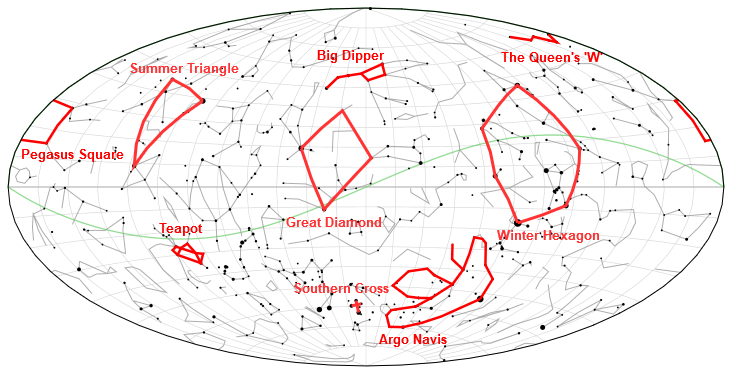
- 由天津四(Deneb)、牛郎星(Altair)和织女星(Vega)——即天鹅座 $\alpha$、天鹰座 $\alpha$ 与天琴座 $\alpha$——组成的 “夏季大三角”,在北半球夏季夜空中格外显眼,因为这三颗恒星皆为一等星。夏季大三角的恒星位于银河带上,该带对应着银河系赤道的方向,并指向银心。
- “冬季大三角” 在北半球冬季夜空中可见,由一等星参宿四(Betelgeuse)、天狼星(Sirius)和南河三(Procyon)组成,其中后两颗分别是肉眼可见的第二近与第四近的恒星系统。
- 更大的 “冬季六边形” 则包含天空中二十二颗一等星中的七颗:北河二(Pollux)、五车二(Capella)、毕宿五(Aldebaran)、参宿七(Rigel)、天狼星(Sirius)与南河三(Procyon),外围还有二等星北河三(Castor),以及略偏中心的参宿四(Betelgeuse)。加入参宿四后,它又被称为 “天之 G 形”。该星群围绕着银道反中心,同时包含双子座与猎户座等星座。六边形中,毕宿五的背景处为毕星团(Hyades),这是距离地球最近的疏散星团,也是五个一等深空天体之一;在其东北方向还可见昴星团(Pleiades,亦位于金牛座)以及英仙座α星团(Alpha Persei Cluster,最亮恒星为昴宿六 Alcyone 与天船三 Mirfak)。
- “春季大三角” 由大角星(Arcturus)、轩辕十四(Regulus)和角宿一(Spica)组成。
- “巨钻形”(Great Diamond)由大角星(Arcturus)、角宿一(Spica)、狮子座 $\beta$ 星(Denebola)和猎犬座 $\alpha$ 星(Cor Caroli)组成,其中后两颗并非一等星。从大角星到狮子座 $\beta$ 星的东西连线,与猎犬座 $\alpha$ 星在北方构成一个等边三角形,与角宿一在南方构成另一个等边三角形,这两个三角形合在一起便形成了 “钻石形”。该星群的恒星正式分布于牧夫座、室女座、狮子座与猎犬座。
其他一些星群部分由多颗一等星构成。
- “南十字座” 包含一等星南十字座 $\alpha$ 星(Acrux)与 $\beta$ 星(Mimosa),位于船底座星云(五个一等深空天体之一)以西,并有一等星半人马座 $\alpha$ 星(Alpha Centauri,距离太阳最近的恒星)和 $\beta$ 星(Beta Centauri)指向十字形,从而将其与较暗、形状相似的星群——如 “钻石十字” 或 “伪十字”——区分开来。
其余所有一等星在其所属的星群或星座中皆为唯一的一等星。例如,大犬座南方的船底座星云以东有船底座 $\alpha$ 星老人星(Canopus),其附近是大麦哲伦云(两者皆为一等深空天体);波江座中的阿彻纳星(Achernar)位于老人星以东;南鱼座中的北落师门(Fomalhaut)位于阿彻纳星以东;而心宿二(Antares)则位于天蝎座中,视觉上靠近银心位置。
3. 基于星座的星群
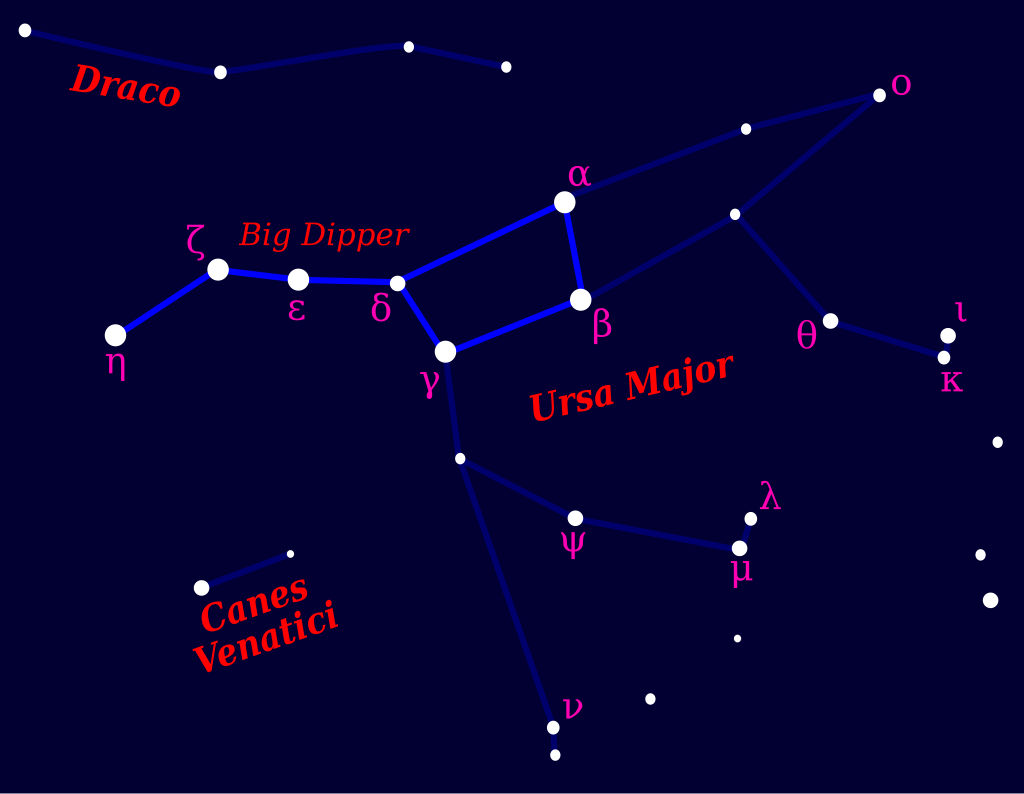
- 北斗七星(The Big Dipper),又称 “犁”(The Plough)或 “查理之车”(Charles’s Wain),由大熊座中最亮的七颗恒星组成。这些恒星勾勒出熊的后半身与被夸张延伸的尾巴,或可视为构成熊头与颈部上轮廓的 “柄”。相比之下,小熊座因其尾部更长而几乎不似熊形,因此更广为人知的名称是 “小北斗”(The Little Dipper)。
- 天鹅座中的 “北十字星”(The Northern Cross),其竖轴由位于天鹅尾部的天津四(Deneb,天鹅座 $\alpha$)延伸至位于喙部的辇道增七(Albireo,天鹅座 $\beta$);横轴则由天鹅座 $\varepsilon$ 星与 $\delta$ 星两翼相连。
- “南十字星座”(The Southern Cross)本名即为一星群,但现已被正式认定为独立的星座 “南十字座”(Crux)。其主要恒星包括 $\alpha$、$\beta$、$\gamma$、$\delta$ 星,有时也包含 $\varepsilon$ 星。早期在拜耳(Bayer)1603 年的《天体图集》(Uranometria)中,南十字仅被视为由半人马座后腿的恒星组成的星群,从而缩小了半人马座的范围。这几颗恒星很可能正是老普林尼在《自然史》(Naturalis Historia)中提到的星群 “凯撒之座”(Thronos Caesaris)。
- “鱼钩星”(The Fish Hook)是夏威夷人对天蝎座的传统称呼。如果将天蝎座图中从心宿二(Antares,天蝎座 $\alpha$)到天蝎座 $\beta$ 星与 $\pi$ 星的连线改为从 $\beta$ 星经 $\delta$ 星至 $\pi$ 星的一条弧线,则图像更显 “J” 形弯钩。在武仙座(Hercules)的主图中,再于左右两翼加上竖线连接肢体,便可构成 “蝴蝶星群”(Butterfly Asterism)的图案。
- 牧夫座(Boötes)有时被称为 “冰淇淋筒”(Ice Cream Cone),也被称为 “风筝”(Kite)。
- 仙后座(Cassiopeia)的恒星排列成 “W” 形,因而这一形状常被用作其别称。
- 飞马座的大四边形(The Great Square of Pegasus)由壁宿一(Markab)、室宿二(Scheat)、壁宿三(Algenib)与壁宿增七(Alpheratz)组成,代表有翼马的躯干。这一星群早在公元前 1100 至 700 年间的楔形文字星表《MUL.APIN》中便已被认作名为 “ASH.IKU”(意为 “田野”)的星座。如今,壁宿增七仅被视为仙女座的一部分,而在古代它同时属于飞马座与仙女座。
- 室女座中的 “室女之盂”(The Bowl of Virgo)由室女座 $\beta$、$\gamma$、$\delta$、$\varepsilon$ 与 $\eta$ 星组成,加上角宿一(Spica),共同形成一个 “Y” 形的图案。
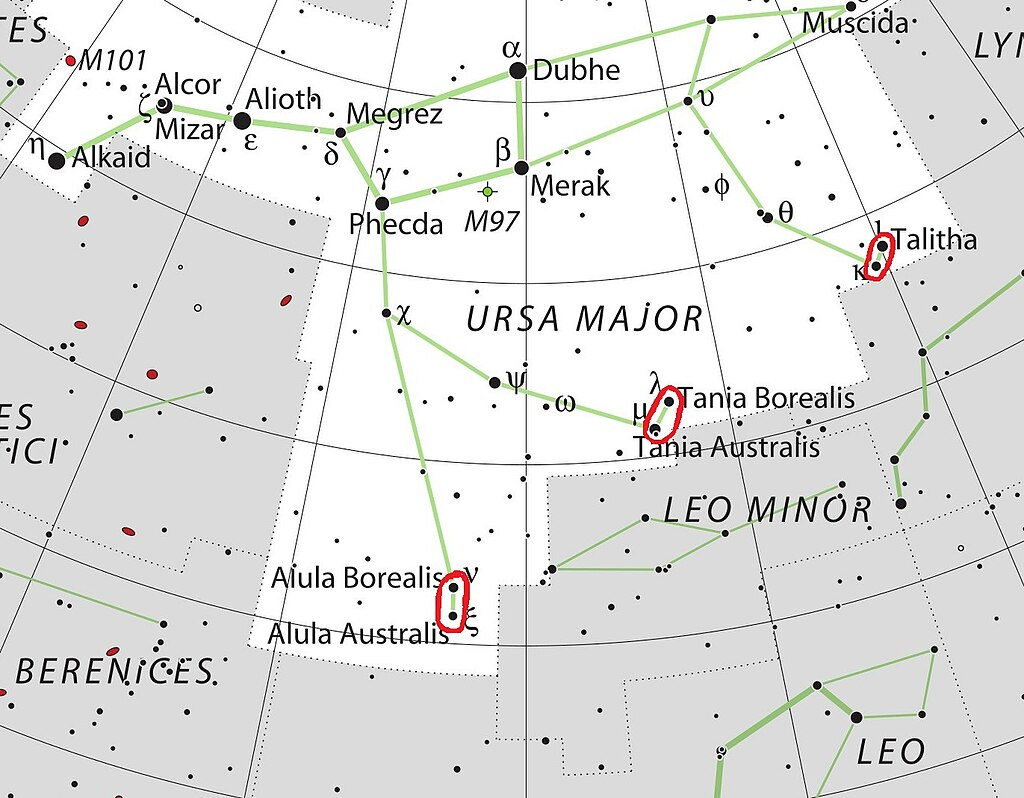
- “羚羊三跃”(The Three Leaps of the Gazelle)由大熊座中三对沿一直线排列、跨度约三十度的恒星组成。在阿拉伯传说中,这三对恒星被描绘为一只被狮子(狮子座)从水塘中惊起的羚羊所留下的蹄印。(其中的 “水塘” 被视为后发星团,即 Coma Star Cluster。)第一对恒星是大熊座的 $\xi$ 与 $\nu$;第二对为 $\upsilon$ 与 $\lambda$;第三对为 $\kappa$ 与 $\iota$。这三对恒星同时也标示出熊的三只脚掌的位置。
某些星群指代传统星座图案中的特定部分,其中包括:
- 宝瓶座的 “水壶” 或 “水瓶”(The Water Jar 或 Urn of Aquarius)是一个以宝瓶座 $\zeta$ 为中心的 Y 形星群,其中包括 $\gamma$、$\eta$ 与 $\pi$。它所倾泻的 “水流” 由二十余颗恒星组成,最终延伸至明亮的星宿一(Fomalhaut)。
- 巨蟹座的 “蟹胸”(The Crab Breast of Cancer,托勒密曾提及)是由巨蟹座 $\gamma$、$\delta$、$\eta$ 与 $\theta$ 四星构成的四边形,代表螃蟹的甲壳(内壳)。其内部包含著名的蜂巢星团(Beehive Cluster,梅西耶 44),其中包含巨蟹座 $\varepsilon$ 星。
- “蛇头”(The Snake Head)是长蛇座(Hydra)最西端的部分,由 $\delta$、$\varepsilon$、$\zeta$、$\eta$、$\rho$ 与 $\sigma$ 六颗恒星组成。
- “猎户座腰带”(Orion’s Belt)由三颗明亮恒星组成,分别是 $\zeta$(Alnitak)、$\varepsilon$(Alnilam)与 $\delta$(Mintaka),共同构成猎户腰带。
- “猎户座之剑”(Orion’s Sword)悬挂于腰带之下,由 42 Orionis、$\theta$ Orionis、$\iota$ Orionis 三颗恒星组成,其中以 M42——猎户星云(Orion Nebula)为中心。
- 金牛座的 “牛头”(The Bull’s Face of Taurus)是由昴宿团(Hyades)中几颗显著的恒星构成的 V 形星群,其中包括 $\gamma$、$\delta_1$、$\delta_2$、$\delta_3$、$\varepsilon$、$\theta$ Tauri,以及明亮的金牛座 $\alpha$ 星(毕宿五,Aldebaran),其象征公牛那颗红色的眼睛。
4. 其他特定的星群
还有一些星群同样由单一星座中的恒星组成,但并不对应传统星座图案。
- 船底座的四颗恒星($\beta$、$\upsilon$、$\theta$ 与 $\omega$ Carinae)构成一个形状优美的菱形,被称为 “钻石十字”(Diamond Cross)。\(^\text{[14]}\)
- “平底锅” 或 “锅子”(The Saucepan or Pot)星群与猎户座的腰带与剑完全相同。其 “柄端” 位于猎户座 $\iota$,而 “远端锅缘” 位于 $\eta$ Orionis。\textsuperscript{[citation needed]}
- 武仙座中四颗中央恒星——$\varepsilon$($\varepsilon$ Her)、$\zeta$($\zeta$ Her)、$\eta$($\eta$ Her)与 $\pi$($\pi$ Her)——构成 “拱顶石”(The Keystone)。\(^\text{[4]}\) 明亮的球状星团梅西耶 13(Messier 13)位于其西段上,介于 $\zeta$ 与 $\eta$ 之间。
- 狮子座前端从 $\varepsilon$($\varepsilon$ Leo)至轩辕十四(Regulus,$\alpha$ Leo)的恒星曲线,形似镜像问号,自古以来被称为 “镰刀星群”(The Sickle)。\(^\text{[5]}\)
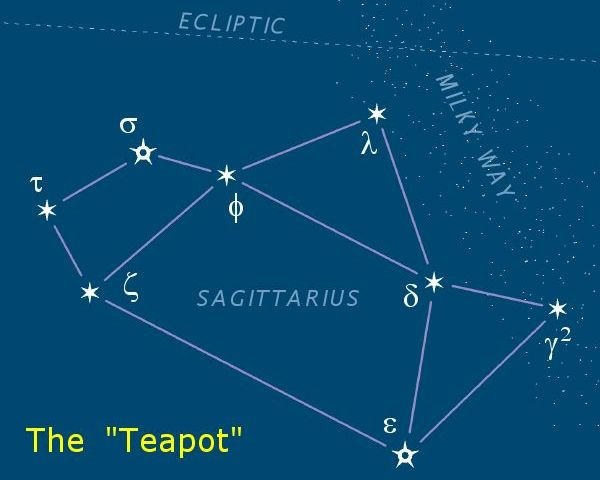
- 人马座中较亮的恒星组成了 “茶壶星群”(The Teapot)。\(^\text{[15]}\)(人马座大星云区看上去就像是从 “壶嘴” 冒出的蒸汽。)
- 在 “茶壶星群” 的东北方向,有较暗的 “茶匙星群”(The Teaspoon),由 $\xi_1$、$\xi_2$、ο、π、ρ₁与ρ₂ Sagitarii 组成。\(^\text{[16]}\)
- 海豚座中的四颗亮星——苏拉辛(Sualocin,$\alpha$ Delphini)、罗塔内夫(Rotanev,$\beta$ Delphini)、$\gamma$ Delphini 与 $\delta$ Delphini——组成 “约伯之棺”(Job’s Coffin)。\(^\text{[5]}\)
- “Terebellum” 是位于人马座后部的一个由四颗暗星($\omega$、59、60 与 62 Sagitarii)构成的小四边形。\(^\text{[17]}\)
- 在飞马座正南方,双鱼座西鱼部位有一个名为 “圆环星群”(The Circlet)的图案,由双鱼座 $\gamma$、$\kappa$、$\lambda$、TX、$\iota$ 与 $\theta$ 组成。\(^\text{[4][5]}\)
- 北斗七星斗勺的两端恒星——天枢(Dubhe,$\alpha$ Ursae Majoris)与天璇(Merak,$\beta$ Ursae Majoris)——常被称为 “指极星”(The Pointers)。\(^\text{[18]}\) 从 $\beta$ 经 $\alpha$ 延伸约其间距五倍的距离,即可到达北天极及北极星(Polaris,$\alpha$ UMi/小熊座 $\alpha$)。
- 南门二(Rigil Kentaurus,$\alpha$ Centauri)与马腹一(Hadar,$\beta$ Centauri)则被称为 “南指星”(Southern Pointers),它们指向南十字星座(Southern Cross),\(^\text{[19]}\) 因而有助于区分真正的南十字座与 “伪十字星群”(False Cross)。
5. 跨越多个星座的星群
以下是由多个星座中的恒星共同构成的其他星群:
- “埃及之 X”(The Egyptian X)是一个大型星群,与 “室女钻石”(Diamond of Virgo)类似,由两组等边三角形组成。天狼星(Sirius,$\alpha$ CMa)、南河三(Procyon,$\alpha$ CMi)与参宿四(Betelgeuse,$\alpha$ Ori)构成北侧的一个三角形(即冬季大三角,Winter Triangle),而天狼星、船尾座 $\zeta$(Naos)与天鸽座 $\alpha$(Phakt)构成南侧的另一个三角形。然而,与 “室女钻石” 不同,这两组三角形不是底对底相连,而是顶点相接。其名称来源于其形状,同时由于这些恒星分布在天球赤道两侧,因此该星群在地中海以南地区比欧洲更容易观测到。\(^\text{[citation needed]}\)
- “菱形星群”(The Lozenge)是一个由四颗恒星组成的小菱形图案,其中三颗——天棓一(Eltanin)、天棓四(Grumium)与天棓三(Rastaban)(即天龙座 $\gamma$、$\xi$ 与 $\beta$)位于天龙座头部,另一颗——武仙座 $\iota$(Iota Herculis)位于武仙座的脚部。。\(^\text{[citation needed]}\)
- “伪十字星”(The False Cross)呈菱形,由四颗恒星组成:船帆座 $\delta$(Alsephina)、$\kappa$(Markeb)、船底座 $\varepsilon$(Avior)与 $\iota$(Aspidiske)。\(^\text{[14]}\) 虽然这些恒星的亮度略低于南十字座的星,但该图形更大且形状更规整,因此有时会被误认为是真正的南十字星,从而在天文导航中造成混淆。与南十字相似,其四颗主星中三颗为白色,一颗呈橙色。\(^\text{[20]}\)
- “北方之 Y”(The Northern Y)由四颗显著恒星组成:大角星(Arcturus,$\alpha$ Boötis)、天市右垣一(Seginus,$\gamma$ Boötis)、北冕座主星宝冠一(Alphecca,$\alpha$ Coronae Borealis),中心位于依扎尔(Izar,$\varepsilon$ Boötis)。在英国等光污染严重、且夏季夜晚天色较亮的地区,当牧夫座与北冕座出现时,其他恒星往往难以观测,而这个 “Y” 形星群却常能清晰可见。\(^\text{[citation needed]}\)
- “闪电星群”(The Lightning Bolt)呈南北排列,由飞马座 $\varepsilon$、宝瓶座 $\alpha$、宝瓶座 $\beta$ 与摩羯座 $\delta$ 四颗恒星组成(不应与所谓 “David Bowie 星座” 混淆)。\(^\text{[21]}\) 即便在光污染严重的夜空中也能肉眼清晰可见,该星群可作为识别飞马座、宝瓶座与摩羯座三者位置的参考。
- “蛇之碗”(The Serpent Bowl)是一个跨度达 3.5 小时赤经的大型弧形星群,在北纬中等地区的 7 月与 8 月夜晚最为显著。自西向东依次包括以下恒星:巨蛇座 $\delta$、$\alpha$、$\varepsilon$;蛇夫座 $\delta$、$\varepsilon$、$\upsilon$、$\zeta$、$\eta$;巨蛇座 $\xi$;蛇夫座 $\nu$、$\tau$;以及巨蛇座 $\eta$、$\theta$。
- “鹰尾冕星群”(The Eagle Tail Corona)是位于天鹰座尾部并延伸至盾牌座的一组扁平弧形星群,由天鹰座 14、15、$\lambda$、12 星,盾牌座 $\eta$、HD 174208、R 与 $\beta$ 组成。致密的疏散星团梅西耶 11(Messier 11)也恰好与该弧线对齐。
6. 望远镜星群

星群的规模从巨大且显眼的形态到微小甚至需借助望远镜才能观测的形式不等。
- 猎户座中的 NGC 2169 星团,被称为 “37” 或 “LE” 星群。\(^\text{[22]}\)
- 小熊座中的 “订婚戒指”(The Engagement Ring),其北极星(Polaris)构成戒指上的 “钻石”,其余较暗的恒星围成一个约一度宽的环。\(^\text{[23]}\)
- 大熊座中的 “断裂订婚戒指”(The Broken Engagement Ring),位于赤经 10 时 51 分、赤纬+56°10′处,位于大熊座 $\beta$(天璇,Merak)之前。\(^\text{[24]}\)
- 麒麟座中的 “圣诞树星团”(The Christmas Tree Cluster)呈现圣诞树形状,由约 40 颗恒星组成。\(^\text{[25][26]}\)
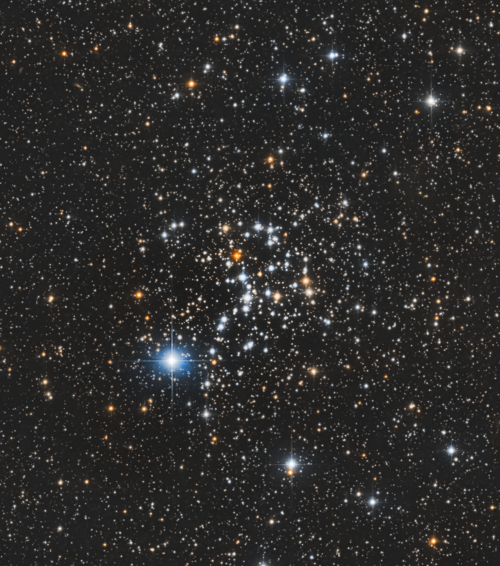
- 狐狸座中的 “衣架星群”(The Coathanger),又称 “布罗基星团”(Brocchi’s Cluster),见上图。\(^\text{[27]}\)
- 鹿豹座中的 “坎布尔瀑布”(Kemble’s Cascade),是一串连成直线的恒星,末端为疏散星团 NGC 1502。\(^\text{[27]}\)
- 牧夫座中的 “拿破仑帽”(Napoleon’s Hat,Picot 1),位于牧夫座 $\alpha$(大角星,Arcturus)以南。\(^\text{[28]}\)
- 天龙座中的 “尼伯龙根之环”(The Ring of the Nibelungen,Ferrero 27),以 1857 年的德国史诗剧《尼伯龙根的指环》命名,位于赤经 15 时 57 分、赤纬+62°32′,邻近星系 NGC 6015。\(^\text{[28]}\)
- 宝瓶座中的 V 形星群梅西耶 73(Messier 73),于 2002 年被确定为星群而非星团。\(^\text{[29]}\)
- 昴宿星团中最亮恒星昴宿六(Alcyone)引出的六星连线,被称为 “艾莉之辫”(Ally’s Braid)。\(^\text{[27]}\)
7. 参见
- 原星座(Former constellations)
- 澳大利亚原住民天文学(Australian Aboriginal astronomy)
- 中国星官体系(Chinese constellations)
- 那伽沙罗(Nakshatra)
8. 参考文献
- “An Etymological Dictionary of Astronomy and Astrophysics: asterism.” Dictionary.obspm.fr. 2018 年 1 月。
- “An Etymological Dictionary of Astronomy and Astrophysics: constellation.” Dictionary.obspm.fr. 2018 年 1 月。
- Allen, Richard H. (1899). *Star Names: Their Lore and Meaning*. Dover Publication, pp. 11, 184–185. ISBN 978-0-486-21079-7。
- Grilley, Michael (2018 年 8 月 31 日). “Table of Asterisms.” wro.org. 存档于 2018 年 8 月 31 日,检索于 2022 年 5 月 11 日。
- “Asterisms.” 1997 年 3 月 9 日。存档于 2010 年 2 月 14 日,检索于 2024 年 1 月 31 日。
- “Spring triangle.” Space.com,访问时间:2011 年 3 月。
- AstronomyOnline: Image of Big Dipper, Diamond of Virgo, The Sail, Sickle, and Asses and the Manger, Astronomyonline.org。
- Space.com: *ercules: See the Celestial Strongman,存档于 2009 年 5 月 23 日。
- History of the Constellations: Bootes,存档于 2011 年 5 月 12 日。
- “Astronomy Online – View Images Template.” Astronomyonline.org,检索于 2019 年 3 月 10 日。
- “Astronomy Online – View Images Template.” Astronomyonline.org,检索于 2019 年 3 月 10 日。
- AstronomyOnline: Image of Cassiopeia, Square of Pegasus, The Circlet, and Y of Aquarius, Astronomyonline.org。
- Rogers, J. H. (1998 年 2 月 1 日). “Origins of the ancient constellations: I. The Mesopotamian traditions.” *Journal of the British Astronomical Association*, 108: 9–28. Bibcode:1998JBAA..108....9R。
- “Starry Night Photography – Southern Cross, False Cross & Diamond Cross.” Southernskyphoto.com,检索于 2019 年 3 月 10 日。
- “Astronomy Online – View Images Template.” Astronomyonline.org,检索于 2019 年 3 月 10 日。
- “BBC Science Focus – How can I see the Teapot and Teaspoon asterism?” 2022 年 8 月 26 日,检索于 2024 年 3 月 19 日。
- “LacusCurtius • Allen's Star Names – Sagittarius.” Penelope.uchicago.edu,检索于 2019 年 3 月 10 日。
- Darling, David. “Ursa Major.” Daviddarling.info,检索于 2019 年 3 月 10 日。
- Darling, David. “Centaurus.” Daviddarling.info,检索于 2019 年 3 月 10 日。
- Moore, Patrick (2010). Patrick Moore’s Astronomy: Teach Yourself. Hachette. ISBN 978-1444129779。
- Constellation Guide, Asterisms(访问时间:2024 年 4 月 19 日)。
- Constellation Guide, Orion Constellation(访问时间:2014 年 3 月 3 日)。
- Chaple, Glenn (2019 年 5 月). “Spot the ring that hides in the Little Dipper.” Astronomy.
- “Asterisms – Broken Engagement Ring.” 检索于 2020 年 9 月 11 日。
- “A star hop through Monoceros including M 50, The Christmas Tree Cluster (NGC 2264), Hubble's Variable Nebula (NGC 2261), NGC 2244, NGC 2301, The Rosette Nebula, 11 Beta Monocerotis, Harrington's Star 17 and Harrington's Star 18.” Backyard-astro.com. 存档于 2018 年 10 月 2 日,检索于 2019 年 3 月 10 日。
- Miller, Katrina (2023 年 12 月 19 日). “It's Christmastime in the Cosmos — Astronomers have a long tradition of finding holiday cheer in outer space.” The New York Times. 存档于 2023 年 12 月 19 日,检索于 2023 年 12 月 19 日。
- “Asterisms.” Deep-sky.co.uk,检索于 2019 年 3 月 10 日。
- “Asterisms: Doodles in the Sky.” Sky & Telescope. 检索于 2025 年 7 月 27 日。
- M. Odenkirchen & C. Soubiran (2002). “NGC 6994: Clearly not a physical stellar ensemble.” Astronomy & Astrophysics, 383 (1): 163–170. arXiv:astro-ph/0111601. Bibcode:2002A&A...383..163O. doi:10.1051/0004-6361:20011730. S2CID 15545816。
9. 参考书目
- Allen, Richard Hinckley (1969). Star Names: Their Lore and Meaning.Dover Publications Inc.(1899 年原版重印)。ISBN 0-486-21079-0。
- Burnham, Robert (1978). Burnham's Celestial Handbook(三卷本)。Dover Publications Inc. ISBN 0-486-23567-X, 0-486-23568-8, 0-486-23673-0。
- Pasachoff, Jay M. (2000). A Field Guide to the Stars and Planets(第 4 版)。Houghton Mifflin Co. ISBN 0-395-93431-1。
10. 外部链接
- 来自 deep-sky.co.uk 的星群列表(List of Asterisms from deep-sky.co.uk)
- 密尔沃基天文学会提供的肉眼可见星群(Naked-Eye Asterisms from Milwaukee Astronomical Society)
- 来自 deepsky.waarnemen.com 的星群列表(List of Asterisms from deepsky.waarnemen.com)
- 来自 nightskyatlas.com 的星群列表(List of Asterisms from nightskyatlas.com)
- 来自 saguaroastro.org 的星群列表(List of Asterisms from saguaroastro.org)
- 来自 waynesthisandthat.com 的星群列表(List of Asterisms, 存档于 2020 年 1 月 12 日于 Wayback Machine)
友情链接: 超理论坛 | ©小时科技 保留一切权利